
Planning Board Dives into ADU Controversy, Proposes Rezoning Around UMass
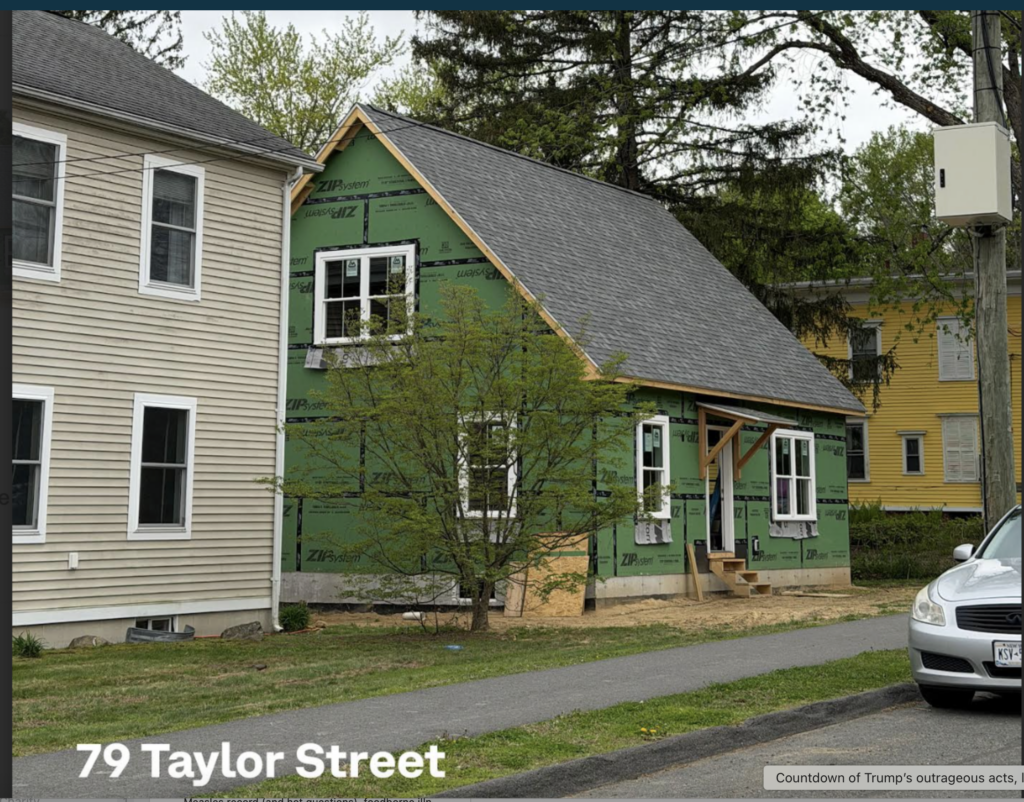
ADU under construction at 79 Taylor St., with four bedrooms and two baths and two floors of finished space. Photo: amherstma.gov
Report on the Meeting of the Planning Board, September 2, 2026
By Maura Keene
This meeting was held over Zoom and was recorded.
Present
Doug Marshall (Chair), Bruce Coldham, Fred Hartwell, Jesse Mager, and Angus McLeod. Absent: Roy Johnson and Jerah Smith
Staff: Walker Powell (Planner) and Pam Field Sadler (Assistant)
Planning Board Members Decry Abuse of ADU Bylaw
Planning Board member Jesse Mager opened the September 2 meeting asking if anyone in town is working on straightening out the ADU bylaw, which has resulted in the approval of dozens of protected accessory dwelling units (ADUs), many of which are larger than the maximum allowable size of 900 square feet. He said, “I know there’s some legal action happening, but in my mind, if council agrees to change the bylaw, regardless of the outcome of that, it could still prevent some of this funny business from happening again.”
Planner Walker Powell said that she thought plans to modify the bylaw are being developed, and that the proposal will come to the Planning Board in the next month or two.
Planning Board Chair Doug Marshall said he hoped it was a priority for those working on it and asked whether the Planning Board should take on the task, but Powell assured him that modifying the bylaw was a priority and the board did not need to take the lead now.
Mager commented that “a lot of applications can be filed in two months.” He stated, “When the state changed the ADU bylaw 16 months ago, what we feared is happening.” He maintained that Amherst is unique among Massachusetts municipalities. It is the only zip code where water use goes down in the summer due to the seasonal loss of the sizable student population. “ADU by right is not being used for the purpose of the state law in our town. The point of this law is not student housing; it’s to provide more housing opportunities for the workforce, middle-income, low-income, etc. Our situation is that every single thing that will be built is just going to be student-occupied,” he said.
Mager said he wanted to gauge the interest of the board and staff in advocating for an exemption on ADUs for Amherst—still allowing owner-occupied ADUs and encouraging denser development in certain parts of town. His preference was “not to have ADUs by right, because it doesn’t allow us to try and intentionally direct where student housing is going.”
Planning Board members Bruce Coldham and Fred Hartwell agreed with the suggestion that Amherst should go to the state to ask for an exemption to parts of the ADU bylaw. Hartwell said, “There ought to be a way to get a little more control over this bylaw in terms of the unique population profile that we have in Amherst.” Several members observed that the Cape and Islands have exemptions from certain state requirements, but they weren’t clear on exactly what the exemptions were. The point was, though, that the state has taken unique situations into account.
Angus McLeod was the only Planning Board member who disagreed that the ADU bylaw was a problem. He said that his preference was for larger by-right ADUs without the requirement for owner-occupancy. However, he stated, “It is incredibly inefficient to build a bunch of small ADUs all across town to house a handful of students, when we can build much larger buildings. But it is also frustrating to me that many of the people in town who are opposed to ADUs are also opposed to other options, and essentially just want UMass to solve the problem. But they [UMass] don’t pay property taxes.” His interpretation of the state ADU bylaw “is that it is trying to alleviate housing pressures, period, and here the primary housing pressure is the students.” He agreed that most of the ADUs built in Amherst would be housing for students, “but that is better than nothing.” He was skeptical that the state would allow an exemption from the bylaw, but if that was something that the community really wanted, “I think I’m open to sending it and seeing what happens.”
Marshall was also skeptical that Amherst could receive an exemption from the state. He added that it was also unclear to him whether residents were opposed to the size or the number of ADUs. “One thing I thought,” he said, “was how can we get the state to recognize that these things should only be 900 square feet, not 1,200 – just a different approach. It probably would result in just as many ADUs, but smaller ones, rather than owner-occupancy, which would actually reduce the number that were built pretty significantly.”
Mager countered, “I don’t think we need to ask the state to help us enforce 900 square feet [maximum], because that’s just in the law. If this [lawsuit] doesn’t go our way legally, I’ll just give up a lot of things, because it’s so ludicrous.” Marshall was not so confident that the town would win the suit in land court.
Powell also doubted that the state would allow an exemption from the ADU bylaw for Amherst. She recommended that the Planning Board wait until the ZBA appeal suit is decided before pursuing any further action, but she agreed to approach Planning and Economic Development Director Jeff Bagg to gauge his feelings on the issue.
Coldham suggested that, rather than appealing to town officials for support, he could enlist State Representative Mindy Domb to gather support from the relevant state officials. Marshall agreed with involving Domb in whatever action the Planning Board decided on taking.
Mager stated that even if the Planning Board decided not to pursue any action regarding ADUs, he would do so personally. He noted that three ADUs are being constructed in his neighborhood, and although it is rare for a single-family home converted to a rental to go back to an owner-occupied house, it would be even less likely for a property with two lucrative rental units to revert to owner-occupancy.
McLeod saw the implications of the proliferation of ADUs on rental properties diminishing the supply of single-family housing in the long term and wondered if properties with an ADU could be subdivided into two properties in the future. Marshall pointed out that allowing that would require changing the Zoning Bylaw to allow smaller lots.
Marshall Suggests Rezoning Some Areas Near UMass to Allow Larger Residential Buildings
Marshall brought up some conversations that he had with a couple of town councilors over the summer about the need to increase the town’s revenue through building more taxable housing. He said, “Since student housing is the primary demand at the moment, we have talked in the past about rezoning land near UMass” from general residential to fraternity, which would allow construction of five-story buildings. He suggested the area north of Fearing Street and the strip of single houses along East Pleasant Street from Strong Street north to Olympia Place.
Mager also mentioned rezoning North Pleasant Street from UMass up to Pine Street. Coldham voiced his support, adding that maybe the upland portions of the Kestrel properties along East Pleasant Street could be extracted from the conservation easement for development.
The Planning Board members decided to limit the initial rezoning recommendations to the parcels adjacent to UMass. Marshall said that he will work on a draft to present for the next meeting. He said an overlay would allow single-family housing to remain.
Some reasons why many people think UMass and the town of Amherst are not doing their part to solving the problem are:
• the brag that they are doing their part, compared to other state universities in much larger towns and cities, while they are aware of the huge number of students that need to find housing in a very crowded Amherst • their plan going forward is only to update 50 year old dorms, which solves a problem, but not the problem of undersupply • that they enter into complex legal agreements with private contractors on campus (PPP), that there won’t be town property taxes, though the dorms they build do not have an educational purpose • that at a recent listening session of many people from WMass towns that are severely under compensated by the state’s lack of a fair PILOT program, there was not one attendee from UMass saying “you not only underfund us for the land on which we sit, but the tax free buildings on that land” • that many decisions in Amherst seem based on avoiding being sued by the state attorney general, and then we get sued anyway, by an attorney who routinely represents developers (except when he routinely opposes them) (and often wins on technicalities) • that there is no effort by the town leadership to communicate to other towns that Amherst is one of the 6 towns in Western Mass that have met their Massachusetts General Law Chapter 40B expectation to have at least 10% of its year-round housing stock deed-restricted or subsidized for low- and moderate-income households, so how about those other towns get to work and share our unique housing demands • that the decision makers at UMass and the Town of Amherst are too often the same people and seem to too often make decisions that favor their day job • that the leadership at UMass has repeatedly refused to meet with a concerned group of longtime Amherst residents to explore the situation together.
We are letting UMass off the hook to say we need to allow all kinds of tall dorms along our town streets.
How great if Amherst could do what was done in Berkeley, Santa Cruz, Davis, Ithaca, Boulder, and Ann Arbor, to restrain university enrollment, campus expansion, or dense student housing.
This is a matter of balance in a community, and shared responsibility.
No NO NOOOO to 5-story buildings along E Pleasant St, north of Strong Street. Two stories max. More units per lot maybe (townhomes), but not 5-story apartment blocks!!!!!!!
“Mager also mentioned rezoning North Pleasant Street from UMass up to Pine Street. Coldham voiced his support, adding that maybe the upland portions of the Kestrel properties along East Pleasant Street could be extracted from the conservation easement for development.”
Surely they’re joking — since, inter alia, the Dakins, who donated that land, were the principal founders and benefactors of the Kestrel Trust — and if they’re serious, the future of Amherst is bleak indeed.