
Waste Hauler RFP Nears Completion as Local Landlords Voice Opposition
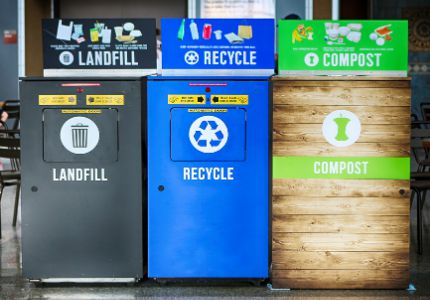
Photo: CalRecycle
Report on the Meeting of the Town Services and Outreach Committee, Oct. 15, 2026
The meeting was held over Zoom and was recorded.
Present
Town Councilors George Ryan (Chair, District 3), Andy Churchill (at large), Hala Lord (District 3), Jennifer Taub (District 4). Absent: Pam Rooney (District 4)
Staff: Paul Bockelman (town manager) and Guilford Mooring (superintendent of public works)
Consultants: Mimi Kaplan (Pioneer Valley Planning Commission), Susan Waite, (Department of Environmental Protection, municipal assistance coordinator.
The Town Services and Outreach (TSO) Committee of the Town Council devoted most of its meeting on Oct. 15 to looking at the nearfinal draft of the Waste Hauler Proposal RFP as initiated by the 2022 proposal to amend Amherst’s waste hauler bylaw. The TSO committee discussed and made a few changes to the evaluation criteria in the RFP.
Public Comment
Laurel Dickey, former member of the town’s Recycling and Waste Management Committee, stated that we should do anything we can to keep the Transfer Station open to at least to take bulky waste and other non-recyclable items. She also supported making it as feasible as possible for people to take compost out of the waste stream.
Eric Frederickson, Vice President of Operations of USA Waste and Recycling, spoke against several aspects of the draft RFP, including the proposal to reduce the size of carts and to use overflow bags, based on worker safety concerns. He wondered how many carts each property would receive. He stated that the town should have clear environmental and sustainability standards. Also, he said, more public outreach was necessary so as to hear more practical concerns.
Tom Crossman of Crossman Properties stated that the proposal will create friction and won’t work. Carts proposed are too small. Residents won’t abide by the rules around overflow bags. More waste industry experts should be part of the planning process. He said knowledgeable stakeholders should be at the table.
Darcy DuMont spoke on behalf of Zero Waste Amherst (ZWA). She said that trash should be able to be picked up biweekly in addition to weekly. She referred to the 2023 ZWA survey results showing that a significant percentage of Amherst residents produce a small amount of waste and should pay less. Weekly collections should be proportionally more expensive than biweekly ones.
DuMont added that a hauler having a contract with an anaerobic digester that takes only food scraps shouldn’t preclude another contract with an industrial composting facility like Martin’s Farm, that takes compostable materials in addition to food scraps. She also outlined questions about items left out of the RFP.
She repeated that a single potential bidder should not be allowed access to the RFP process without the town reaching out to other potential bidders to give them equal access. USA Waste and Recycling has been part of the RFP development process by providing public comments and meeting with Town Councilors.
Chad O’Rourke, owner of Pipeline Properties, said the proposal implements too many changes at one time. He stated that many 1-4 unit residences in town include a lot of renters who move every year, which he thinks is a problem. He said there has been a lack of public input and that the proposal has been too rushed.
Background
Ryan started the conversation, summarizing that this RFP is a result of the motion passed in September of 2024 and that TSO is working with the Town Manager to shape it. On public input, he said we need answers on cost first, and the council will get public input during bylaw creation.
Discussion of the RFP Subtopics
Mimi Kaplan stated that she created the draft RFP document with evaluation criteria and a Price Proposal Sheet with Superintendent of Public Works, Guilford Mooring. Firms will need to show how they meet the criteria in each topic listed in the RFP. She said that Darcy DuMont mentioned a few items that still need to be added. [Note: DuMont mentioned items omitted such as the preference for recycling processing by a facility that takes the widest range of compostable materials, the preference for the use of overflow bags, and the preference for a local composting facility.] The evaluation criteria would rate contractors’ responses to different items in the RFP as highly advantageous, advantageous, not advantageous, and not acceptable.
The general topics in the RFP and criteria for the most advantageous remained the same for the questions relating to contractors’ years of experience collecting trash and recycling (five years), the number of sustainability practices engaged in by the bidders (five or more), and the frequency of receiving tonnage data on each of the materials collected (monthly). Regarding years of experience in compost collection, the committee recommended reducing the requirement from five or more years to three or more, since compost collection is a new industry.
On curbside trash collection, the group discussed keeping “the ability to provide both weekly and biweekly collection options” as highly advantageous. The group retained the current language with no substantive changes.
For both recycling and compost collection, the TSO retained “the ability to provide the service both weekly and biweekly” as highly advantageous. Kaplan said the western Mass contractor Banana Compost offers compost pick-up both weekly and biweekly, and biweekly is less expensive.
At this point, Kaplan pointed out that there were no criteria for the type of recycling–that is, single- or dual-stream. She reminded the committee that they had decided to include both in the RFP. The committee didn’t act on this issue, though Churchill and Ryan both spoke in favor of single-stream recycling.
Regarding bulky waste, after a good amount of discussion, the committee agreed not to retain the highly advantageous “regularly scheduled monthly” bulky waste pickup, but instead to “pick up by appointment” (possibly paid by the customer, depending on the cost to the town for this service). Kaplan gave the example of a town receiving five bulky waste pickups a year that are included in the contract.
On yard waste, the group recommended changing the highly advantageous language in the current draft version from “regularly scheduled monthly collection” to “offering seasonal collection in Spring and Fall”. Waite reminded members that we don’t need yard waste collection during the winter. Churchill expressed resistance to including yard waste, as he believes residents don’t have much yard waste and it would add cost to the contract.
On customer service and public education, the highly advantageous criteria stayed the same: “can provide full service customer support capability” and “has a fully developed public education program on waste restrictions, recycling, composting and the do’s and don’ts of waste management”, respectively.
The committee considered the highly advantageous criteria for the transfer station: “requests no change in the operation of the existing transfer station” and discussed changing it. Taub said the transfer station should stay open and accessible to all residents. Waite suggested finding out how many residents actually use the transfer station for trash and recycling by counting permit holders who purchase trash bags. Waite suggested asking the haulers for ideas on how to make the transfer station financially viable.
Mooring suggested changing the criteria to “integrates the transfer station into the overall waste management system for the town with limited changes”. In a poll on whether to use Mooring’s suggested language, two councilors agreed (Churchill and Taub), one disagreed (Ryan) and one abstained (Lord). The committee did not decide whether to change the language, but Ryan said he would suggest using Mooring’s proposed language.
Kaplan and Waite argued for keeping the station open but not for regular household trash and recycling. Waite suggested considering taking only overflow trash to the transfer station, as South Hadley does, an option haulers would prefer. Kaplan said the process would be very different if we were not offering 5000 households in the RFP. Ryan stated that although the transfer station is in competition with haulers, this would not be a change from the town’s current situation with USA Waste and Recycling.
Mooring stated that the vendors are listening to these meetings. He noted that USA went to the Town Council to “help bend the rules more in their favor”. He suggested that we let the haulers “do the work” to figure out what we want and what they can offer.
Next Steps
Kaplan will be on medical leave for at least a month. She will add the most recent edits to the draft RFP. Mooring will then take it to the procurement office and hopes to bring a final RFP back to the committee in December.