
Average Amherst Tax Bill to Top $10,000
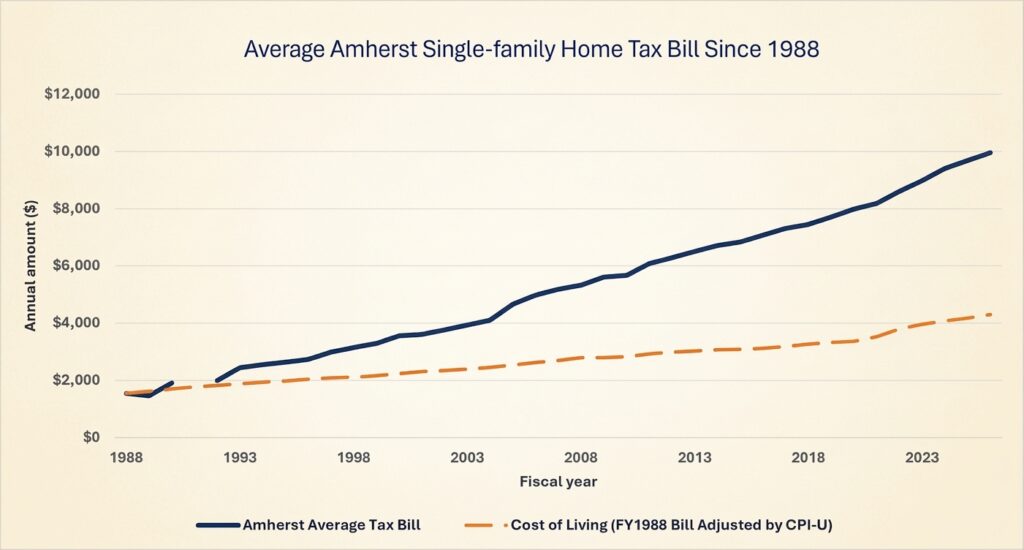
Amherst average single-family home tax bills outpace inflation. Source: Mass. Dept. of Revenue and U.S. Bureau of Labor Statistics
The average annual Amherst single-family home tax bill is on track to exceed $10,000 for the first time, rising to an estimated $10,457.92 in fiscal 2027, according to figures presented at the Town Council’s Oct. 19 tax classification hearing. The increase, about $501 over the current average bill, marks only the second time that Amherst tax bills will have jumped by more than $500 in the 38 years of data published by the Massachusetts Division of Local Service. A $2 million Proposition 2 ½ override contributed to a $553 average increase in 2005.
Amherst will join Longmeadow ($10,915) as the only other town in Western Massachusetts with a 5-digit average single-family home property tax bill.
Estimated tax bills for the first half of FY2027 were mailed out last June. Higher bills reflecting the new rate are due to be mailed by the end of December, with payment due Feb. 1.
Property Tax Calculus
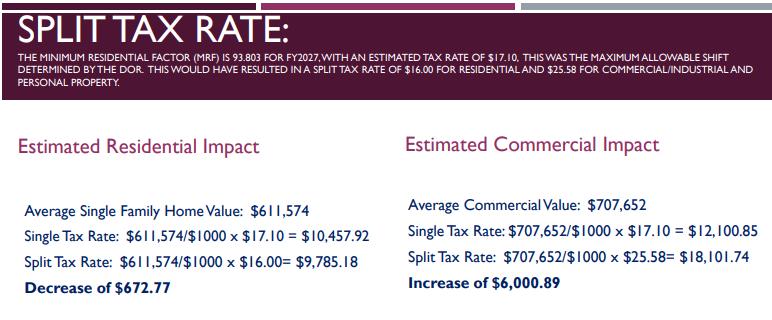
Principal Assessor Kim Mew told councilors that the average single-family home, assessed at $611,574, would be taxed at an estimated $17.10 per $1,000 of value, producing the $10,457.92 bill. The average commercial property, valued at $707,652, would owe $12,100.85. Mew pointed out that the new rate is an estimate. The state Department of Revenue must certify it, which should happen in November.
The Town Council voted 13-0 on Oct. 19, to retain a single tax rate for both residential and commercial properties in FY27.
The near-record tax bill increase is the result of two main factors:
Soaring Property Valuations
Single-family homes continue to be a hot commodity in Amherst with the average value rising from $588,826 to $611,574 over the past year.
Amethyst Brook School Debt Exclusion.
According to a property tax explainer from the town, the 2023 debt exclusion override to pay for the new Amethyst Brook Elementary School added 50 cents for every $1000 of assessed property value in FY26, contributing an average of $294.41 to 2026 bills. The town’s Capital Improvement Program shows annual debt payments for the project increasing each of the next five years. A Debt Exclusion Impact page from 2023 estimates that annual bump from the debt exclusion for the average single-family home is $451, “based on economic conditions and subject to change.”
Amherst Tax Bills are Outpacing Inflation
Proposition 2 ½ is a Massachusetts statute passed in 1980 that limits a municipality’s total annual property tax levy increase to 2.5% over the prior year, plus allowed new growth. A majority of voters must approve any tax hike greater than 2.5% through an override or debt exclusion ballot question.
Town officials occasionally blame Proposition 2 ½ restrictions for budget challenges, noting that the U.S. inflation rate has exceeded 2.5% in recent years. However, Amherst’s tax history shows that past overrides and the steady rise in property valuations have more than offset inflation.
The Department of Revenue reports that the average Amherst single-family home’s tax bill was $1537 in FY1988. In 2026 the average bill stands at $9957, an increase of 548%. Bureau of Labor Statistics data show that over the same period consumer prices have risen by a much smaller 185%, raising the question of whether undisciplined spending and failed fiscal planning may matter more than inflation.
2nd Quarterly Tax Payment Due November 2
Property owners should be aware that the second of four FY2027 tax payments is due on November 2. Taxpayers get an extra day because November 1 is a Sunday.
Paying late can be costly. Unpaid balances accrue interest at an annual rate of 14% with no grace period, as mandated by Massachusetts General Law.
Taxes will come up again at the yearly Financial Indicators presentation on Nov. 2 at 6:30 p.m., when the Town Council meets with the School Committee, Jones Library Board of Trustees, Finance Committee, and Budget Coordinating Group to discuss the long-term financial outlook and FY2028 budget projections.
The S&P 500 index is now more than 10 times where it stood in March 2009. Housing is an investment as well as a necessary expense, so part of its price rise — and the concomitant rise in our real estate tax bills — is due to investors (including resident homeowners) speculating in the real estate market.
Each year that I served on the Select Board two decades ago, I made motions to have a split tax rate and to grant the maximum allowable exemption for owner-occupied property: sometimes those motions garnered a second, often leading to a lively discussion about the adverse affect on tenants if either measure were adopted (they never were); and other times, there was no second and no debate, so the uniform rate was adopted.
The inertia here is tremendous: the greatest beneficiaries (landlords) are “joined at the hip (pocket?)” with those for whom housing is a necessity, not an investment opportunity (tenants), so is it a surprise to anyone that the council made no change to the tax structure once again this year?
Might agreement on a gradual change in the relative tax burden be more palatable in future years?
Why isn’t the town reducing the tax rate more? Are they collecting more than budgeted? That doesn’t sound right and it doesn’t sound fair for residents. Porp 2 1/2 or not., it sounds like the town is collecting more than they should from us.