
An Afterword for “Views on Views”: Community Playgrounds & Community Gardens
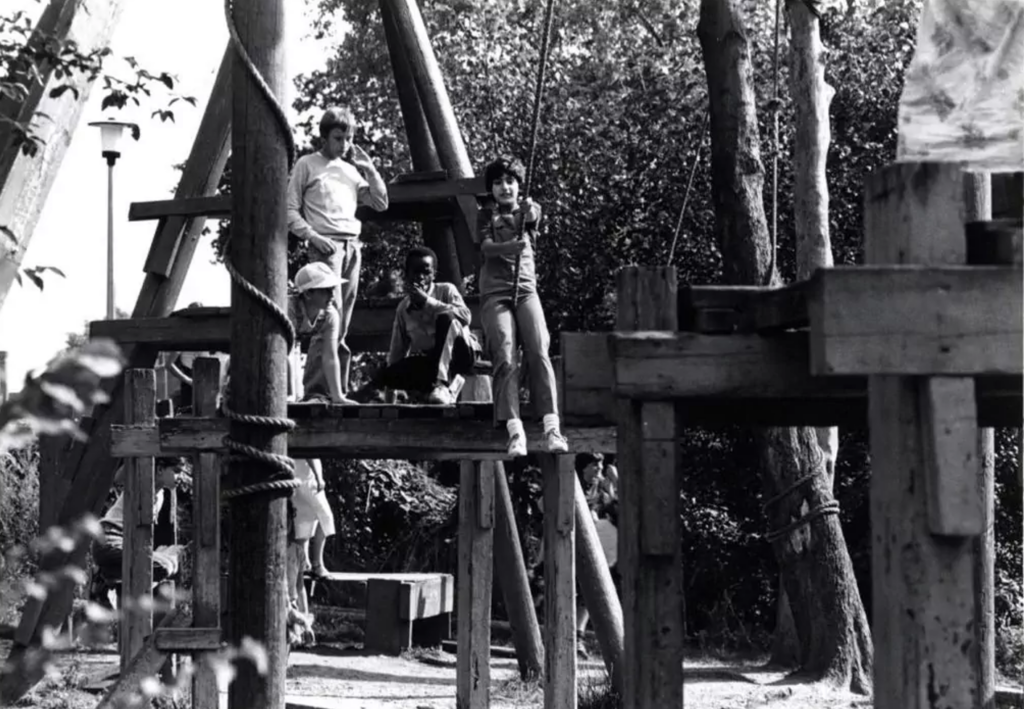
Holland Park Adventure Playground. Photo: The Royal Borough of Kensington & Chelsea library blog
This is an afterward to the 10-part series, “Views and Views”. Read previous columns in the series here.
I thought my series about landscape design was complete. But one topic emerges as a radical corrective to some of what I have featured up to now. While I have touched on community gardens in Amherst in earlier articles (see also here), I wanted to feature community playgrounds and gardens a little more. Like our public parks, these places also address well-being and recreation for people of all ages and backgrounds. While much of our town land is privately owned, this column focuses on small, hopeful parcels held in common, or in partnerships, much like the historic commons in New England’s towns and villages. One commonality to both playgrounds and community gardens is the pivotal role that women have played in helping to create such places in the first place, a nod to Women’s History Month.
Community Playgrounds
Community playgrounds—with a shared ownership by private foundations, or settlement houses (see also here) or municipalities—date back to the late 1800s. They were made popular in America thanks to the work of social reformers during the Progressive Era. These upper- and middle-class philanthropists, often born-to-rule women, felt that children of the working-class had few places to play safely in cities and towns. They advocated for better alternatives to the streets – often crowded, dirty and perceived as unhealthy – as better play spaces. Historian David Nasaw, now in his 80s and a founder of Radical History Review, documented this topic in his book, Children of the City: At Work and Play (1985) that became a source for the play and film Newsies.
Settlement house founders like Jane Addams, in cities like Chicago, Boston, and New York, saw it as their mission to help children from newer immigrant families and in some cases offered Americanization classes. It’s a complicated history that isn’t possible to more than outline here, but one outcome was a profound interest in where Americans of modest means lived, worked, and particularly where their children played, way before the famous Cat Stevens/Yusuf 1971 song, “Where Do the Children Play?” From a contemporary standpoint their interest would seem paternalistic, and without doubt, a prejudiced perspective. But this newfound attention then paid to population groups that might later be considered vulnerable, yielded radical studies of childhood, a category that until the late 18th century had not even been considered a discreet demographic grouping. The study and work of reformers nurtured the development of psychology, public health awareness, and on-going critiques of industrialized, urban environments. During the 1920s and 1930s after World War 1, many countries experimented with urban playgrounds. Germany had open air gymnasia and sand gardens. America, and notably, the Round Hill School in Northampton, had its gymnasiums while England, with the guidance of ‘child play’ experts, offered open-air spaces, in the gardens of settlement houses, where children could play.
The playground movement grew in the post-War period. By the 1960s, in Europe, playground designers and reformers began to focus on junk and discarded materials (especially old car and truck tires) for playgrounds; kids were even encouraged to build their own spaces with some supervision. In the UK, it was common to see children playing in post-war bomb sites. And this led to new ideas about play and even a focus on supervised risk-taking. The idea of a personal treehouse (a source of delight for children of all ages from ancient times) was re-invented on a professionalized scale.
Some English playgrounds, like those in London’s Chelsea and Notting Hill neighborhoods, were championed by a pioneer from the aristocracy named Lady Marjory Allen. Again, her language at the time, and the attitudes embodied in the language to identify social and welfare needs, would be considered inadmissible in today’s culture. However, Lady Allen encouraged self-directed play and a better deal for children of the inner city in the post-war period, suggesting that a few square yards of asphalt were not enough. She was also inspired by a playground she saw in Emdrup, in Copenhagen, Denmark, founded by a Workers Cooperative Housing group.
My school friends, my brother, and I played after school at the Holland Park Adventure Playground (near Notting Hill) for many years in the 1960s and early 1970s. Purchased by the London County Council in 1952, Holland Park grew out of the bombed-out parts of Holland House, a 1605 Jacobean house with extensive grounds. Later, a new YMCA and a high school, Holland Park, were built nearby. Long, tree-lined walks, public statues, sculpture, picturesque vistas, an Orangerie, a cafe, and the nearby sounds of the piercing cry of peacocks (who put on their displays for families daily) were all a part of ‘my’ park (my version of Central Park or Prospect Park in New York, or Franklin Park in Boston.)
Holland Park’s adventure playground was designed with many climbing nets, rope swings, and recycled wooden structures. Large old tree trunks were available to climb (my favorite), and there was a downhill go-kart track (my brother‘s favorite). There were also large and small sand pits and a clubhouse. Parents and caregivers were expected to be present, despite the general air of permissiveness around play, and it was staffed by youth workers. It continues to be a magnet for families today, is well-known, and has won multiple awards. In 2017-2019, it was substantially re-designed with a Japanese-inspired aesthetic, and in 2020 it won the BALI National Landscape Award for Community and Schools Development.
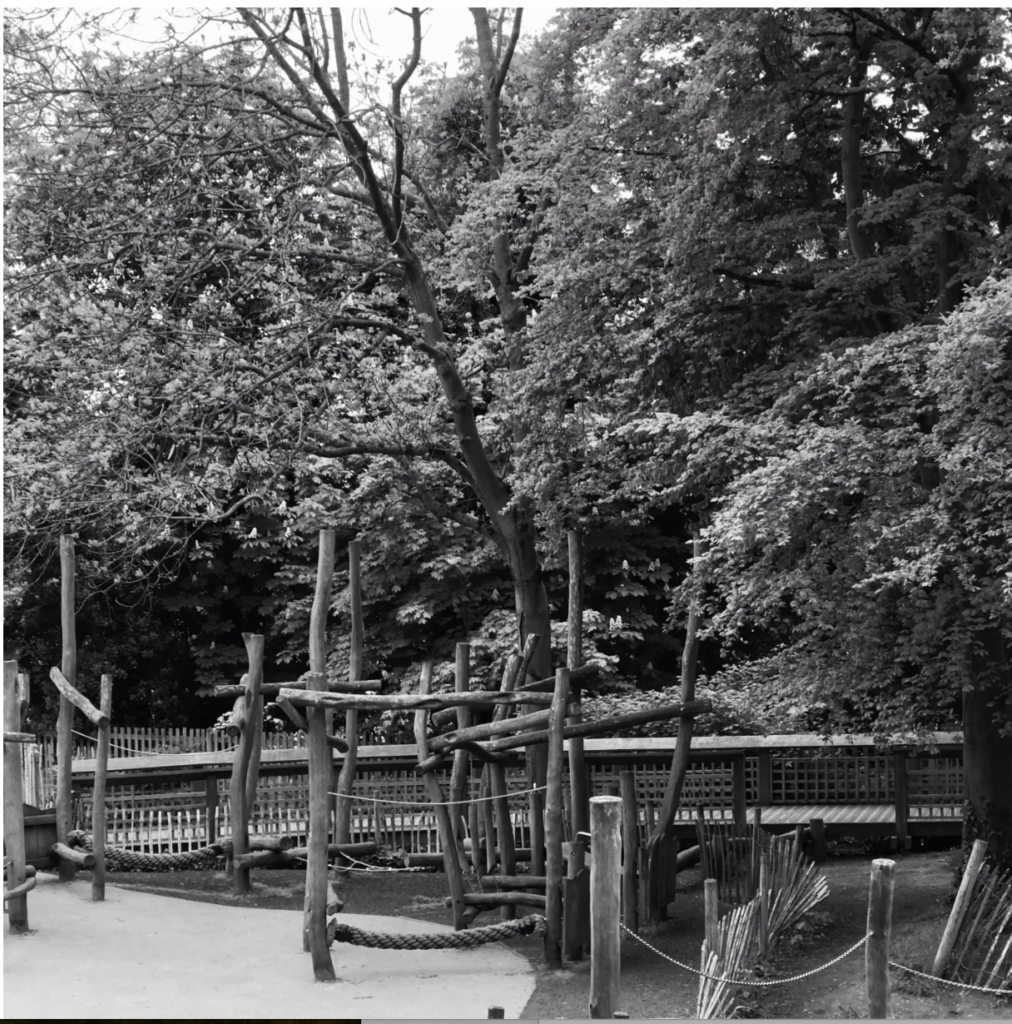
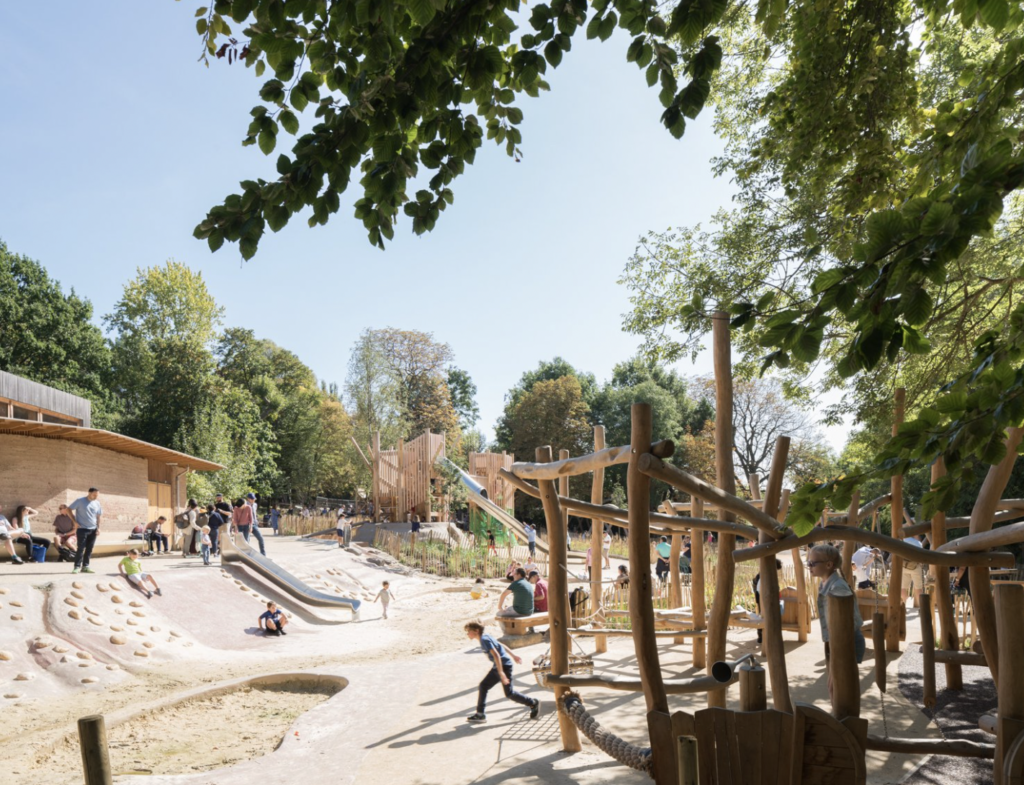
Much closer to home, and to our own time, is the Billy A. Taylor Park on Camp Street in Providence, RI, a site I used to walk to with my kids in the stroller when they were tiny in the late 1980s/ early 1990s. The park was named for Billy Taylor, a young man who had a congenital heart defect and who passed away in 1986 at the age of 29. He seemed to have been a beloved figure in Providence who dedicated his life to mentoring local youth. Taylor “ taught young people to play chess, bought them pizza, found them jobs, encouraged them to aim high, and took them in a red-and-white bus to beaches and other places they’d never been to, or couldn’t afford. A foundation/non-profit continues his work (see also here), focused on education, job training, and community development.
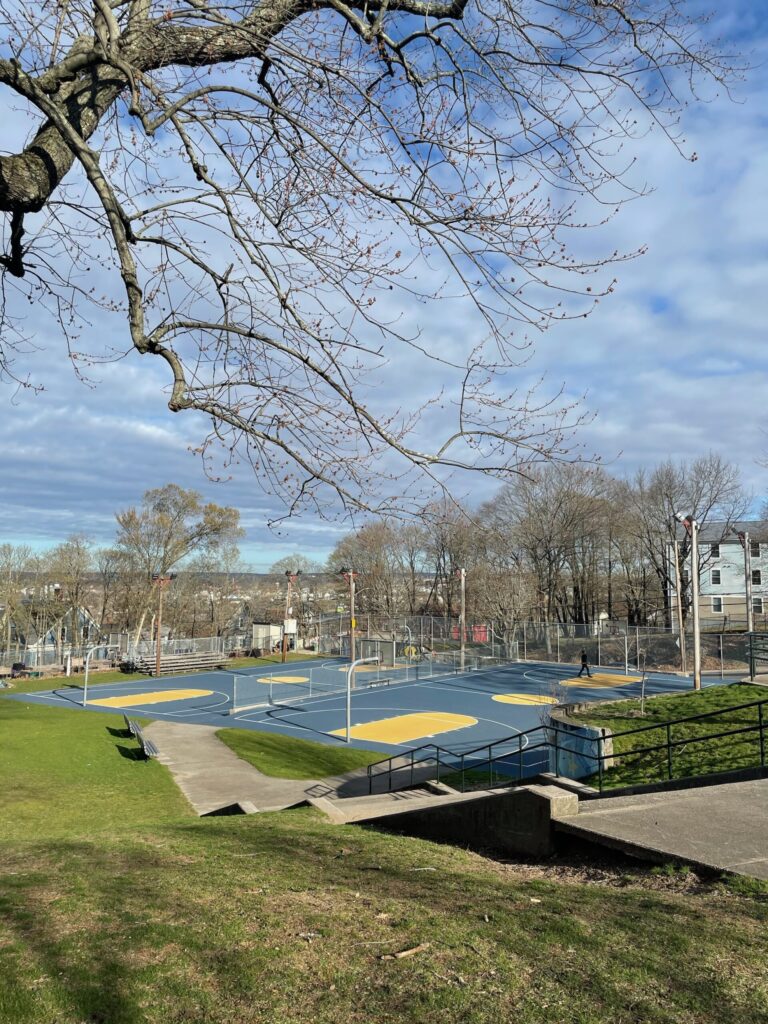
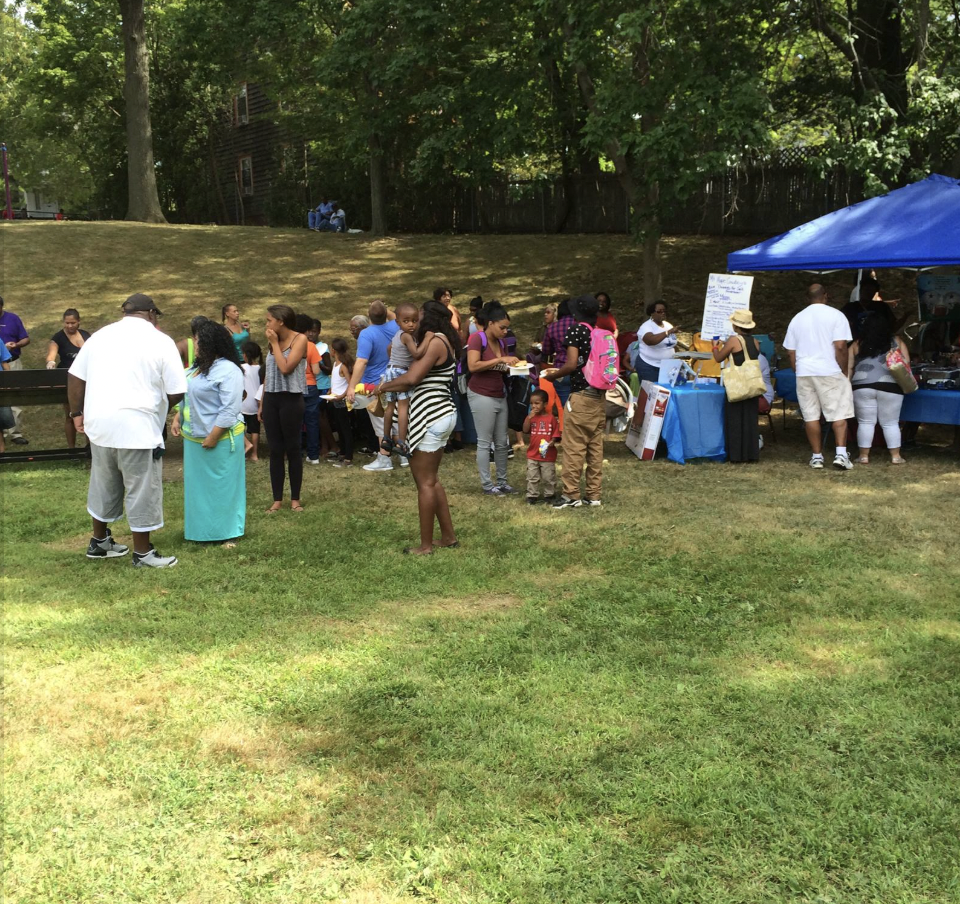
Billy Taylor Park is fenced-in and includes basketball courts, playground equipment for ages 2-13, picnic areas, a grassy hill, and large trees around the perimeter. There are monkey bars, swings, a zipline, and a spiderweb climber. The park functions as a community splash pool, a basketball court, and a skatepark. There is also a teaching/community garden with plots for residents and neighbors. This place by itself offers the amenities of all three of Amherst’s town parks combined (Kendrick, Sweetser, and Groff Parks). At Billy Taylor Park, there are several entrances that connect the park to the neighborhood, rather than one dominant entrance, suggesting the myriad ways the playground is connected to its community. A big boost to the park was the re-emergence of the concept of neighborhood watchfulness along with funding from Bank of America and a city Community Development Block grant.
Community Gardens
In similar ways to community playgrounds, community gardens hark back to the mid-1800s and, specifically, to the legal provision for protection for common fields at a time of the 1845 Great Enclosure Act in the UK. Coinciding with this was an emergence in North America of private botanical study-groups and horticultural societies that pre-date the beginnings of the early Republic. By 1876, celebrations of America’s hundredth birthday, brought this enthusiasm for gardening and for landscape design to the fore. This time the focus was on restoration and renewal projects and historic preservation. Significantly, landscape architecture and design at the college level began to be offered – and be embraced as a new academic discipline; women began to enroll in such programs.
One garden during this period is special: a herb garden known today as The Lexington Field and Garden Club that was founded in 1876 at Cambridge Farms (the old name for the town of Lexington, Massachusetts). More garden clubs in cities and towns emerged in the 1890s, and they won national recognition in 1913 with the creation of the Garden Club of America. Amherst Garden Club was founded in 1915. Further boosts to community gardens took the form of the so-called Victory Gardens set up during World War II. Maybe readers will remember Lady Bird Johnson’s beautification schemes involving plantings and flowers for the median strip for America’s new public highways up and down the country. Garden clubs to this day tend many public and community spaces for everyone to enjoy.
Returning to Amherst, Echo Hill, an innovative housing scheme opened in 1959 as a Planned Unit Development (PUD), promoted the creation of open spaces, mixed-use housing and land use, environmental preservation, sustainability, and development flexibility. It was designed around a series of small ponds with “open common space” much like Orchard Valley would adopt later on.
In Echo Hill, the Aubin family envisioned forested common areas that would serve as a buffer between the single-family homes. Additional zones to the housing development were constructed through 1965 and the initial swim club became the Hampshire Athletic Club. According to resident Kitty Axelson-Berry, neighborhood gatherings happened often and there was a community garden. However, over time it proved difficult to maintain the garden and bring water to the plots. Eventually, demand for garden plots petered out in favor of people’s own back or front gardens for dedicated growing space. These days, there are also different populations living there such as undergraduate college renters who are resident only in the fall and spring semesters.
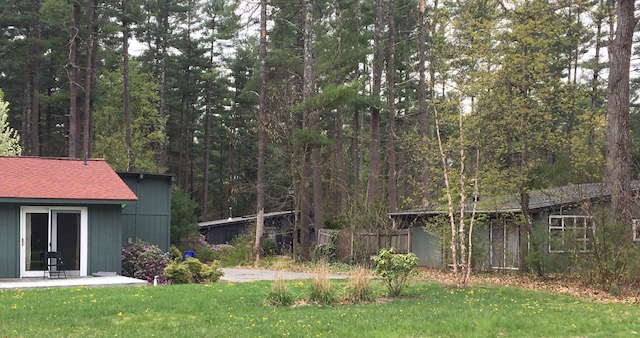
Amherst also has community gardens at Fort River and Amethyst Brook as well as ones on Mill Lane (individual plots and shared water and compost) and in past years at The Boulders. More information is can be found here and here.
North of Amherst, there are two very active community garden organizations in Turners Falls close to Unity Park. In Greenfield, the John Zon Senior Center has a garden that is lovingly tended by volunteers who also take care of Energy Park. Energy Park has a native plants garden and a bandstand that make the site a popular destination for everyone all year round. Some of the garden plots at the Zon Center border Pleasant Street where there is also a handicapped accessible garden bed. The community recently celebrated its 25th anniversary. Two of the active volunteers include Dorothy Sotiros (who also volunteers for the Nolumbeka Project) and recently retired Rabbi Andrea Cohen-Kliener. This group sought advice from both NOFA and UMass Extension Service. The people tending these community gardens have a deep respect for the land and its gifts for all. In towns and cities larger than Amherst it is possible to find other arrangements such as In Bridgeport, CT where community gardens are managed by a network called GroundWork Bridgeport that offers plots for free to grow your own food..
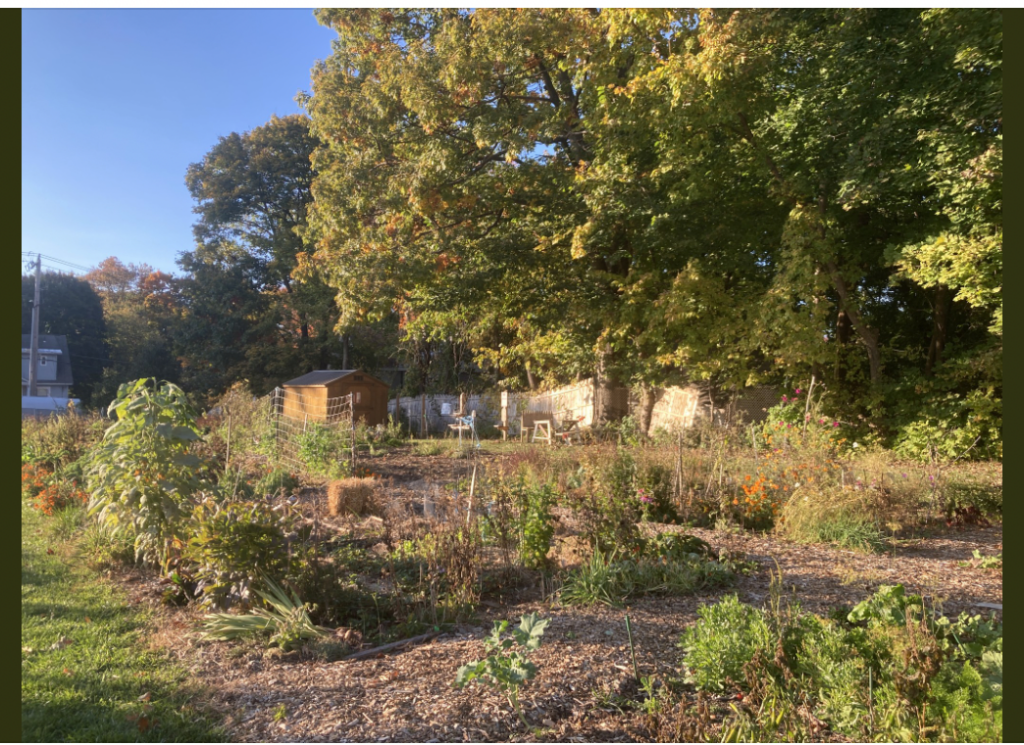
Finally, two community gardens close to my heart are the North Amherst Library flower garden, tended by a group of local volunteers drawn from the local District One Neighborhood Association. This group is very dedicated and active, and they work on behalf of the Jones library system and all its patrons, as well as anyone driving or walking by. It is a very beautiful, historic flower garden. This group, managed by Ava Fradkin, also takes care of the traffic triangle on the corner of Summer Street and Montague Road. As the story linked here suggests, there are other stakeholders involved in this prominent and busy intersection in our town.
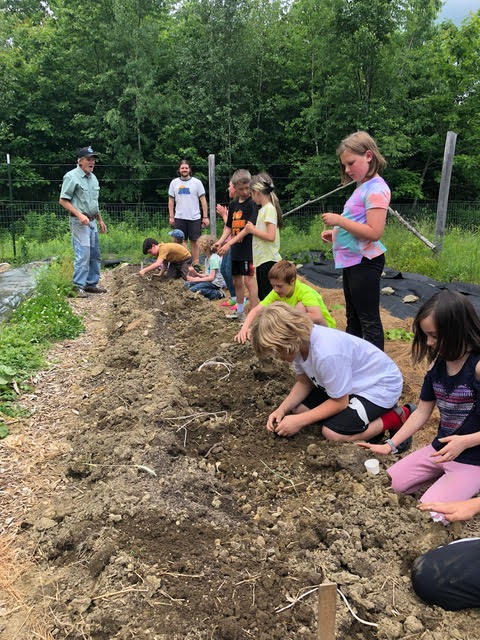
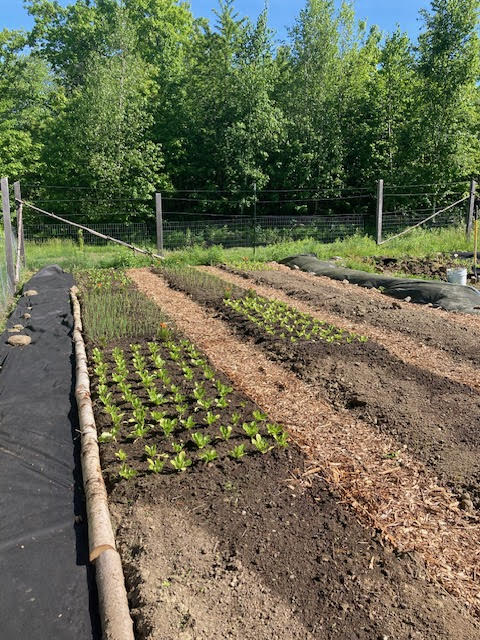
`My’ other garden is in Ashfield, where Bug Hill Farm proprietors Charlotte and Sam Perkins tend an area of their land for the Hilltown Churches food pantry. The garden is in an area of early succession woodland, and in this case, privately owned. The Perkins family and a small group of volunteers share this with the community in terms of the produce donated to the food pantry but also aim to pass on sustainable stewardship of the land to volunteers and visiting groups of local school children. The gardens here follow permaculture practices with a mix—as Sam Perkins says—of “meditation and productivity.” Again, NOFA plays a role in helping to sustain the knowledge base of the gardeners, where they ‘feed the soil, not the plant” and practice diversity rather than monoculture. The garden offers the local food pantry, led by recent Citizen of the Year, Pat Thayer, a range of fresh produce beyond the usual offerings in all seasons on a bi-monthly basis.
Returning to a focus on the community by way of the topic of playgrounds and gardens suggests that there are always careful collective responses to community needs. Collectively developed design elements can play an important role in maintaining a town’s identity and uniqueness. Such places also suggest a community’s guiding principles and values. .I think that is true for our town. I find this particular aspect of landscape design encouraging – not just because it is part of my own history but also because, with the world burning up around us, and now a new war that is not good for plants and all living things, the examples here may offer ideas and resources to anyone envisioning a landscape feature of this sort in their own city or town. The series was envisioned as a way to address the spaces that we create as a society where we can share common space. Every now and again, I wonder if we can hold on to these commonalities and ways to share when so much in our proverbial sandboxes pushes us to take up arms against each other.
Spring Gardening Symposium: Gardening as a Community
Frontier Regional High School, South Deerfield
Saturday March 21 from 9 a.m. – 2:15 p.m.
Here’s a fun and energizing way for beginning and experienced gardeners to branch out or brush up with folks from the Western Massachusetts Master Gardener Association. There will be soil testing, workshops, a raffle, tasty treats, and a keynote speech about tick safety by UMass microbiology professor and TickReport director Dr. Stephen Rich. More info