
Town Engineer Explains How Road Repairs are Prioritized
Photo: istock
Report on the Meeting of the Town Services and Outreach Committee, April 2, 2026
This meeting was held over Zoom and was recorded.
Present
George Ryan (District 3, Chair), Andy Churchill (at large), Pam Rooney (District 4), Jennifer Taub (District 4). Hala Lord (District 3). Lord joined the meeting at timestamp 46:52 and left before its conclusion (timestamp not recorded).
Staff: Paul Bockelman (Town Manager), Athena O’Keeffe (Clerk of Council), Jason Skeels (Town Engineer), Guilford Mooring (Superintendent of Public Works)
The bulk of the meeting was devoted to a presentation by town engineer Jason Skeels who reported on the state of Amherst’s roads and how road repairs are prioritized. See his Power Point presentation here. There was considerable discussion following Skeels’ presentation which was followed by public comment and approval of appointments to the Community Safety and Social Justice Committee and the Council on Aging.
Town Engineer Explains Road Repair Priorities
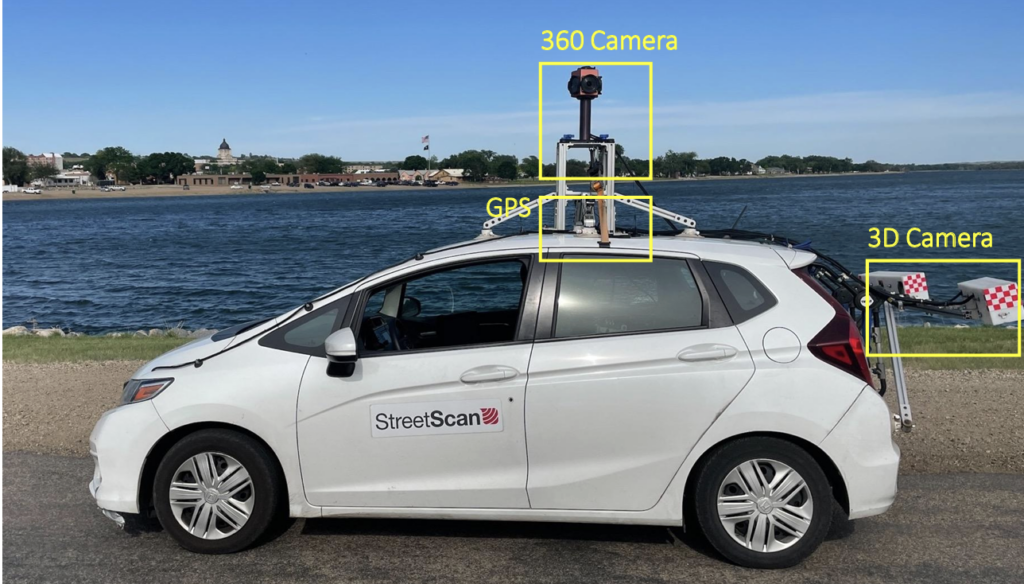
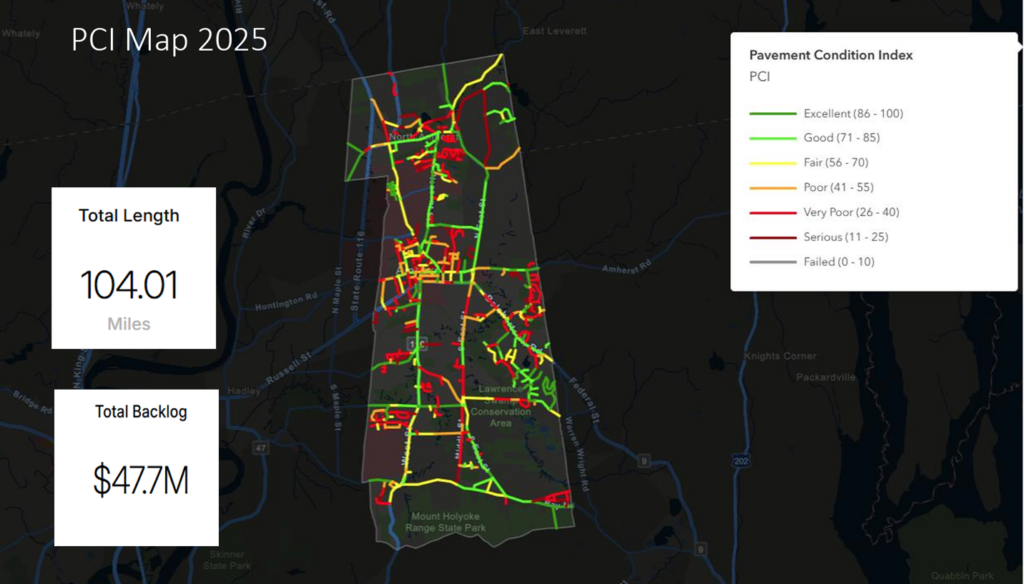
Skeels explained that the town employs the firm Citilogix (formerly Street Scan) to map all 104 miles of the town’s 762 streets. The company uses a Honda Fit mounted with 3-D cameras to map every foot of street surface, providing a detailed accounting of road conditions.
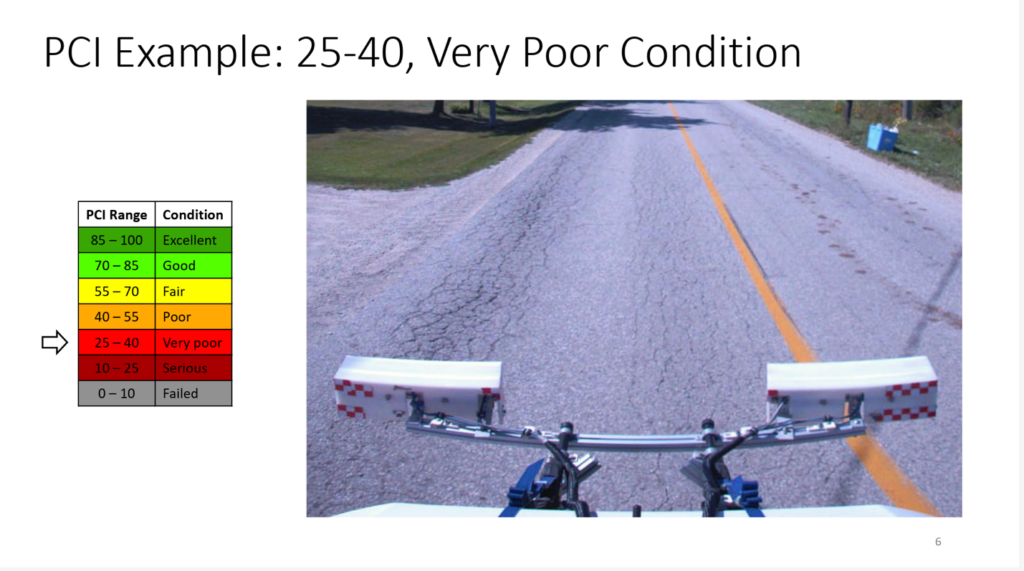
The company then uses an AI-assisted algorithm to create a report card for town roads, grading each road’s condition with a Pavement Condition Index (PCI) score of 1-100, with with 0-10 indicating a failed road, 10-25 serious, 25-40 very poor, 40-55 poor, 55-70 fair, 70-85 good, and 85-100 excellent. Roads with the lowest PCI scores, for the most part, are ranked as highest priority for repairs in the next repair cycle.
While the state of road deterioration largely determines road repair priorities, arterials receive special consideration for repair because they are the roads that are used the most, and they also degrade the fastest. Skeels said the town has been unable to keep up with neighborhood roads that are mostly used only by those who live on the street. He said that many of them have not been repaved since they were built.
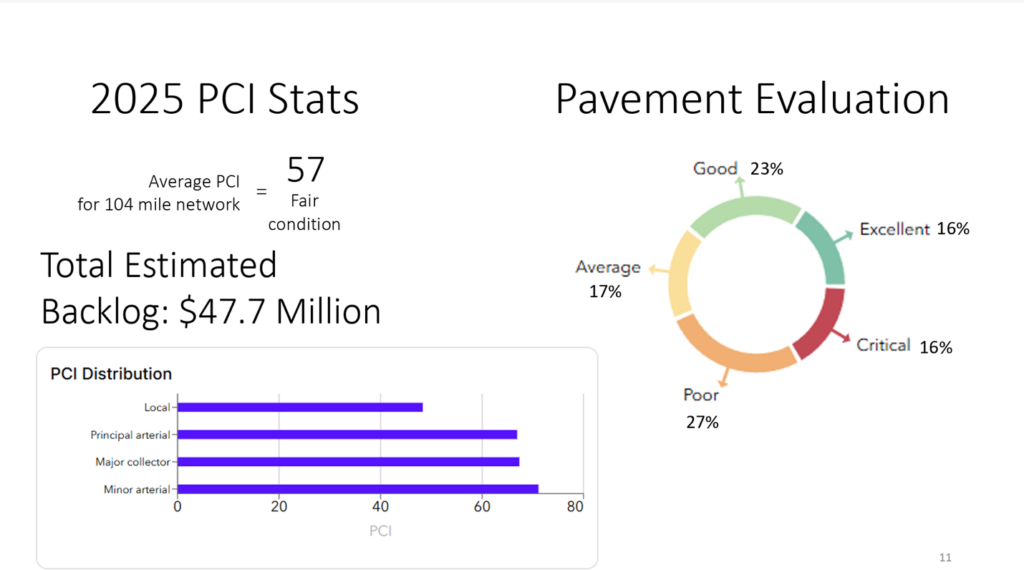
In 2021 the town’s overall PCI score was 61 indicating an overall rating of fair for Amherst’s roads. In 2025, the town’s overall PCI score was 57, also categorized as fair but only two points shy of a poor rating. The town’s overall PCI score has dropped eight points in the last five years, and that prompted Skeels to warn in 2025 that it would take a minimum budget of $5 million annually just to prevent further deterioration. Skeels suggested that an annual roads budget of $7 million would enable the town to raise its PCI score by about 1 point per year. Anything less than $5 million will likely result in a reduction of 2-3 points per year.
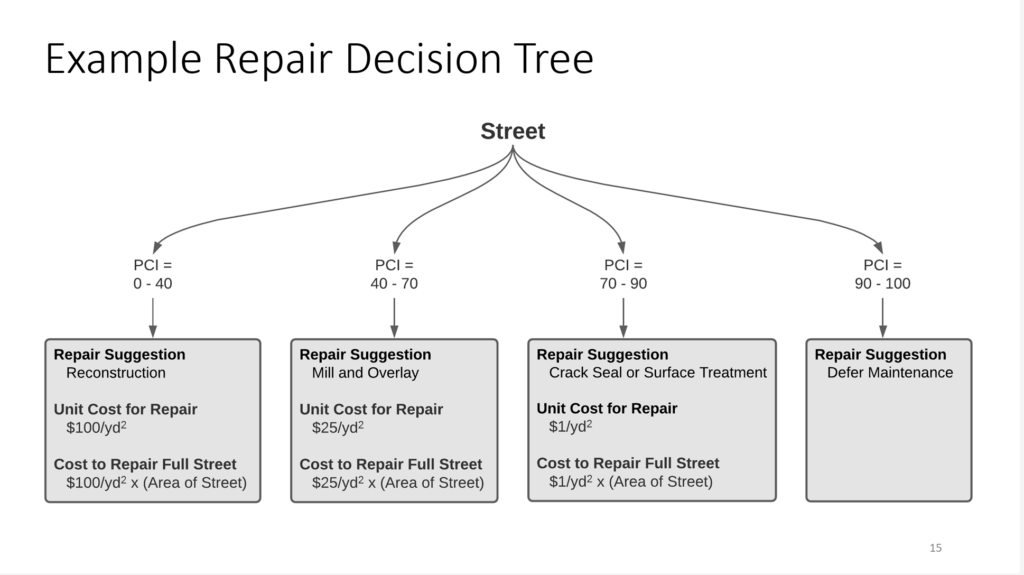
Roads with a PCI of 0-40 require a full-depth reconstruction which costs at least $100 per square yard, even more on a main street that has manholes and crosswalks. With a PCI of 40-70, the DPW does a mill and overlay, which costs about $25 per square yard. Roads that only need crack sealing or surface treatment cost about $1 per square yard. Skeels estimated in 2025 that repairing all roads with a PCI of less than 30, would cost nearly $6 million.
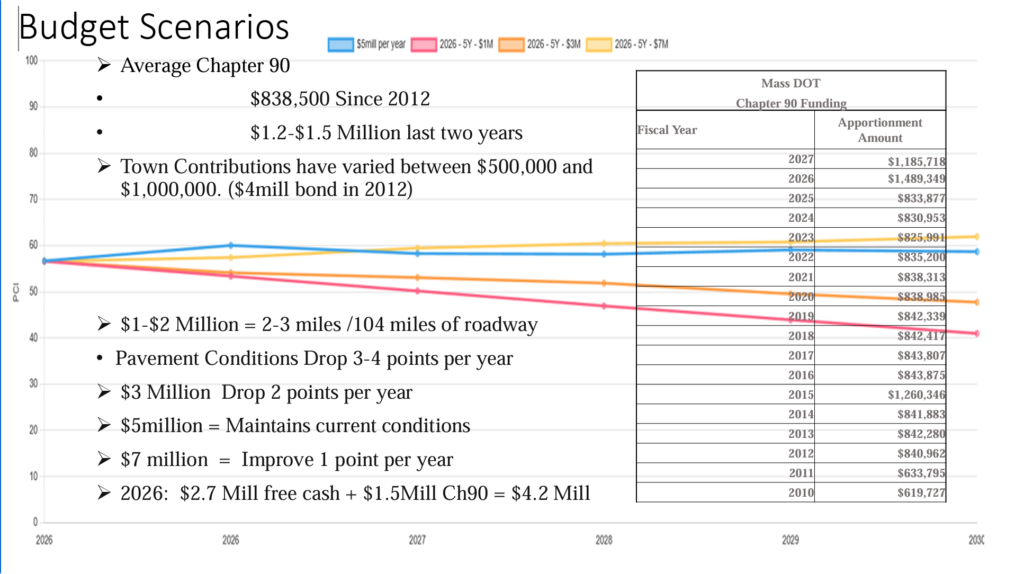
Skeels noted that while the DPW has been successfully experimenting with less expensive ways to make repairs, the current crisis in the Middle East could drive up the cost of asphalt and necessitate cutting back on repairs next year.
Road mapping is done once every three to five years, and the most recent mapping was conducted in September of 2025. For the years in between the actual mappings, Citilogix uses a computer program to model expected deterioration and to calculate the annual report card and a ranking streets most in need of repair.
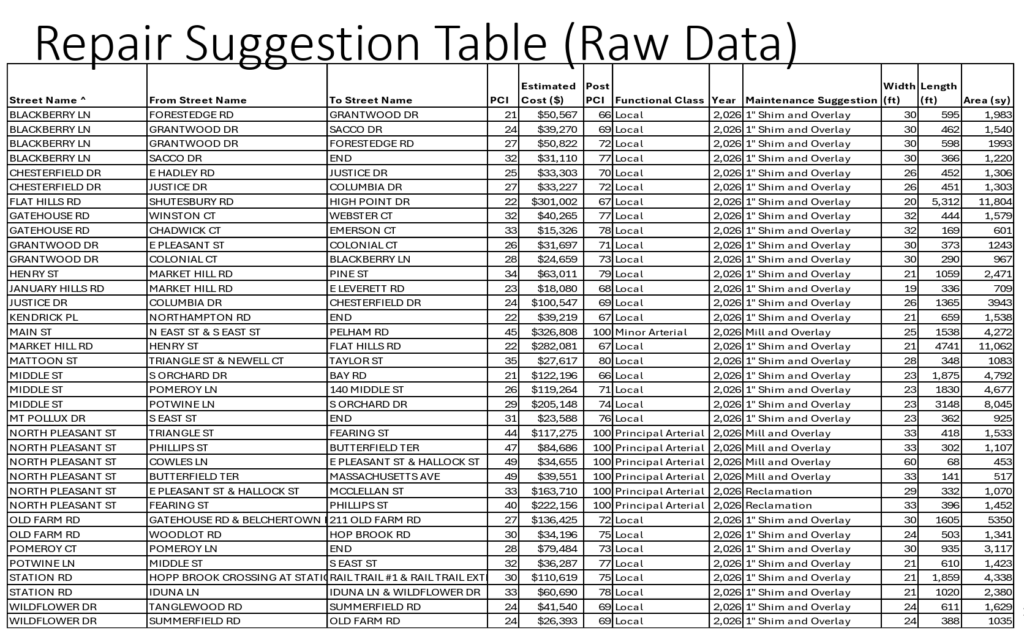
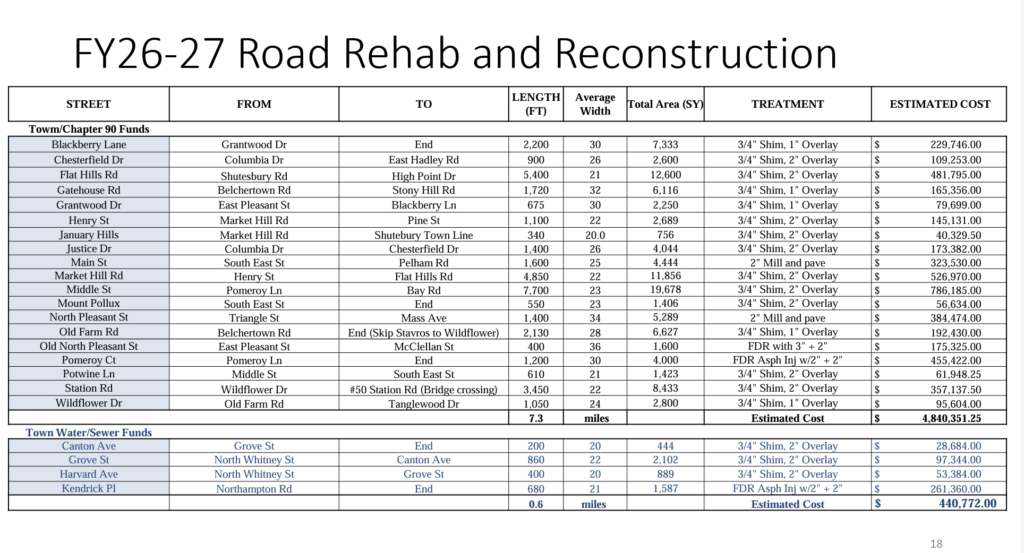
Skeels presented spreadsheets showing which roads are slated for repair in 2027 as well as spreadsheets listing all of the road and sidewalk repairs that the town has completed in the last six years.
See related: Cuppa Joe With Paul and Town Engineer Jason Skeels, April 17 (Amherst Indy)
Questions from the Committee
Pam Rooney asked why College Street (MA Route 9) is not the responsibility of the Mass Department of Transportation (DOT).
Superintendent of Public Works Guilford Mooring replied that when the Highway Division of Mass DOT was founded in the 1960’s, they assigned this section of Route 9, as well as a section of MA Route 116 that runs through the center of town to Amherst as part of their original agreement with the town.
Jennifer Taub voiced concern about deteriorating road conditions on High Street which are hazardous for both motorists and pedestrians, but which is waiting for necessary storm water and sewer repairs before the road repairs can be addressed. Mooring noted that it would make no sense to fix the road, only to have to tear it up to repair the sewer infrastructure, and those repairs do not appear to be imminent. Taub asked, “if there is no room in the budget to do these repairs in the immediate future, is there nothing we can do?”
Mooring responded that there are several roads like this in Amherst, where both roads and sewer infrastructure are in poor condition. He cited Summer Street as one example and said that other urgent projects keep popping up that push those like High and Summer Streets aside. He noted the recent repaving of Route 9 in the center of town as an example where they moved the sewer work up in priority so it could be done while the street was torn up. He acknowledged that “we need to get these severe projects [like High Street] back to the top of the list.
Skeels added, “ we’ll take a look and see what we can do but please don’t ask for traffic calming.
Andy Churchill wanted to know why traffic calming is a problem and Skeels responded that it’s expensive. Each barrier costs $10,000, and it takes funds away from paving.
The councilors all wanted to know about the possibility of supplementing the roads budget with grants.
Bockleman pointed out that the town has been quite successful in getting grants in the past. Recent grant-supported projects include the paving of Belchertown Road and the new roundabouts on Pomeroy Lane and on University Drive.
Churchill wanted to know how requests from residents impact prioritizing repairs.
Skeels responded, “Hopefully not at all. We try to stick to the scores to set priority independent of popular opinion.” But he noted that there’s more that goes into creating the list than just the score. He said, “ It makes sense to do main roads first, but we’ve fallen so far behind on side streets that we need to now address both at the same time. And we try to save money by concentrating projects geographically so the contractor is not moving back and forth across town.”
Rooney noted that much of the volume on certain roads is traffic to get to and from UMass, and many of those roads are the most deteriorated. She wondered, “Can we ask UMass and the state to help out?”
Taub added that it’s the same thing with sidewalks, pointing out the poor condition of the sidewalks on Fearing Street, a major pedestrian route to UMass. She noted that there is a sinkhole in front of her house on Lincoln Avenue that she reported four years ago. “We make an effort to fill it in and keep refilling it but there’s a safety concern, “ she said. She concluded that there is an apparent connection between UMass traffic and the rate of deterioration of roads and sidewalks and that it seems like it would be reasonable to ask UMass to help with this.”
George Ryan asked where the funding is coming from for road repairs and where we stand for the current year.. Skeels was not certain about the particulars of the current road budget, but reported that the town’s state chapter 90 money for this year is spent, and he did not know how much is left in town funds. Much depends, he said, on how the bids for the work come in.
Ryan wondered how water and sewer budgets impact road repairs. Mooring pointed out that most water and sewer work is funded from the water and sewer enterprise funds but that some work, like the current work near Pelham, is grant funded. Bockelman added that when there is water and sewer work, the repaving comes out of the water and sewer funds and not out of the roads budget.
He noted that the council has approved $2.7 million for roads for next fiscal year and “we’re looking to get that up to $5 million per year.”
Ryan asked how the town will do this and Bockelman said that this is set out in the capital plan and that he will share a memo with the committee containing the details.
Help from UMass?
Taub said, “Since we are in the process of renegotiating the strategic partnership agreement with UMass and Amherst College, are we going to include infrastructure as part of those negotiations? Do they understand how bad things are? Surely they must know the infrastructural challenges that we are facing as a town. We’re at a point where we need some critical support.”
Bockelman agreed that it is worthwhile to emphasize this, but noted that the University and Amherst College are already making valuable contributions to the town’s fire service and to downtown improvements.
Ryan asked about planning for a new traffic pattern at the new Amethyst Brook Elementary School, and about addressing the long-standing traffic problems in North Amherst, and whether there are any plans to seek some state help with that?
Mooring responded that the town can’t get any help from the state for the school traffic management until it comes up with a concrete plan, and that there are no state funds for planning. He reminded the councilors that the town decided to wait and see how things work out when the new school opens and then develop a plan from there. Then, “we’ll need to invest in a study that will come up with a plan for that corridor. Once we have a plan, we can appeal to the state for funds to implement it,” he said. He offered one example of a funding source, the Safe Routes to School Program, and suggested that the town is in a good position to get money from that program when they are ready to apply for it.
Public Comment
Kay Lesseck of High Street reiterated Taub’s concerns about High Street. She spoke of the poor condition of the road which is heavily used by cars and pedestrians as a thoroughfare to local schools and UMass, and expressed dismay that High Street is not on any of the repair lists for the coming years– especially with the decaying infrastructure underneath. She also noted that parking on High and Taylor streets is so congested that these are effectively one way streets and this reduces visibility which creates an additional hazard.
Ryan suggested that she take her concerns about the parking to the new Transportation and Parking Commission, which will begin meeting soon.
Taub noted that there is a student rental property at the corner of Taylor and High Streets that currently has eight residents and an ADU under construction that will add four more residents, resulting in 12 cars on a concentrated lot. She said that raises the question of how infill will impact parking and how that will be addressed.
Bockleman invited residents with general questions about roads and maintenance (e.g. why did a cold-patched pot hole on my street fail so quickly) to send them to him, and he and Skeels will work on pulling together a FAQ on road repairs.
Committee Appointments
The committee voted unanimously to recommend the appointments of Margaret Arsenault to the Council on Aging and Anna Derby the Community Safety and Social Justice Committee.
Ryan reported that he will be meeting, with the Resident Advisory Committee (RAC) on April 3 to learn more about the role the RAC plays in the Town Manager’s Committee appointments and to get their perspective on the steps that might be taken to reduce the number and/or size of town committees appointed by the manager. He asked if TSO members had questions that they wanted him to pass on to the committee.
Rooney observed that the RAC is a very small committee (3 members with almost no turnover since its creation in 2019) and yet has a substantial workload and she wondered if that committee ought to be a little larger, and given its role in appointments, have broader representation from the community, especially given concerns that certain people or groups are unable to obtain appointments to town committees.
Bockelman responded that he doesn’t think that the narrative [that certain people are excluded from appointments] is accurate and that he has only heard about one person who has claimed to have had that experience. He asked that if any of the councilors have specifics to share, they should share that information with him. He voiced his satisfaction with the RAC and its makeup as is, but said that TSO was free to ask the RAC for feedback. Bockelman also said that the interview committees assembled for the above-mentioned appointments to the CSSJC and COA were diverse and asked incisive questions.
Churchill asked Ryan to clarify if the RAC was aware of people who had gone through interviews a few times but have never been appointed.
Upcoming Agenda Items
The committee will hear from Sammantha Geffen and Angela Mills on April 16 about outreach for feedback on town committees. It will take up the question of street lights at its May 7 meeting, and will hear from the waste hauler bylaw consultant on May 21.