
No Shortage of Good Energy and Ideas at Cherry Hill Listening Session
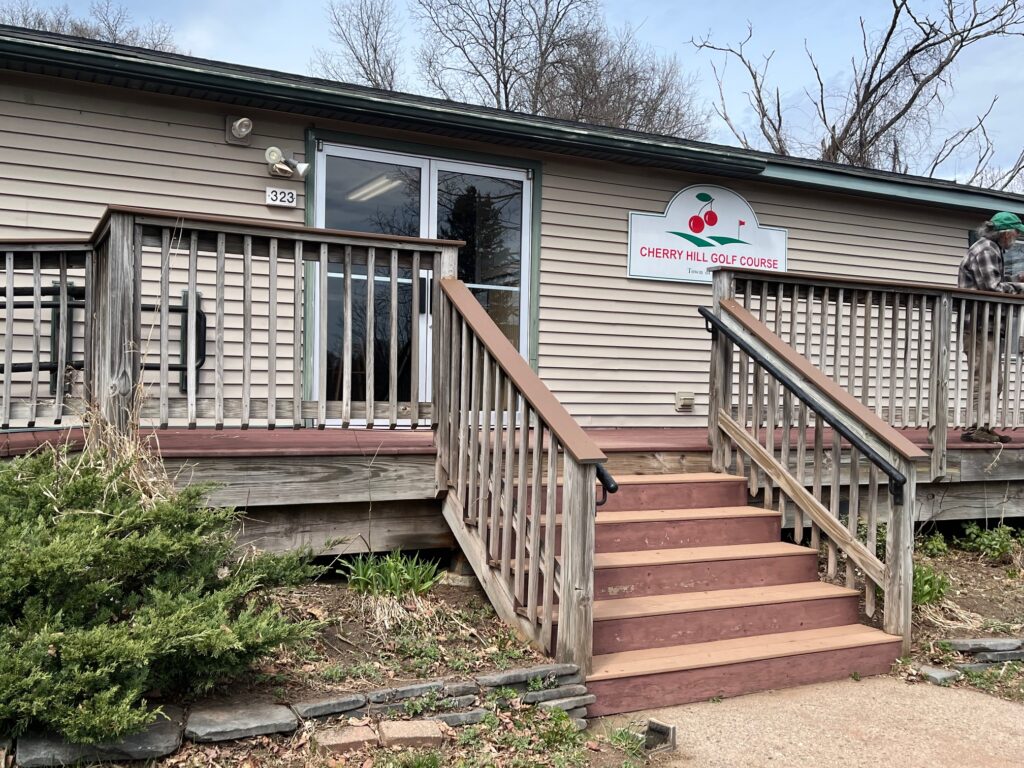
Clubhouse, Cherry Hill Golf Course. Photo: Maura Keene
About 20 people attended the Cherry Hill Working Group’s (CHWG) listening session at the Cherry Hill Golf Course Clubhouse on Sunday, April 12, despite its being held during the final round of the PGA Masters Tournament. Zoom attendance was also enabled.
Also in attendance were Michele Miller (Chair), and CHWG members Chris Pareiseau, Hillary Matheson, Anurag Sharma and Ryan Diplock, as well as Town Manager Paul Bockelman and Recreation Director Rey Harp. Town Councilors Cathy Schoen and Andy Churchill were also present.
This was the opening weekend for the golf course, and there was a steady stream of golfers of all ages heading onto the course throughout the meeting.
Miller began by reading the CHWG’s charge:
The purpose of the Cherry Hill Working Group (CHWG) is to provide advice and recommendations about the long-term viability of golf operations at Cherry Hill Golf Course, innovative strategies for course management and fiscal sustainability, and alternative/compatible uses of the property. The goal is to determine if golf operations can and should continue to be provided by the Town and to determine if these golf operations can be and should be self-supporting. The committee will develop a final report which will include in-depth analysis and robust recommendations for various topics, including:
- Land Acquisition and Legal Constraints
- Purpose and Mission
- Finances and Operations Review
- Recreation Role and Community Benefit
- Five-Year Financial Plan
- Evaluation of Alternative Uses and Disposition
Miller said that the group has spent most of their meetings determining a financial structure for the golf course that will ensure that the profits of the course are reinvested into the course through a revolving fund. As of now, all revenue from the golf course goes into the town’s general fund. Expenses are part of the overall town budget, and the course must apply to the town for improvements. This structure makes it difficult to determine how well the course is doing financially.
The working group is now beginning to broaden the discussion to other uses for the 91-acre parcel that was purchased by the town for $2.2 million in 1987. The group is also developing a five-year financial plan.
Sharma noted that the course has made a profit in the last seven years, but it spends 33% less than comparable courses on staff and equipment.
Thoughts and Suggestions from Attendees
Resident Gerry Guidera asked, “What are the options for the land that the working group is considering, such as housing or ‘just letting the weeds grow?” Bockelman stated that state grants used to acquire the land restrict its use to open space and recreation, so housing cannot be built there.
Another resident asked about having a management company run the golf course. Sharma replied that the working group has less appetite for that because they want the course to remain affordable and accessible to many people.
Cathy Schoen said she was glad the group was looking broadly at how the site is used. She said that there are many walkers there around sunset every evening. And it is a prime place for cross-country skiing. She pointed out how quickly the Hickory Ridge site degraded when the golf course was closed, and suggested that the course look into winterizing the club house by placing solar panels to help provide heat.
Harpo Power noted that if it is managed with its own funds, money made by the golf course and through fundraisers at Cherry Hill could be used to improve the course.
Andrew Pazmany pointed out the huge turnout for the course clean-up day the previous weekend, which demonstrates the town’s support of the course. However, he said the posted salary for the two half-time groundskeeper positions to help Course Manager John Coehlo is only $15 per hour. He said that increasing the membership fee by 10% and the green fees by $2 should generate an additional $25,000 to $35,000 in profits. He suggested raising the wages for the part-time positions to $25 per hour at a total cost of $6,000 to $8,000 for the season. Pazmany also commended the golf course’s presence on social media.
Several people worried about the course depending so much on one person, Coehlo. Pazmany said, “If something happens to John, the course will cease to operate. Andy Churchill asked if there was an alternative management plan.CHWG member Ryan Diplock said he had considered this in drafting a five-year financial plan for the course. He said that a big part of his cost-planning was to increase staffing and make sure that the revenue was sufficient to support the additional staffing. He proposed adding a full-time assistant course manager and a third half-time groundskeeper. His suggestions for increasing revenue were to obtain a liquor license for the clubhouse and to increase operating hours.
Other suggestions raised were to work with the Turf Management School at UMass to determine the best way to maintain the course. Lee Jennings suggested that the town could sell cross-country ski passes and rent skis. The course could hold cross-country ski races and serve hot chocolate in the clubhouse. This could be an event sponsored by a Friends group.
Pazmany said that he would love to be able to store his clubs in the clubhouse, so he could bicycle to the course. Someone said that the course should fine people for littering on the course. Finally, it was suggested that members who didn’t need a golf cart could sign up to play before the course opened, which would free up tee times later in the day.
Those in attendance were universally in favor of creating a revolving fund for the golf course, although it would need to be determined what portion of the Recreation Department staff salaries would be attributed to the golf course and how much to their other duties. Schoen noted that the public pools have a revolving fund that is not required to pay for major repairs, and the golf course could operate similarly. Churchill noted that, with many golf courses closing, used equipment might be available. Chris Pariseau suggested getting an autonomous lawnmower that could decrease the need for staff.
Interest in Forming a Friends of Cherry Hill Booster Group
Most attendees were interested in joining a Friends of Cherry Hill Booster Group. They suggested reaching out to all those who helped during the clean-up day. Bockelman noted that gifts made to the golf course would be placed in a special account, not in the general fund, that could only be used for the course.
The Recreation Department is also working on getting sponsorships for the club. Someone concluded, “This is a fantastic course with a great layout.” Those in attendance were enthusiastic about the potential for growth.