
Three Design Firms Selected as Finalists for DPW Building Project
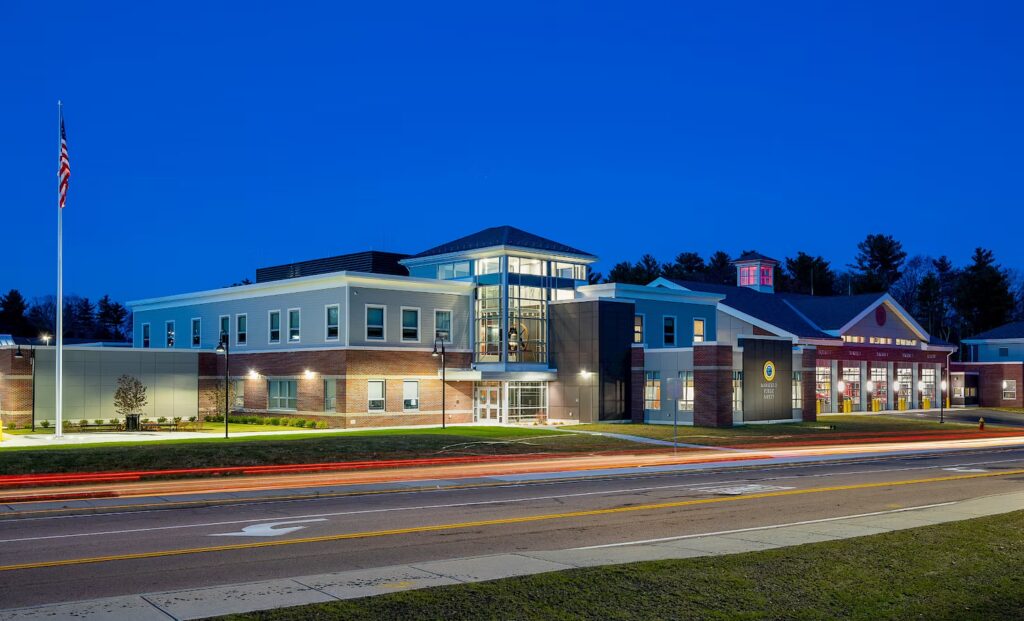
Co-located DPW and public safety facility in Mansfield, MA. The phased construction project was completed in 2019. Photo: KBA Architects
Appointment of DPW Employee to Committee May Be Forthcoming
The DPW Building Committee met in the Amherst Police Station community room on June 10 with the primary goals of shortlisting design firms and finalizing the questions for upcoming interviews.
DPW Worker May Be Added to Committee
In response to a question from Committee Chair Christine Gray-Mullen about appointing a DPW employee to the committee, Town Manager Paul Bockelman said he could potentially submit an appointment request to the Town Council before its next meeting on Monday, June 15. If approved, the employee — Town Engineer Jason Skeels — would join the building committee in time for the designer interviews.
Three Design Firms Ranked Highly by Committee Members
Town Special Projects Manager Bob Peirent shared a printed sheet showing individual committee members’ scores and composite scores on submittals from seven design firms (no scores were reported from committee member Joe Cook). Three firms scored significantly higher than the rest, and the committee voted to invite them to interview. They are Helene Karl Architects of Groton, Mass. (64.8 points out of a maximum of 75), HKT Architects of Boston (62 points), and Weston & Sampson of Foxboro, Mass. (46.8 points). The other firms’ scores ranged from 5.8 to 37 points. DPW Superintendent Guilford Mooring noted that these three firms — along with a fourth, RGB Architects — were interviewed in 2016 for a prior DPW building committee effort.
Some Members Question Compliance with Net Zero Bylaw
As the discussion turned to the list of interview questions, members debated the Zero Energy Town Buildings Bylaw and whether it should be amended. The concern, raised primarily by Gray-Mullen and Bockelman, was the perceived difficulty of designing a public works facility that complies with the bylaw, which requires town buildings to meet zero-energy standards. Gray-Mullen asked Town Councilor Pam Rooney whether she thought a bylaw amendment would pass the Town Council; Rooney responded that it might be a split vote. Mooring pointed out that the bylaw already includes carve-outs for certain public works processes, such as wastewater treatment. Resident committee member David Ahlfeld noted that a carve-out also exists for specialized equipment and that the issue may simply require updating definitions. Finance Director Sean Mangano suggested waiting until the project is further along before determining whether a bylaw change is needed.
Committee members agreed the finalist firms should be asked how they would design a facility to meet the town’s Zero Energy Bylaw. Ahlfeld noted that only one of the three finalists — Helene Karl Architects (HKA) — had demonstrated experience designing a zero-energy public works facility, a project completed in 2020 in Medway, Mass.
Interviews and Final Ranking Set for June 23
After deliberation, the committee narrowed its list of interview questions and agreed that Peirent would share the questions with the three finalists and schedule interviews in the Town Room of Town Hall for June 23 at 10 a.m., 11 a.m., and noon. That session will be recorded. Gray-Mullen said two committee members — Mooring and Cook — will not be available that day, but she expects the committee to have a quorum. Peirent was also asked to check references for the three finalists.
Following the interviews, the committee will discuss and agree on a ranking of the three firms to submit to Bockelman as a recommendation. Per the committee’s charge, Bockelman has the final decision on which firm to select.
This is not the first time the chair has expressed interest in trying to get around the town’s Net Zero Bylaw, which is exactly why the bylaw was written in the first place. We knew then the town’s plan for multiple large municipal building projects (including the DPW) and the intent was to make sure that they would be net zero. The library project skirted the bylaw because it is not a town-owned building. The school project has done a fabulous job of adhering to it, and the town, the schools, and the environment will benefit from that work. Especially now, when the federal government is rolling back all kinds of climate action, the DPWBC needs to stop talking about how to avoid compliance and focus on making net zero happen.
If Net Zero will be required then that will add more cost and construction elements to the project which is another reason to consider including the small Fire House to this total project now or when the DPW research is competed. Why hold out what will be a 20,000 square foot building to the 60,000 to 80,000 square foot DPW Building? Whether they are built under one roof or together. The current Fire Station takes up to 10,000 square feet of ground space and is a multi-floor building. If a Fire Station is built now it could cost up to $25M and if it is built 5 years later it could be $40M. My estimate is based on the calculations of Easton MA and Abington MA which have just built Fire and DPW facilities together. Easton and Abington estimated percentage increases for separate and delayed completion of these buildings. Amherst does not have the robust tax revenues or a strong tax base to squander years in completing these projects or the luxury of building them separately.
Zero energy buildings are designed to save energy costs in the future. And everything we do from here on in should be designed to make Amherst more climate resilient. and self sufficient. The zero energy task force made the case well back in 2017. https://zeroenergyamherst.weebly.com. Also, Amherst should be all about no frills and combining DPW and Fire Station uses, as Terry says.
The suggestion by committee members that the new DPW facility should not be required to comply with Amherst’s net-zero bylaw sounds alarmingly like the Trump Administration’s continued weakening of environmental regulations.
Medway, Mass., which reports maintaining roughly the same number of road miles as Amherst, completed a certified net-zero DPW complex in 2020 at a construction cost of $13.2 million.
The DPWBC should respect the importance that Amherst places on sustainability and adopt a law-abiding “can-do” attitude.
If there needs to be a large area to park vehicles, perhaps emulating the UMass model of covered parking lots would go some of the way toward net-zero. And if more of those vehicles were EV’s, they could benefit from direct DC to DC charging — a challenging proposition if the vehicles are in use during the peak charging times of the day.