
Library Trustees Acknowledge That Fundraising Gap Will Be Substantial
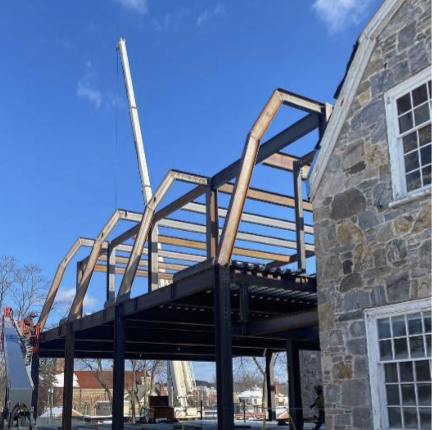
Jones Library addition under construction, February, 2026. Photo: amherstma.gov
At their July 30, 2026 meeting, the Jones Library Trustees finally received a fundraising update for the building expansion project (there had been no report since May 1). Chair Austin Sarat said, “We need to acknowledge that the gap [between Capital Campaign fundraising and the library’s portion of the building project costs] is likely to be substantial.”
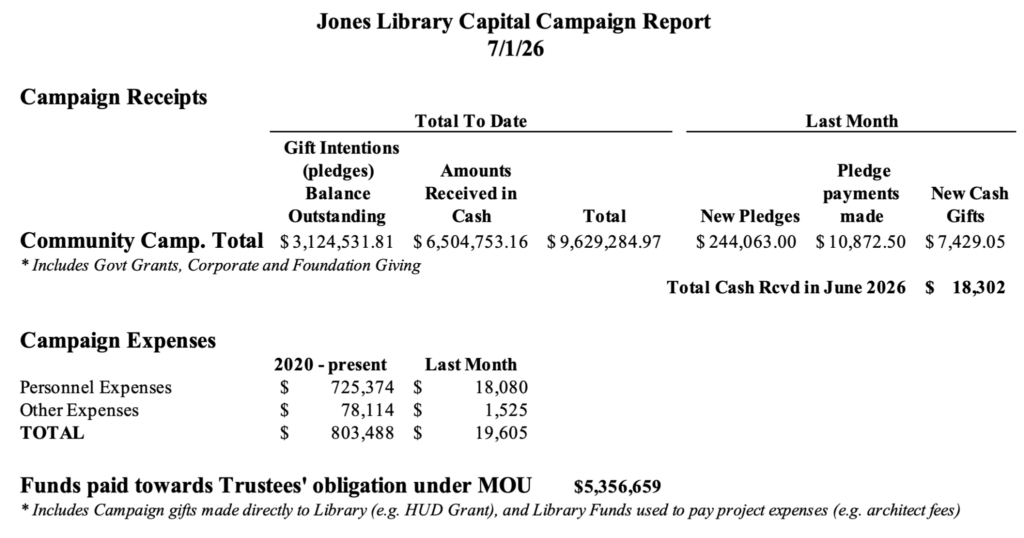
During public comment held at the beginning of the meeting, I asked the trustees to address some persistent problems highlighted by the Capital Campaign report’s figures:
- The total amount of outstanding pledges has not budged from $3 million for a very long time.
- What is the nature of these pledges?
- Why haven’t they been fulfilled?
- At what point will the trustees acknowledge that they are not going to materialize?
- With $9 million due to be paid back to the town in about 18 months, what is the library doing to raise an average of a half million dollars per month, or to secure loans if that fails? Notably, donations actually received trailed campaign expenses, resulting in a net loss in June 2026.
Trustee Lee Edwards reported that the state budget included $50,000 for the Jones Library for its inclusion of gender-neutral bathrooms in the building project. She also noted that the trustees will be releasing $600,000 of fundraising dollars to the town, although she was not sure about the timing of that reimbursement. She expressed confidence that all pledges would be received and explained that donors had been told that they could arrange for pledged amounts to be paid over a five-year period. Sarat asked her to provide a pledge payment schedule at their next meeting. She did not offer any strategies for raising the other millions of dollars still due.
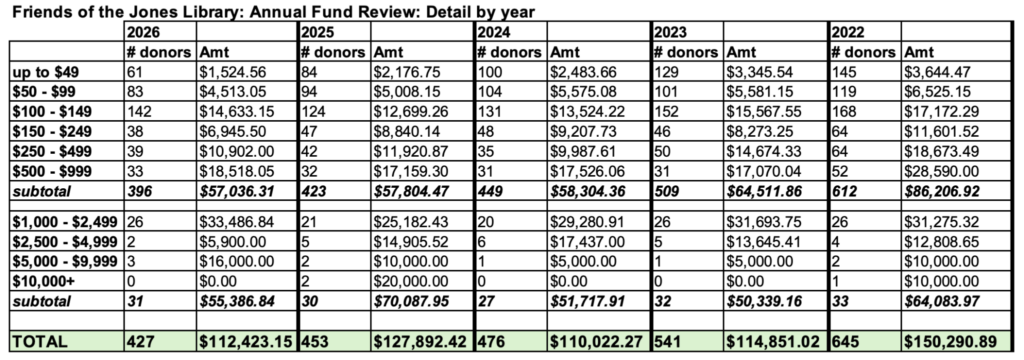
Sarat asked Jones Trustee Treasurer Nat Larson to say a few words about how the library would “fill the gap” that will exist when the deadline for the library’s repayment to the town occurs. Larson noted that $4.5 million of the library’s $9.5 million endowment has been placed in a money market account so that it could be used for this purpose. Sarat reminded the trustees that the library relies on the endowment to pay operating expenses. Larson said it may be possible for the library to also borrow money, but cautioned that this would incur additional costs. He said the trustees would need to decide between continuing the capital campaign for several years or pivoting to Annual Fund receipts. (A report on the Annual Fund showed steadily decreasing numbers of donors from 2022 to 2026 with annual intakes declining from approximately $150,000 to $112,000.)
While it was refreshing to hear Sarat finally be more forthright in acknowledging that the library’s fundraising efforts will fall far short of their responsibility, it offers no comfort when that gap was entirely predictable and will cause financial hardship to both the library and the town. Every time this project was at a decision point of whether to move forward, the trustees and project proponents made promises about the money that would be pouring in, and most town officials happily went along with that magical thinking.
this is SO infuriating! so many concerned residents of Amherst knew this expansion/destruction of our beloved Jones Library was unnecessary. the mountain of lies from the Board of Trustees being told with regards to fundraising. the willingness of Town officials to go along with the ruse. and now what? town residents must cover the cost? the present library director and the Board of Trustees have not been honest with Amherst residents for how many years now? 10? a very long time. thank you to Maria for her continued vigilance on this travesty. and a thank you to Jeff Lee for his articulate, illuminating articles exposing this as well.
Another case of leadership with inflated egos not listening to the public’s concerns. It is maddening, disheartening, and saddening.
I note that the previous Board of Trustees that served under Director Bonnie Isman was unanimously against this project and continued to lead the opposition to its funding. They were voted out of office by our fellow residents who seem to be unwilling to pay for it out of their own pockets.
I have little to add to Emilie Hamilton’s comment, and I share her fury. We will soon have a building – too large for its setting and too expensive to staff and operate – to remind us of the hubris of the Library Trustees, and the complicity of Town government in what Maria Kopicki aptly describes as “magical thinking.”
And now, it seems, that the way out of this mess will be designed by the people who got us into it. As far as I can tell the town charter provides no remedies for the malpractice of elected officials. However the Town Council can decide that its role in this matter is to represent the people of Amherst. The whole sorry history of the library project (save for the sorry role of the Massachusetts Board of Library Commissioners in requiring a larger building in return for its contribution) is encysted in the attitude growing out of the long-standing distrust of Town Meeting and democratic participation that I associate with the now-disbanded Amherst Forward PAC. This “we know better” attitude, perhaps endemic in an academic town can affect all of us but few of us have the means or the patience to act on it. Amherst Forward did but their disdain for other voices – particularly those in The Indy – was telling, especially since those voices presented detailed and undisputed evidence of the dire financial situation as well as the conceptual problems with the project as a whole.
The town council could, for example, publicly vote to oppose the use of the library endowment for capital expenses. It could, under the charter, summon the library director to appear before it to explain how the library plans to operate its enlarged plant with a smaller endowment (and perhaps adjacent matters where she has worked hand-in-glove with the trustees).
In this matter, The Indy has been a responsible and indispensable source of opposition to the whole library project. It didn’t have to be this way; at any point in the past decade the Trustees could have invited Indy reporters and columnists to meet with them to try to negotiate a better plan that the whole town could stand behind and support. Every writer on the Indy has made clear their (our) love of the Jones Library and desire to see it succeed in this project. None of us, though, has engaged in “magical thinking.” It’s time to help the Library Trustees to face their obligation to find 9 million dollars and preserve the endowment.
In 2016 the Jones Library trustees adopted a set of Investment Management Policies for the corporation that limits the annual endowment draw to 4%. It states that “the Board intends the Endowment to endure in perpetuity.”
Somewhere along the line Sarat, Sharry and company lost their way, and decided that building the ninth largest public library in Massachusetts in a town of 13,000 non-students is more important than preserving the integrity of the resource that they oversee.
Austin Sarat should resign. Sharon Sharry should be fired.
How interesting that Professor Sarat regularly writes op-eds for the Guardian criticizing, and rightly so, the excesses and arrogances of foreign leaders and countries and yet we see that he has a little of that himself. Faith over facts? Our way is the only way? I grew up in libraries from Riverdale NY to Yonkers NY to Irvington NY onto Auburn NY. So it is appalling to watch this Amherst Library unfold the way it has. And the worst part of this is that other critically important town capital needs have been denied and delayed for years and these delays will make these projects far more expensive for taxpayers. Just inches from the Library is the Town Fire Station that is in disgraceful condition.
Now, we can all recognize that this library renovation has caused a SERIOUS problem for Amherst.
First, is the apparent disregard for the taxpayers of Amherst. We elect people and hire others to represent us and protect our rights and property. Has that happened here?
Second. We expect representatives to be honest and trustworthy. Are they?
After all the alerts, warnings and pleading by some citizens to alert the public to the questionable things that were occurring during this library renovation and it’s funding, it appears that a huge, very avoidable, injustice is happening.
We cannot expect to simply dump this huge debt on the taxpayers. That is WRONG.
Accountability must happen. Library Trustees, Town officials and anyone else who allowed this spending, now need to take responsibility for finding a solution to fund their debt to the town. And, definitely not out of the pockets of taxpayers.
From its inception, the Jones renovation has been a boondoggle.
False promises and reassurances took an aging gem in need of repairs through an unrealistic wish list of “improvements” to its current state – an underfunded expansion that leaves the town’s finances in shambles. Amherst’s town manager prides himself on his fiscal responsibility when it comes to coddling real estate developers, but he failed to ride herd on this project. Its “Forward” proponents prioritized unrealistic and/or unnecessary facets of the renovation, justifying their dreams of a temple to Amherst’s intellectual supremacy with bogus figures of the library’s level of use, and wishful fantasies of a major project not incurring state funding problems, and unexpected delays and expenses.
If only there was a way to hold these folks personally finacially reponsible…..
I have wondered if the excessive cost of the library project and the lack of care given to financing it may be related to the fact that neither Board of Trustees President Austin Sarat nor Library Director Sharon Sharry pay property taxes in Amherst.
According to town records, Sarat lives in a house owned by the Trustees of Amherst College. Sharry is a resident of Franklin County.
Neither seems to appreciate that the tens of millions of dollars committed by the town to the bloated project have a direct effect on our real estate tax bills.
1919 saw some similar skullduggery with Chicago’s American League baseball team.
A century later, history — while not exactly repeating itself — sure seems to rhyme.
Say it ain’t so [fill in their names]!
In a vacuum, I agree that libraries are valuable. I agree that we should support and treasure our libraries, and fund them. From my understanding, the rhetoric around the value of this project stemmed from a place of “valuing our libraries”, etc.
However, this rhetoric rings hollow to me. If our aim was truly to fund and support the library, why was some of this money not used to pay and hire more staff? Expand programming and library services?
As far as I understand, there was an archival room that did need renovations to protect from water damage – however, that cost was much lower than the cost of this project.
The current location of the Jones is quite nice – if the prior building was inadequate, could we not have moved the Jones to University Drive (where it is now), and slowly performed necessary maintenance on the main building at reasonable cost?
I understand that there was some grant funding tied up in this, and that those have deadlines. However, even with the grant funding, we still face a massive funding gap as seen above.
How come we can spend so much on this library, yet our DPW workers had to storm the Town Council for fair pay?
Again, I love the Jones, and love and treasure libraries in general – and this is why I’m concerned. The funding gap in this project seems possible to harm the Jones. What if this inflated project puts our beloved library in financial jeopardy?
I’ve been attempting to follow this project for years, and it still feels like I don’t understand it. It’s difficult to parse fact from rhetoric and misinformation for this renovation, especially because it’s been such a hot-button issues.
“The current location of the Jones is quite nice – if the prior building was inadequate, could we not have moved the Jones to University Drive (where it is now), and slowly performed necessary maintenance on the main building at reasonable cost?”
“How come we can spend so much on this library, yet our DPW workers had to storm the Town Council for fair pay?”
….music to my ears. And the DPW folks had to wait for their building. I love all three of our Amherst public libraries and also – especially the Reference, Special Collections and IT staff….we are lucky to have them. But this project need not have had this history. It was one of the most challenging things to manage, being on the A. Historical Commission. And in that capacity, finances were not my purview …only making sure that historical and architectural issues were addressed fully, including Section 106. It doesn’t escape my notice that what the current administration wants to effect in terms of changes to the law with respect to 106 are the kinds of things that the Library trustees might have gotten behind. The Historical Commission volunteer commissioners were poorly served with respect to this project. I don’t like to cry over split milk but there will be some cleaning up to do, and it will no doubt fall to the town and its taxpayers.
“Larson noted that $4.5 million of the library’s $9.5 million endowment has been placed in a money market account so that it could be used for this purpose” [to fill the gap in payments owed to the town if fundraising falls short].
Having spent the weekend poring over another institution’s endowment figures, this statement suddenly caught my eye. The stock market has been particularly happy this year; I’ve seen returns in the 7 to 10% range. But money market accounts, not so much nowadays. Depending on where you bank, you might be lucky to get in the 3 to 4% range. While money market accounts are not subject to potential volatility in the stock market, they also don’t benefit from gains when stocks do particularly well. By finally taking a prudent financial move to make up for unrealistic fundraising optimism, it looks like the Jones endowment will now lose out on some of the gains that it sorely needs.
If my analysis is incorrect, I would be happy to hear otherwise.