
Opinion: 250th Anniversary – of What?
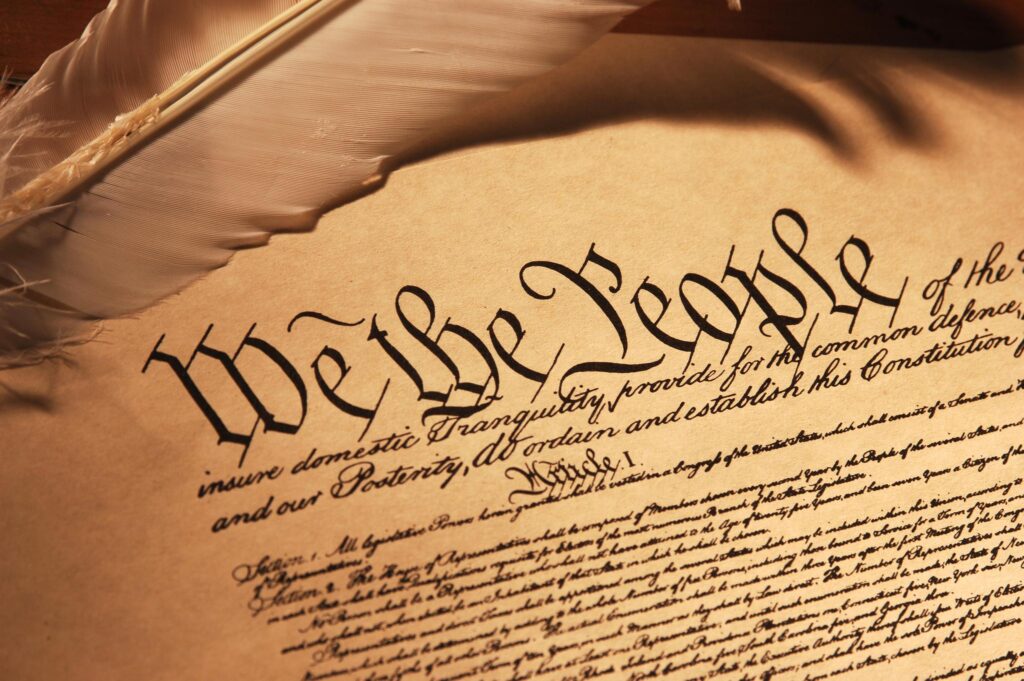
US Constitution/ Photo: pixy.org (CC BY -NC_ND 4.0)
I sit here on the eve of our great national celebration wondering, like many others, what exactly there is to celebrate. It’s not the creation of our nation; if we are lucky we will do that a decade or so hence. If we celebrate today the stirring and ambiguous opening words of the Declaration of Independence, a decade hence will we acknowledge the way those words were modified in our original Constitution and also the long and deadly path to the XIIIth, XIVth, and XVth Amendments followed by the awful compromises that ended Reconstruction and instituted Jim Crow. Our history is now understood as both aspirational and actual, and for a time it seemed as though the two were coming together until they were thrust widely apart, with that gap growing wider as we celebrate this weekend.
What is widening the gap? There are many ways of addressing this question, but I am going to pick only one and I choose it because I think it pertains to Amherst as well as the United States. The particular feature of our governance that the Founders insisted upon was the tripartite separation of powers, with supremacy given to the Legislative branch, not the Executive branch. The Judicial branch, treated only sketchily in the Constitution, gained the power to adjudicate the constitutionality of federal and state laws and acts after the Constitution’s ratification.
What has happened since, is the accrual of power by the executive branch at the expense of, but with the complicity of the legislative and judicial branches. It is comforting for liberals to lay this at the feet of the current administration, but that misses the long sweep which includes the growing dominance of political parties and the frequent control of all branches by the same party, as well as the frequently observed desire on the part of the citizenry for strong leaders, less at the federal level than at state and local levels. Sadly, that long sweep also includes the power of hate which has played a significant role in following a leader who promises that one’s hate is legitimate.
When power is concentrated, at any level, in the hands of those who hate, civic society disappears, and with it civil and human rights and individual liberties. And that brings me to Amherst.
Amherst’s Flawed Charter
As I have been writing for the past eight years, Amherst has a deeply flawed “constitution,” the Home Rule Charter that voters approved to take effect in 2018. Let me remind old-timers and explain to recent newcomers what we lost under that Charter.
We lost an independent legislature, Representative Town Meeting, a strong executive Town Manager chosen by the Selectboard, a Finance Committee chosen by the elected Town Moderator, a Planning Board chosen by the Town Manager, and a Zoning Board chosen by the Select Board. This was a true separation of powers, making the concentration of power very difficult. Influential members of the Charter Commission that drew up this charter and presented it to the voters currently sit on the Town Council, and it is hard not to conclude that the concentration of power is precisely what they wanted.
But it is equally hard not to conclude that the voters are ok with it. Perhaps that is not difficult to understand; many Amherst residents are transient who feel that Amherst is their temporary home. Other residents hold foreign citizenship and are not eligible to vote. (This has been appealed year after year to the State by Amherst Town Meeting, but to no avail.) Other Amherst residents, fully engaged with town and national issues, are too young to join the voter rolls.
Given this, we can count ourselves fortunate that our governing boards do not include haters. Furthermore, at each of our town elections, the composition of the Town Council, which holds the power, has become more diverse and therefore more representative. It was a pleasure to see the Town Council march proudly in the Pride Celebration last weekend. I saw councilors whose policies I frequently oppose marching alongside councilors whose policies I usually support.
So I have discovered what I am celebrating this weekend. I still wish that Town Council will realize that there is much within its power to do to remedy some of the faults of the Home Rule Charter – it can rethink the approach to membership of the Finance Committee and Planning Board, which it currently controls; it can use its Rules of Procedure to limit the terms and powers of its officers. There is more, but this is enough for starters.
Can those in power ever be expected to limit their power voluntarily? That is a good question to think about this weekend.
Michael Greenebaum was Principal of Mark’s Meadow School from 1970 to 1991, and from 1974 taught Organization Studies in the Higher Education Center at the UMass School of Education. He served in Town Meeting from 1992, was on the first Charter Commission in 1993, and served on several town committees, including the Town Commercial Relations Committee and the Long Range Planning Committee.