
Finance Committee Pursues Budget Book Overhaul
Source: amherstma.gov
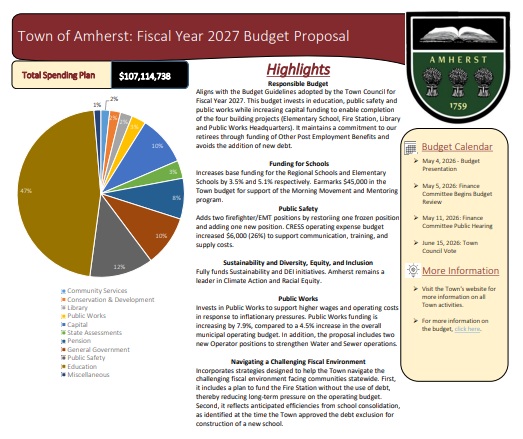
For years, Amherst’s 200-plus-page municipal budget book has often functioned more like a heavy paperweight than a public service. This hefty tome represents the Town Manager’s annual proposal to the Town Council for how to allocate Amherst’s money. In the face of criticism that the document is unwieldy, confusing, missing critical information and largely unread, the Finance Committee has formed an Ad Hoc Budget Document Subcommittee to recommend improvements.
On August 28, the group, composed of Finance Director Sean Mangano and Finance Committee members Kathy Schoen, Jill Brevik, and Cathleen Mitchell (Chair), met to discuss potential changes.
The subcommittee traces its existence to Amherst’s Charter Review Committee, which spent 2025 examining the town’s governing document and, along the way, fielded complaints about budget transparency. In its recommendations on financial policy, the charter panel pushed for a budget process that gives “the public sufficient notice and opportunity to review and have input” — and Finance Committee members said residents and councilors alike had told them the budget book itself was part of the problem. The Finance Committee formed the ad hoc subcommittee this summer to translate that feedback into concrete edits, with Mangano and Town Manager Paul Bockelman weighing in on what’s realistic for the town’s Finance Department to change in a future budget cycle.
Eight Ideas
Mangano, working from a list of suggestions Schoen had sent him after the subcommittee’s first meeting in July, walked the group through eight potential changes,
- Relocate critical data — move key summary tables (total revenues, spending by department, staffing, reserves) closer to the front of the book.
- Condense the executive summary — Schoen noted the town manager’s budget message currently runs about 17 pages before readers reach a spending summary on page 31; Mangano agreed it needs trimming, with some material possibly pushed to an appendix.
- Expand the grant section — currently, in Mangano’s words, “a little bit clunky” and hard to search, without a clear link between grants and the departments that receive them.
- Add detailed line-item information on operating expenses — breaking spending into standardized categories such as utilities, dues and subscriptions, and travel, replacing a narrative format Mangano called “clunky” and easy to misread.
- Add a consolidated spending table per department, showing general-fund, capital, and grant spending in one place — a feature Mangano said: “schools do.”
- Highlight key challenges and connect them more directly to budget decisions, department by department.
- Add a staffing trends report, similar to what Amherst’s schools already produce, broken out by position and funding source.
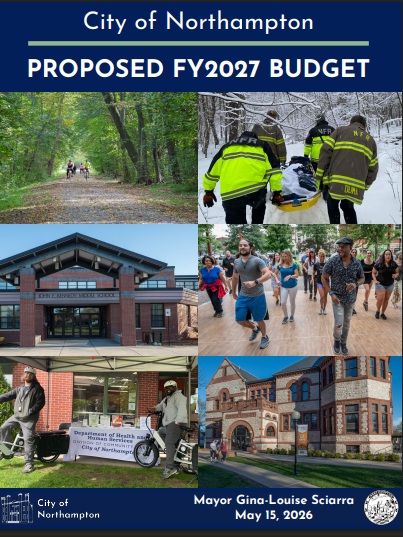
- Add a condensed revenue-and-expense report with more line-item detail, modeled on a report Northampton uses — which Mangano said could replace an existing chart he called “clunky.”
Mangano said most of the changes are achievable for this budget cycle, though the more labor-intensive line-item breakdown (#4) and staffing-trends report (#7) “may come in this year; it may come in next year.”
Schoen acknowledged a tradeoff. “I know where to look for things … but that’s not everybody. [The Council] should not have to have that background knowledge,” she said.
An Added Issue: Pension and Health Insurance Costs
The most pointed exchange of the meeting concerned whether the budget book should show pension and health insurance costs broken out by department, alongside salaries.
Schoen pushed for it, wanting a way to show that departments like the Police Department and the town’s civilian responder department CRESS cost more than their line-item salary totals suggest once benefits are included.
Brevik was more cautious. She asked Mangano whether allocating benefit costs evenly across departments by salary “runs the risk of being more misleading” than helpful, since the town’s accounting system doesn’t actually track health insurance or pension costs at the department level. It tracks them in lump-sum pools by plan type. She added, “If you’re not tracking it by department, … it runs the risk of being inaccurate,” and questioned whether residents would easily understand a figure built on an allocation rather than real department-level accounting.
Mangano agreed that any department-by-department benefits figure would be an allocation, not a real accounting of who has what kind of coverage: “It wouldn’t actually reflect — do the people actually have health insurance in that account, or is it just an allocation,” he said. He also relayed Schoen’s side of the argument. “Cathy wants to be able to say the police department doesn’t cost $5 million, it costs $7.5 million,” he said, “and CRESS doesn’t cost $800,000, it costs $900,000” — once benefits are counted. “I get wanting to understand the true total cost of a department,” he said, “but … we don’t budget by department” when it comes to health plans and pensions.
The group’s likely fallback is not a department-level breakdown but a single figure in the executive summary showing benefits as a share of total salaries townwide — data the town already tracks for its financial indicator charts. That figure has moved sharply in one direction over the past decade:
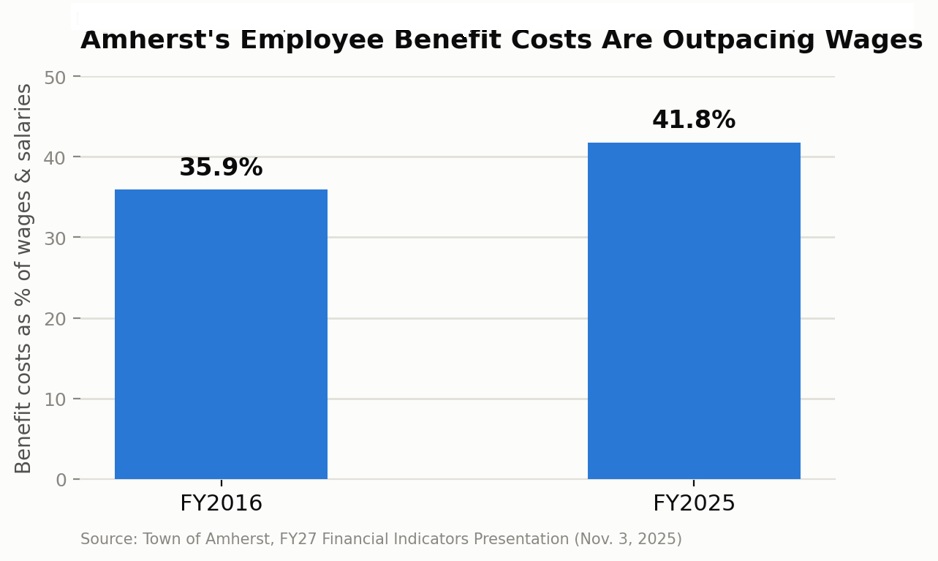
As Schoen put it, rising health-insurance costs have “been eating up almost half of our three-and-a-half-percent revenue growth.” She maintained this can be easy to miss when the public sees increasing revenues.
Town Manager’s Summary Draws Discussion
The subcommittee wrestled with trimming the budget’s executive summary. Schoen argued for moving much of the town manager’s budget narrative — including the record of Town Council goals and budget guidelines that shape each year’s spending decisions — into an appendix rather than cutting it outright. She reasoned that residents sometimes blame the town manager personally for spending decisions that were actually directed by the council. “There have been key points where the council has said what we want the manager to achieve,” she pointed out, arguing that record needs to stay somewhere in the document.” However, she suggested, “it bulks it up so much” if left in the executive summary.
Mangano agreed the material should move rather than disappear and noted that Town Manager Paul Bockelman had separately urged the group not to stray from budget-format standards set by the Government Finance Officers Association and the Massachusetts Association of School Business Officials, even while trimming length. “We still want the document to kind of conform to GFOA best practices, Mangano said, describing the standard four-part structure — executive summary, organizational section, financial section, and informational appendix.
Untangling Grants – and the CRESS/Police Distinction
Schoen also flagged confusion in the current grant section, which she said isn’t reliably searchable within the PDF. She cited two examples of Amherst departments whose staff counts don’t tell the whole funding story: the Police Department has two positions funded by an outside contract the town doesn’t pay for directly, while CRESS has employed staff funded through grants — a “precarious” funding source, she noted, since it can end. “The police have a contract with an outside agency,” she said. “I know it feels like they’re two people that work for us, but they don’t work for us — they work for the agency. CRESS has somebody that we hired that actually works for us, and they’re funded by a grant. It’s just — they’re really different.”
The group also debated how to classify Community Preservation Act funding, which currently gets lumped in with grants in places. Mangano and the councilors agreed CPA money, which is a locally raised surcharge, not outside aid, probably belongs under a “special revenue” heading rather than “grants,” since calling it a grant “gives people … the wrong idea about what it is,” as Mitchell put it.
Next Steps
No members of the public were present at the Zoom subcommittee meeting, leaving limited opportunities for residents to offer input on how to improve the budget book.
Mangano said he plans to circulate a draft report by Sept. 8, in time for Mitchell to write up the subcommittee’s recommendations for the full Finance Committee at its Sept. 15 meeting. From there, the committee is expected to present the report to the Town Council for approval at its Sept. 28 meeting.