
Amherst faces $1M Budget Shortfall Year After Year, Council Learns
Source: GPT-4o
Amherst’s budget gap is not a one-year problem, and town officials said Monday night that it will not be solved with a one-year fix. At a Town Council meeting on October 5, Finance Director Sean Mangano told elected officials that town spending is growing faster than revenue by about $1 million every year, and staff offered a menu of strategies to close the gap, from speeding up zoning to a Proposition 2½ override.
With the School Committee, Library Board of Trustees and Finance Committee also in attendance, Mangano gave a Long Term Financial Presentation that he described as “a conversation starter.”
A Structural Problem
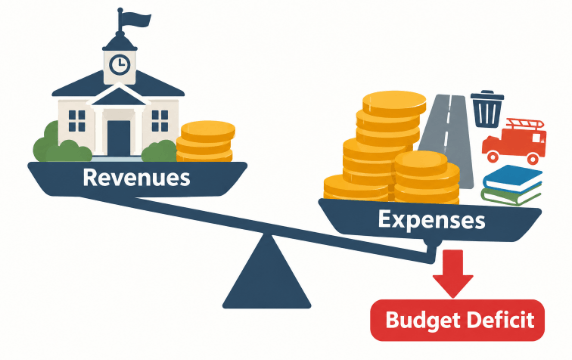
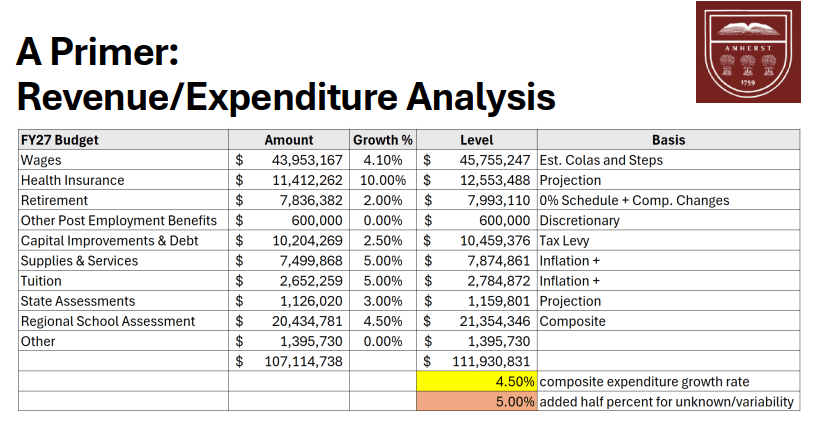
Mangano described the unsustainable situation in which town revenues are historically growing at a rate of 3% to 4% while departmental expenses are increasing by 4% to 5% per year. Because Amherst’s overall annual municipal spending plan stands at approximately $100 million, that 1% divergence translates directly into an annual deficit of $1 million.
Money difficulties in recent years “have caused a lot of tension and some challenging budget reductions,” the Finance Director said.
Pain Points
The presentation outlined a series of red flags and cost drivers that threaten to exacerbate the town’s financial strain.
Sluggish New Property Tax Growth. Revenue from new construction, which has historically provided vital budget expansion, hit a wall in FY26, missing targets. Projections for FY27 and FY28 show depressed levels continuing. Mangano pointed out that delays and cancellations of major development proposals, such as the Olympia Drive fire and permitting snags, have contributed to a visible revenue gap.
Inflationary Pressures. Health insurance premiums are climbing at about 11% annually. Electricity rates are expected to jump 10% to 20% upon contract renewal, while fuel and paving costs remain elevated.
Capital Debt and Interest Rates. With interest rates persisting above 4%, debt service for Amherst’s four major capital projects (Amethyst Brook Elementary School, a new DPW facility, a new Fire Station, and the Jones Library expansion) consumes an increasing share of capital allocations, putting direct pressure on the operating budget.
Charter School Tuition. Net charter school assessments pulled from the town and regional school budgets have quadrupled over the last 15 years, rising from $910,000 (108 students) in FY11 to $3.4 million (174 students) in FY26.
Leadership Conflicts. Mangano identified as warning signs the surfacing of conflicts among elected leaders and “disintegration of normal budget dialogue and compromise.”
Raising Revenue: Zoning, PILOT and a Possible Override
Mangano and Planning and Economic Development Director Jeff Bagg offered some suggestions for increasing revenue.
Development. Bagg urged the Council to finish zoning work already underway for Hampshire College, the downtown and East Amherst, and to advocate for projects. Zoning change is a slow and sometimes contentious process. Bagg noted that University Drive development zoning talks began around 2023-24 and tax revenue is not expected until FY27-28.
Tax Incentives. Bagg said the town may need to consider tax concessions to developers known as Tax Increment Financing (TIF) and District Improvement Financing (DIF). TIFs are a direct tax reduction offered as encouragement to a project developer, while DIFs represent improvement of the surrounding area by the town. Bagg promised a town economic development plan within 9 to 12 months.
Elementary regionalization: A regional Amherst-Pelham elementary district would bring in $300,000 or more a year in state transportation reimbursement, shared between the two towns. School Committee member Deb Leonard noted that regionalization usually saves money only when a school closes. Mangano replied that Amherst and Pelham already share a central office and union contracts but still keep two accounting systems and file two year-end reports.
State PILOT reform: Amherst receives about $334,000 a year as Payment In Lieu of Taxes for Massachusetts-owned land, placing it near the bottom of the state list. Edgartown on Martha’s Vineyard, with about 2,800 acres and 5,300 residents, receives about $2.8 million. The state values Amherst land at about $17,000 an acre, compared with about $93,000 in Edgartown. Mangano suggested the town may need to fund legal support, perhaps with a consortium of college towns. He added that changing the formula without raising the overall state appropriation could upset towns that experience a reduction.
Proposition 2½ override: Mangano reported that since 2022, 127 communities have considered a tax override and 90 passed. Amherst last approved an operating override in 2010. Amherst’s average single-family tax bill ranks 68th in the state, down from 51st in 2011. However, he neglected to point out that Amherst passed a $98 million debt exclusion override in 2023 for the recently completed Amethyst Brook School. Amherst’s Average Tax Bill as a Percent of Income is currently the highest in the state (45.4%).
Belt-tightening Suggestions
On the expense side, staff focused on costs the town can influence.
Sharing services. Look for services that could be regionalized, such as the town’s dispatch center for smaller neighbors.
Collective bargaining. Work with union leaders on a shared understanding of the town’s finances. Wages are the largest cost.
Benefits review. Plan for the pension system to be fully funded in the mid-2030s, which should lower the assessment, and decide how to use the savings. Review optional retiree benefits for future retirees only; Mangano said nothing proposed would change benefits for current retirees.
Buildings and programs. Consider consolidating or disposing of unused property and re-examine whether the town still wants to provide every program. Mangano noted that school buildings have already dropped from four to two as enrollment fell.
Silence on the Jones Library Project
A significant number of Amherst residents have expressed anger that in 2025 town leaders committed to a costly and arguably unnecessarily large renovation-expansion of the Jones Library. The total project cost has grown to $57 million including debt service, has seen slow payment of promised reimbursements from the library trustees, and threatens to wipe out the library endowment with no detailed recovery plan announced. Construction completion has slipped by at least two months and is now scheduled for mid-2027. Repayment of loans for the project is projected to cost the town close to $1 million per year for thirty years. Many wonder why current warnings of a dire structural budget deficit were not contemplated before approval of the very expensive project.
Up Next
The Town Council’s next meeting, in two weeks, will include the annual tax classification hearing. Council President Mandi Jo Hanneke said fall appropriation orders and other finance items are waiting on the state’s certification of free cash. On November 2, the Council is expected to hear the annual Financial Indicators Report and FY28 budget projections and possibly continue Monday’s discussion of the long-term outlook.