Redistro: A Community Space and Free Store Where Folks Give What They Can and Take What They Need
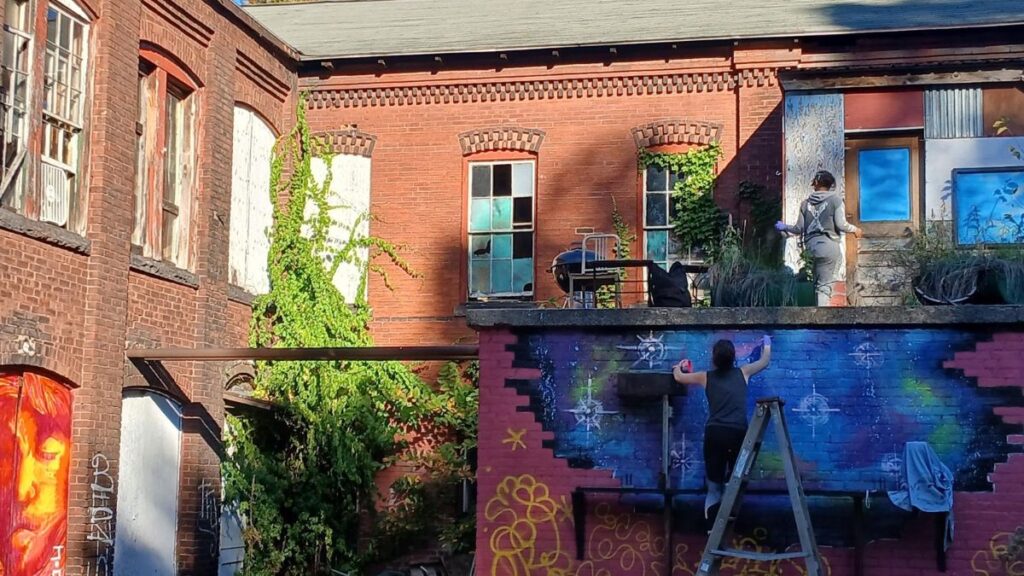
Redistro free store, Greenfield. Photo: redistro.org
by Lucy Wiklund and Lila Furlow
Becoming Human and A Better World Is Possible
We resume our series “Becoming Human”, in partnership with our series “A Better World is Possible”at a time when global fascism is ascendant, and as we feel the impacts of burgeoning authoritarianism and pervasive inequality in our daily lives. As we struggle to fend off these malevolent trends, it helps to remember they aren’t inevitable, resistance isn’t futile, that we can build something better, and that inspiring alternatives surround us. The profiles presented in this series illustrate some of these alternatives, showing that a better world is indeed possible. Over ten weeks, we’ll run a weekly profile of a hopeful endeavor that offers a counter-example to current trends. Members of the Building Solidarity Economies Assemblage (BSE) at UMass Amherst author these profiles. Read previous articles in the series here.
Redistro is a mutual aid collective in Greenfield focused on building community locally by redistributing our shared abundance. Redistro envisions a solidarity economy based on mutual aid and cooperation, and a circular economy based on regeneration and environmental justice. Redistro works to facilitate the circulation of goods locally in the Connecticut River Valley, turning excess materials into an opportunity for community redistribution, abundance, and creativity. The collective’s aims are:
- to operate a goods exchange co-op and community space that is self-serve with monthly public open hours and pop-up events located in Greenfield
- to be a community third space for socializing, coworking, and skill-sharing.
- to promote personal and social wellbeing by educating the public on the meaning and benefits of sociocracy and mutual-aid.
- to facilitate waste-reduction, goods-exchange, and decluttering in our communities in Greenfield, Franklin County and the Connecticut River Valley.
Redistro founders, Sara Brown and Nina Levison, are long-time friends who connected through their love of reducing waste.
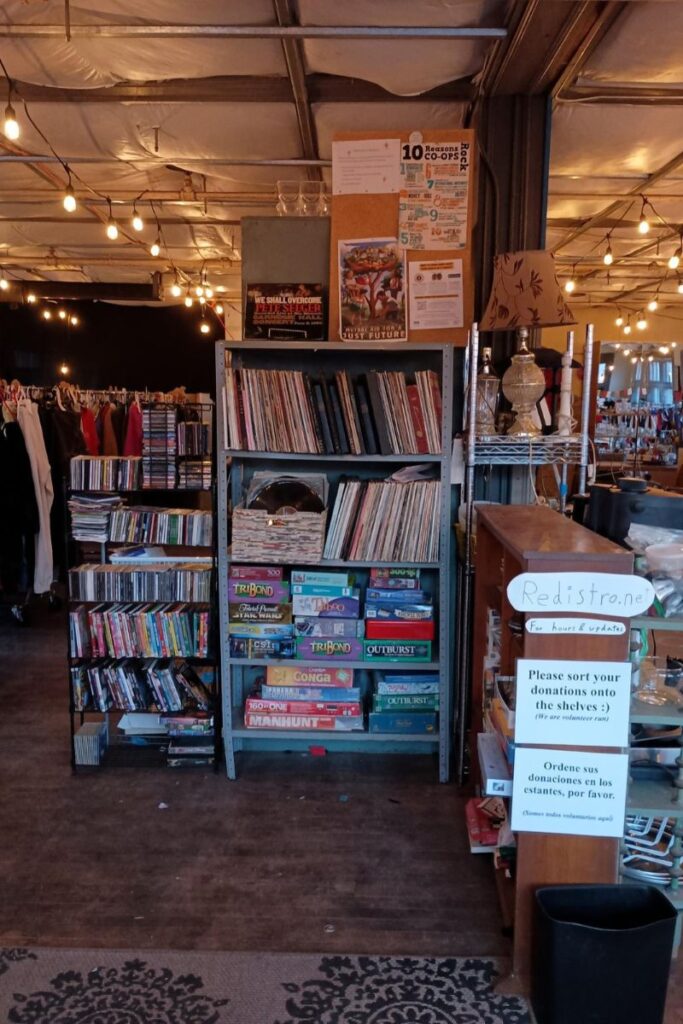
The idea for their project began when they tried to salvage end-of-the-year school refuse with a tag sale. They wanted to keep everything they were accumulating in one place instead of constantly moving things around. Sara decided to put down the first month’s rent on a studio space in Greenfield. After opening, there was a small event where friends came, and people brought things; and soon, there were racks of clothing and household items, both practical and ornate.
Today, Redistro’s new location at 15 Arch St. in Greenfield allows it to function as a free store, but it is more than a regular store with a different kind of price tag. It is a collectively managed spot that redistributes goods locally, provides a space for community, reduces waste, and acts as a hub for mutual aid. People come to Redistro to give what they can and take what they need, and just hang out. Nina dreams of Redistro as “a vibrant library, shopping mall, and living room.” Redistro additionally hosts workshops, free meals, and does pop-ups at other locations, such as Stone Soup and Touch the Sky.
An extension of Redistro is the PV Curb chat, a Signal group and retired Instagram profile started to save usable goods that are unable to be collected and brought to the Redistro site. It functions similarly to Buy Nothing groups, but people also promote other events like food distributions. Nina explained, “Is there free stuff in the county? You can post it here.”
Nina is grateful that the Valley’s growing culture around mutual aid has helped their store. “The only reason it’s possible [is] because somebody was able to be, like, ‘oh, a free store. I get that conceptually, and I think it makes sense, because I live in a place where this kind of thought is being generated…It is a culture where people can just be generous.”
Redistro builds on this culture of solidarity by creating opportunities for people to share resources and build connections. Nina says, “I’m just really able to be more loose and trusting that we have what we need collectively.” Having a free store in the community encourages interdependence while reducing feelings of scarcity and isolation.
Nina says being involved in Redistro “brings you face to face with the mortality of material goods and this excessive producing environment. It makes you think about waste and what we can do about it in a creative way.” Moving forward, Sara and Nina hope Redistro becomes a staple in the Valley and an example for more free stores to pop up everywhere.
Read Redistro’s FAQ here.
If you want to get involved with Redistro, visit the store at 15 Arch St, Greenfield MA (entrance on the Wells St. extension of Grove St.) during open hours on Sundays 11 a.m.-2 p.m. and Mondays 5 p.m.-8 p.m. Redistro hibernates over the winter, with their last regular open hours on December 22. During the winter, they are open the first Sunday of the month, 11 a.m.-2 p.m. and will resume regular hours the first week of April. On the first Sunday of every month, Redistro hosts a community potluck during Sunday hours.
Lucy Wiklund and Lila Furlow are members of the Building Solidary Economies Assemblage (BSE) at UMass Amherst
Each edition of Becoming Human features an article, reflection, interview, poem or other types of expression that engage with a creative community or municipal effort. These will include original features that discuss a local initiative and also stories about efforts in other parts of the world that we might learn from. The growing narratives, relations, and power from which other worlds are being assembled, maybe, can help reorient our hope and desire—and resignation—away from the death drive of white supremacist, heteronormative, capitalist modernity, and towards an open, uncharted horizon of radical egalitarianism and towards the reality that other worlds are in the making or already here. For the full introduction to Becoming Human that appeared in its inaugural column, look here. For a listing of previous columns, look here.
Acknowledgments: This column is in dialogue and solidarity with numerous collaborators and comrades including Vin Lyon-Callo, Meredith Degyansky, Penn Loh, Stephen Healy, students in Anthropology 340 – Other Economies are Possible, Anthropology 341 Building Solidarity Economies, Anthropology 597CC Community, Commons, Communism, and the pluriverse of world-making and world-defending efforts, movements, and projects in Massachusetts and around the world.
A Better World Is Possible” is an occasional Indy feature that offers snapshots of creative undertakings, community experiments, innovative municipal projects, and excursions of the imagination that suggest possible interventions for the sundry challenges we face in our communities and as a species. Have you seen creative approaches to community problems, or examples of what other communities do to make life better for their residents, that you think we should be talking about? Send your observations/suggestions to amherstindy@gmail.com. See previous posts here.