
ARHS Duo Engineered and Patented an Award-Winning Mosquito Elimination System
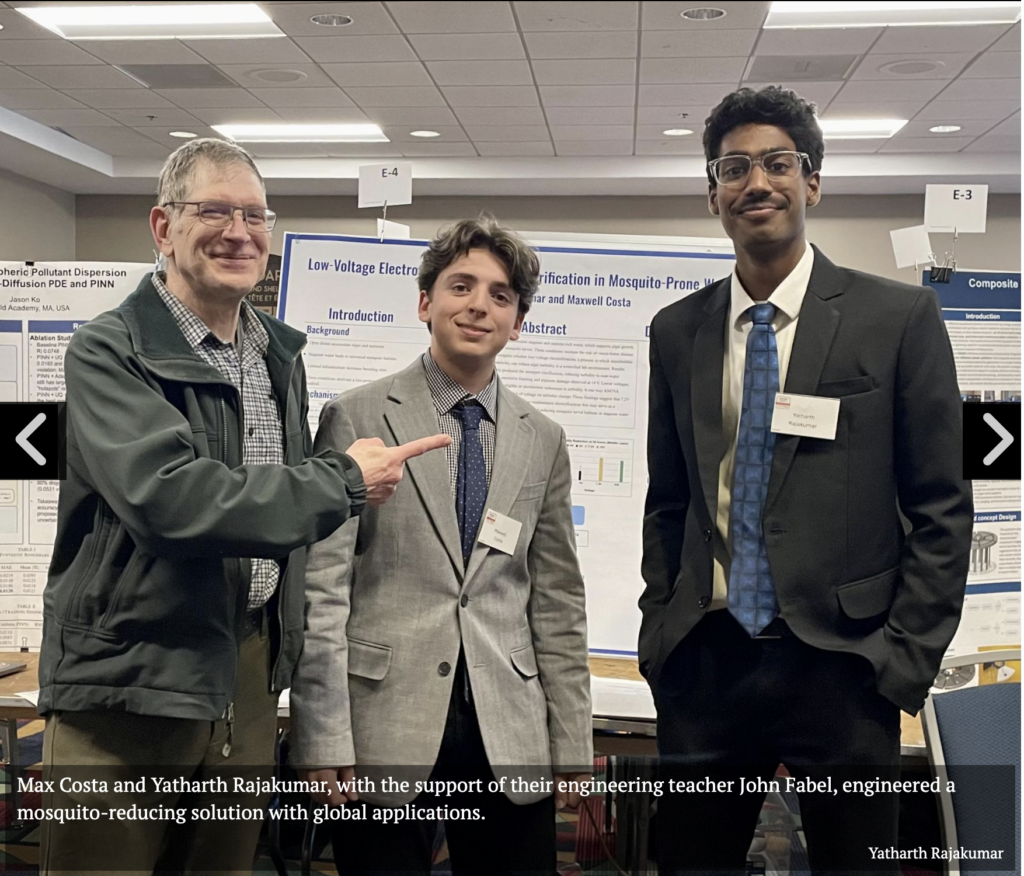
Photo: c/o The Graphic
by Ava Beganny
The following article originally appeared in The Graphic on Nov. 16, 2026, and is reposted here with permission.
According to the Centers for Disease Control and Prevention (CDC), “The mosquito is the world’s deadliest animal. Spreading diseases like dengue, West Nile, Zika, chikungunya, malaria, and lymphatic filariasis, the mosquito kills more people than any other creature in the world.” Malaria, the most common mosquito-borne disease, “continues to be a leading cause of preventable illness and death in the world, resulting in nearly 282 million cases and 610,000 deaths across 80 countries in 2023.”
Amherst Regional High School (ARHS) seniors Maxwell Costa and Yatharth Rajakumar recognize the deadly nature of the mosquito and have since been trying, using science and engineering, to create a solution to reduce the number of mosquitoes, possibly for use worldwide. “[It] started with general frustration with mosquitoes,” said Rajakumar.
This idea ended with the pair developing a prototype using electrolysis for the Mosquito and Organism Purification Project (MOPP), patented for use around the globe.
They shared their solution at the Western Massachusetts Science & Engineering Fair (WMSEF) and were awarded second place in that competition, then qualified for the Massachusetts Science & Engineering Fair (MSEF) and won third place in their category (environmental engineering) after presenting to a panel of judges for roughly five hours. They also won the National Oceanic and Atmospheric Administration’s (NOAA’s) “Taking the Pulse of the Planet” award.
Their idea began after Rajakumar got home from a trip to see family in India in the summer of 2024. Rajakumar noticed the large mosquito problem in India and realized that it may have something to do with stagnant water in storm drains. Stagnant water can be a great host for algae, which is a significant food source of mosquito larvae.
When Rajakumar arrived home, he contacted Costa to ask if he would be interested in undergoing a project to reduce mosquito larvae in stagnant waters. Costa agreed, and they talked about the details throughout the 2024-2025 school year. They started their preliminary research in August of 2025.
They didn’t have a lot of advice going into the project, nor were there many directly related studies or resources online. “There was [no one doing] exactly what we were doing,” said Costa. “So, we were kind of blind, and we only had a rough idea of how everything worked.”
Costa said they were aiming for affordable, accessible reduction tactics. “We [wanted] to find something to do about [mosquitoes] that isn’t like any of the current solutions. [The current solutions] are not widely applicable, because they need mass infrastructure or reapplication or are costly,” he said.
At the start of the 2025–2026 school year, Rajakumar had the opportunity to schedule one of his school periods as an Alternative Learning Program (ALP), which gave him extra time for research. The two seniors also started working with ARHS engineering teacher John Fabel to set out their plan for the project.
Fabel also helped the two source funding for the project. University of Massachusetts (UMass) Extension Professor Dr. Christine Hatch granted the seniors the funds through UMass and also gave them some research guidance.
“She had a lot of beneficial guidance, and then she also helped us contact UMass to receive initial funding, which, of course, was very crucial,” said Costa. “We would not have been able to buy our algal cultures, any of our growing equipment, or some of our measuring equipment. And our actual prototypes we bought with that funding money.”
With that money and help from the ARHS science and engineering departments, they were able to start experimenting. They spent three months learning how to grow algae effectively. They used the old Transportation Lab room to host their algae. In the recent past, before their experiment, the room was just used for storage.
They both noted that growing the algae was an incredibly tedious process and one of the biggest challenges of the whole project. But they pushed through, often having to just look information up for advice. “Here’s an obstacle, how do we figure it out? Google it,” said Rajakumar.
From their research and Rajakumar’s trip to India, they thought that it would be best to focus on eliminating mosquito larvae directly. “It’s the most logical [solution] in theory,” said Costa. “[It’s the] easiest way to do it because the larvae themselves are pretty immobile and stay in their relative same water bodies that we [would be] targeting.”
So, they studied how electrolysis—the process of splitting water into hydrogen and oxygen gas, which creates small gas bubbles in water—affected algae. They found that the bubbles would float up and latch onto the surface algae particles, causing them to group and aggregate. Then, due to the aggregated algae’s weight, the algae would sink down to the bottom of a stagnant body of water. For this system to work effectively, the electrical current only needs to run for a short period, with initial trials at five minutes every two hours.
This allegedly helps to fend off mosquito larvae since they reside at the surface of stagnant water and the algae serves as a major food source. “You have a surface in a stagnant water body that is clear and has minimal nutrients available for mosquito larvae to eat and thrive off of,” said Rajakumar.
Once they had somewhat of a theory and a prototype, they wanted to take their project to the next level. Rajakumar decided that they should look into local science fairs, starting with WMSEF.
Costa agreed that this would be a great idea. “If we can do this, it might be helpful because [we] might get a little bit of publicity, but we also might get guidance from people that are there because there are a lot of experts,” said Costa. “And we might have the chance of getting [some] resources for the project because there’s prize money. We thought that it might be worthwhile, but also it’s just interesting.”
In their second semester of junior year, they were both enrolled in Fabel’s Engineering for Social Good course, which allowed them to have over an hour every school day to continue their project. In this time, they were able to solidify their theory and start writing a research paper.
Before the summer of 2026, they also secured a paid internship to continue their research through UMass. They mentioned having the opportunity to work with the Town of Amherst’s Department of Public Works and experiment on real pond samples in Amherst, specifically from Gull Pond.
It definitely brought some challenges as the species of algae in Gull Pond (Spirogyra) differed from the species that they originally experimented on (Chlorella Vulgaris), but this only brought more motivation to make their machine be able to adapt.
Going into the 2026-2027 school year, Costa is currently enrolled in an ALPs to continue their research. However, research has been put on the back burner as college applications are in full swing.
In the future, they are looking to make their machine adaptable to real-time data so that it can be applied in scenarios across the world. “We want it to be open source,” said Rajakumar. “We filed the provisional patent to make sure that anyone around the world can look at our documentation and rebuild it on their own.”
They also plan to continue their work with Amherst to make sure their machine goes through many real-world adjacent tests before being deployed.
In addition to their thorough scientific process, they plan to keep the whole system humane as well. The goal isn’t to kill any algae, as other organisms also use it for nutrients. “Luckily, it would appear that by not killing the algae, the microenvironments stay pretty stable because all the algae does is settle to a slightly lower depth and then eventually down to the bottom pond,” said Costa.
And it wouldn’t be deployed in areas with extreme biodiversity. “This system shouldn’t bother any other creatures because it will be deployed in places where mosquito larvae are the main issue,” said Rajakumar.
As for the electricity, the voltage and current wouldn’t be strong enough to inflict any sort of electric shock, as the goal isn’t to electrocute the larvae; it’s to remove their food source. “[Someone] could put [their] hand directly between the electrodes, and [they] would be fine,” said Costa.
Reflecting on all of their work, from their original ideas to their patent-filed prototype, the two said their love of engineering has grown.
“Something really special about this project to me is how full scope it is; it has allowed me to use what engineering knowledge and skills I have acquired from traditional classroom learning to solve a real-world scientific problem that I had the privilege of choosing and researching,” said Costa.
“Even though [we’ve] barely started in terms of applying it, I’ve started to see how I can utilize engineering to at least try to change the world for the better.