
Following Angst-filled Discussion, School Committee Accepts Sixth-Grade Move to Middle School for Fall 2026
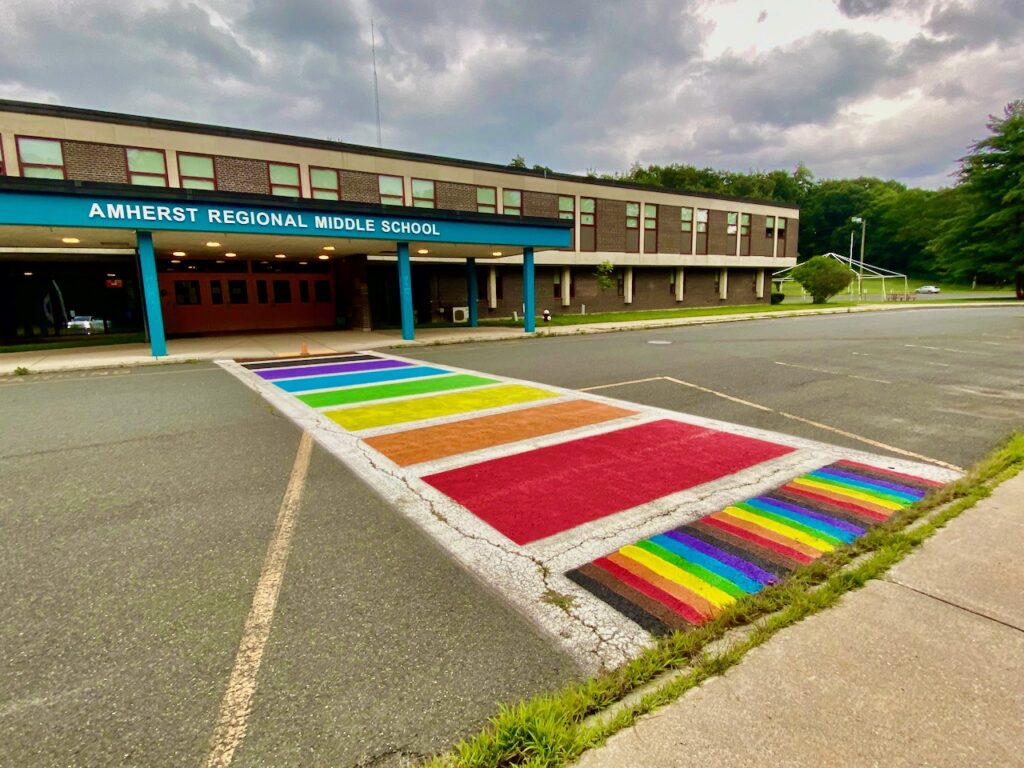
The rainbow crosswalk at Amherst Regional Middle School. Photo: Art Keene
Report on the Meeting of the Amherst School Committee, January 20, 2026
This meeting was held in the library of Amherst Regional High School, was simulcast on Amherst Media Channel 15, and was recorded.
Present
Amherst School Committee: Deb Leonard (Chair), Andrew Hart, Laura Jane Hunter, Bridget Hynes, and Sarah Marshall
Staff (all participating remotely): E. Xiomara Herman (Dr. Xi, Superintendent), Shannon Bernacchia (Finance Director), Dwayne Chamble (School Support and Engagement Liaison), Megan Dushko (Assistant to the Superintendent), Michael Gallo O’Connell (Director of Operations), Allison Estes (Principal, Wildwood Elementary School), Marta Guevara (Director of Student and Family Engagement), Tonya McIntyre (Director of Curriculum, Equity and Instructional Leadership), Derek Shea (Principal, Crocker Farm Elementary School), Tammy Sullivan-Daily (Principal, Fort River Elementary School)
No members of the public were present.
Should the Town Proceed With Implementation of the Planned Sixth-Grade Move to the Middle School?
The discussion of whether to move all Amherst sixth graders to an independent, stand-alone academy at Amherst Regional Middle School (ARMS) concluded at the Amherst School Committee meeting on January 20, when, after nearly four hours of discussion, the committee finally accepted the move. On the agenda for the evening was an argument to retain the status quo and distribute the 89 sixth graders expected for next fall across the town’s two elementary schools (Crocker Farm Elementary and the new Amethyst Brook Elementary). The argument was authored by committee member Bridget Hynes.
As the discussion came to a conclusion, none of the committee members was willing to offer a motion to embrace the status quo, and instead the committee voted unanimously to support a motion from committee member Laura Jane Hunter to move forward with the plan to establish the sixth-grade academy (to be named the Chestnut Street Academy) at ARMS.
The discussion of whether to embrace moving all sixth graders to the middle school spanned at least the last three Amherst School Committee meetings (see e.g. here, here, and here), in which Hynes and now-Chair Deb Leonard raised doubts about the wisdom of the planned move and asked for consideration of possibilities to remain a K-6 district and avoid the move, especially with a projected $2 million budget deficit for the coming year. At each of these meetings, School Superintendent E. Xiomara Herman (Dr. Xi), other administrators, elementary school principals, and the new building’s architect explained that there was not sufficient room in the two remaining elementary schools to accommodate the 89 sixth graders expected this fall and that the town was too far into the execution of the planned move to change at this late date.
Dr. Xi said that when she arrived in Amherst in 2024, she thought, “You are a K-6 district, but you’re building a K-5 school? That is crazy.” But that is the plan she was given and has had to work with.
At this meeting, Hynes and Leonard argued that with only a small increase in class sizes, the 89 sixth graders could be accommodated at Crocker Farm and Amethyst Brook, though some renovations would be needed at Crocker.
Following a deeper exploration of the history of the proposed sixth-grade academy, Hynes offered a rationale for retaining K-6 and abandoning the plan to move the sixth graders. She stressed that she was not necessarily asking the committee to adopt the alternative plan but was seeking an airing of the concerns and questions that she felt had not been considered in the current plan’s adoption.
Similarly, Committee Chair Deb Leonard prefaced the discussion saying that “we need to understand the history and context of the decisions made by previous school committees in order to best move forward. The process that brought us here is fragmented. The documentation is minimal. This discussion is not about blame and criticism, it’s about getting clarity.” Leonard expressed appreciation to Dr. Xi for having this conversation. “There is just too much that needs to be clarified and this conversation will move us toward the necessary clarification. And it’s important and healthy to raise these questions in a time of limited resources,” she said, adding that she wanted to assure Dr. Xi and the administration that the intent was “not to blindside them but to make sure that we all understand what’s in front of us.”
School Committee member Sarah Marshall strongly objected to revisiting the issue, arguing that it was not the best use of the committee’s time. “We have to submit a budget to the Town Manager by April 1 and hold a public forum and we only have two meetings between now and then. How can we possibly make a change in the sixth-grade plan and meet our budget demands in the time we have?” she asked. She added, “ I am distressed that this issue keeps coming forward—especially in some cases out of concerns of caregivers that were raised five years ago, before we had a plan. I am distressed by the lack of confidence that my fellow committee members are showing in the professional judgment of our superintendent, our principals, and even our architect. It seems that the committee members are also expressing fear. I think it would be a grave mistake to vote to change our plan at this time.”
The subsequent discussion covered little new ground, instead rehashing the arguments and counterarguments that had arisen at each of the previous meetings. While at the end of the evening, those opposing the sixth-grade academy chose not to adopt the alternative plan (i.e., the status quo), they indicated that the discussion had helped them feel better about the move and deemed the conversation valuable.
A Bit of History
The idea of moving the sixth graders had been broached prior to 2020 and was formally discussed at a school committee meeting in February of 2020. By 2022, then-Superintendent Mike Morris had developed a plan to create a K-5 system in Amherst (allowing Amherst to reduce the size of its new elementary school building that would consolidate the students from Fort River and Wildwood Elementary Schools). That plan would have integrated Amherst’s sixth graders into the Middle School to create a grades 6-8 Middle School, a prevalent model across the United States. However, the Morris administration did not explore whether such an arrangement could be legally implemented within our regional agreement. The district was informed by the Massachusetts Department of Elementary and Secondary Education (DESE) that Amherst’s sixth graders could not be integrated into ARMS without all four towns in the region embracing the same arrangement, only after the new building plans were adopted. The other three towns in the region have emphatically rejected that possibility. Amherst subsequently devised a plan to create a standalone sixth-grade academy within the ARMS building, with its own space and staff, separate from ARMS. The academy was originally slated to open in 2024 and that opening was postponed to 2025 and then to 2026.
Concerns About the Proposed Move
At the heart of the matter was Hynes’ question of whether sixth graders would not be better served by being distributed across the district’s two elementary schools.
Hynes cited problems with the proposed move of the sixth graders, emphasizing concerns about them being isolated in the ARMS building and losing the community that comes with being part of a larger school. She was also concerned about the impacts of opening two new schools in the same year on the already austere budget. Additionally, she felt that insufficient community input had been gathered from caregivers, and that there were persisting, unexpressed or unaddressed fears about the move on the part of students and caregivers.
Hynes developed a detailed rationale for keeping the sixth graders in the elementary schools and offered 10 reasons to support that alternative to the planned move. Read her full memo here and view her slideshow presentation to the committee here. Her reasons to support the status quo follow.
1. Regional structure is still a barrier–there is little prospect for creating an integrated 6-8 middle school under the regional agreement.
2. ARMS facilities are not ideal. The building is not owned by the elementary district and faces substantial maintenance challenges. The move will require an estimated $450,000 in facility upgrades. Concerns about shared hallways, bathrooms, and buses are yet to be resolved.
3. Staff feedback shows significant hesitation to embrace the plan.
4. The community has raised concerns about the future of the Caminantes dual language program in the academy, the delivery of special education services, and shared buses with high school students.
5. Administration concerns–opening two new schools in the same year in a three-school district is an administrative challenge that past administrators have warned about.
6. Special education programs will be less well supported in a 6th-grade academy.
7. Caminantes dual language was part of a whole-school model at Fort River and for 6th graders will now be an isolated island.
8. The educational model is untested. Standalone 6th-grade academies are fairly unique and there is no body of research assessing their efficacy.
9. Anticipated K-6 enrollment declines diminish the pressure to adopt a change.
10. Budget conditions remain strained, budget assumptions are unresolved. The planned move would likely increase an already gaping deficit.
Hynes said, “I walked a lot of neighborhoods [during my campaign for school committee], and talked to a lot of people and heard a lot of concern about the plan and the way that it was brought forward. I am afraid that we might be unable to meet our budget challenges while opening two new schools. I understand how much work has gone into this, and with the best intentions for getting the best for our kids. I just wanted a public discussion to get all of the information out there.”
Hynes’ proposal emphasized the ways in which the sixth-grade academy was problematic but was short on details on how the status quo could be maintained within buildings designed to be K-5 schools.
School Administrators Argue that Abandoning the Plan at this Late Date is Impossible
Dr. Xi emphasized, as she has done at each of the previous discussions, that the district is too far along in the restructuring/transition process to change direction and, in any case, there is simply no space for the sixth graders in the town’s elementary schools. She pointed out that this is not simply a matter of finding some more seats and classrooms; that injecting sixth graders back into the schools which are now designed to be K-5 buildings would disrupt programming, scheduling, staffing, and curriculum, and would undo work that has now been years in the making. (Read Dr. Xi’s memo here. Read the administration’s checklist of restructuring tasks here.)
She said, “Any shift at this moment would cause us to pivot drastically. We are now having a two-year conversation in a one-night meeting. And this will impact children and impact families. This cannot be flipped really quickly.”
Several administrators spoke of the chaos that would result from disrupting the planned move at this late date, noting how the new school was designed to be a K-5 building that cannot easily accommodate another grade.
Director of Curriculum, Instruction, and Educational Leadership Tonya McInTyre said, “There is currently a gym and art rotation for K-5 that could not accommodate K-6.”
Wildwood principal Alison Estes pointed out that there are only a sufficient number of specials rooms (e.g. art and music) to cover grades K-5. If another grade were added, some specials would have to be held in classrooms. She also noted that the schedule for the gym and the cafeteria does not have room for adding another grade.
Crocker Farm principal Derek Shea added that there is simply no room in his building to accommodate additional students.
Dr Xi concluded that her intention was to have this conversation to ensure that the school committee has a complete understanding of where we are and how we got here. She concluded by apologizing to the district’s families for the uncertainty this discussion has engendered and stated that the district is ready to implement the new plan and ensure it puts students first. She added that it was an injustice to ask the administration to change direction at this late date and that she did not see another path forward beyond the one the district has taken.
Much of the discussion had focused on fears of school committee members and of caregivers about the planned move. Andrew Hart concluded the discussion by asking Dr. Xi, “What are your biggest fears about the current plan and about moving ahead?”
Dr. XI responded, “My biggest fear right now is this conversation. This is a distraction from addressing what remains to be done. Here’s the biggest concern I have. Every time this conversation comes up, it delays the work that needs to be done, including outreach to families, and raises the possibility that we might have to stop and come up with something entirely different. I can’t focus on where we need to be because of the possibility that the School Committee will impose a directional shift. We haven’t even submitted a budget yet, so I don’t understand where these budget numbers are coming from. My team is so distracted by this that we can’t do the work that we need to do.“ She added, “There are some unheard voices in the room – caregivers of our most marginalized students. I’d like Marta [Guevara] to speak to that.”
Guevara, Director of Student and Family Engagement, then summarized her extensive outreach efforts, especially to Latino families, to explain the planned move and to gather their concerns. She said she answered many questions along the way and found that when people had their questions answered, they were largely supportive of the move.
Read more:
6th Grade Move to ARMS – Amherst Regional Public Schools
Amherst School Committee Considers Proposal to Keep 6th Graders in Elementary Schools (Amherst Indy)