
Steel Rising, Endowment Falling? Jones Library Leaders Wrestle with Uncertain Future
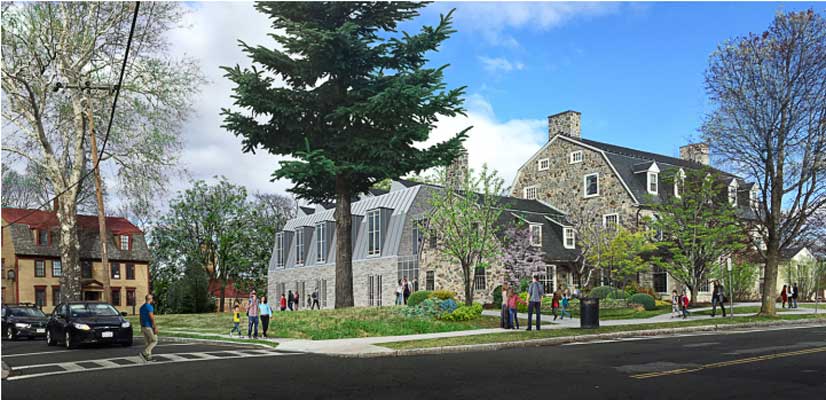
The February 18, 2026, meeting of the Jones Library Board of Trustees presented a study in contrasts: the physical structure of the new library has begun taking shape, yet the financial foundation supporting it remains under intense pressure. While “steel is rising” at the Amity Street site, the board is simultaneously agonizing over an endowment model that warns of a potential “downhill spiral” if aggressive fundraising goals aren’t met.
Construction Milestones and Delays
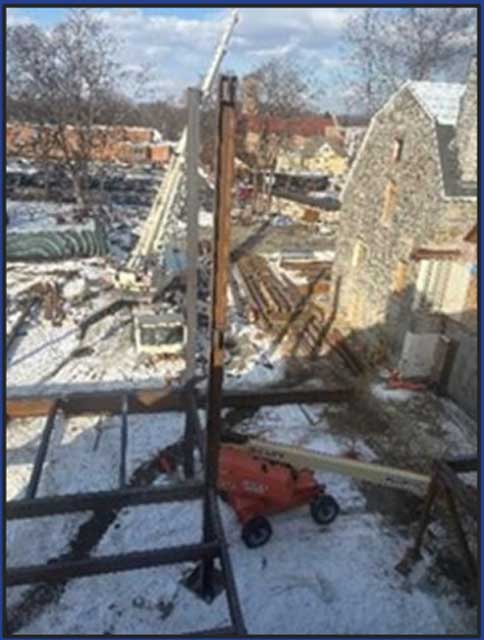
The meeting opened with a report on construction progress. Despite being two to three weeks behind schedule due to issues with steel fabrication, structural steel framing is now visible atop the highest level of the historic building. To celebrate, the library will hold a topping-off ceremony on February 27, where community members can sign a structural beam. President Austin Sarat noted that while the delay is not unusual for a project of this scale, prospects for making up that lost time remain unclear.
The Endowment: A Critical Balancing Act
The most sobering portion of the meeting focused on the library’s $9.24 million endowment. To fund the building project, the trustees are planning to withdraw approximately $5 million from these funds. This amount is up from a planned withdrawal of $4.3 million presented to a Town Council concerned with high costs last April.
Adding to pressure on the expense side is a decision by the trustees to authorize the hiring of a new teen librarian and an additional part-time custodian. The added staffing cost means that a 2.9% draw ($250,000) from the endowment formerly planned in April must be increased to 4.8% ($417,000) in the coming year.
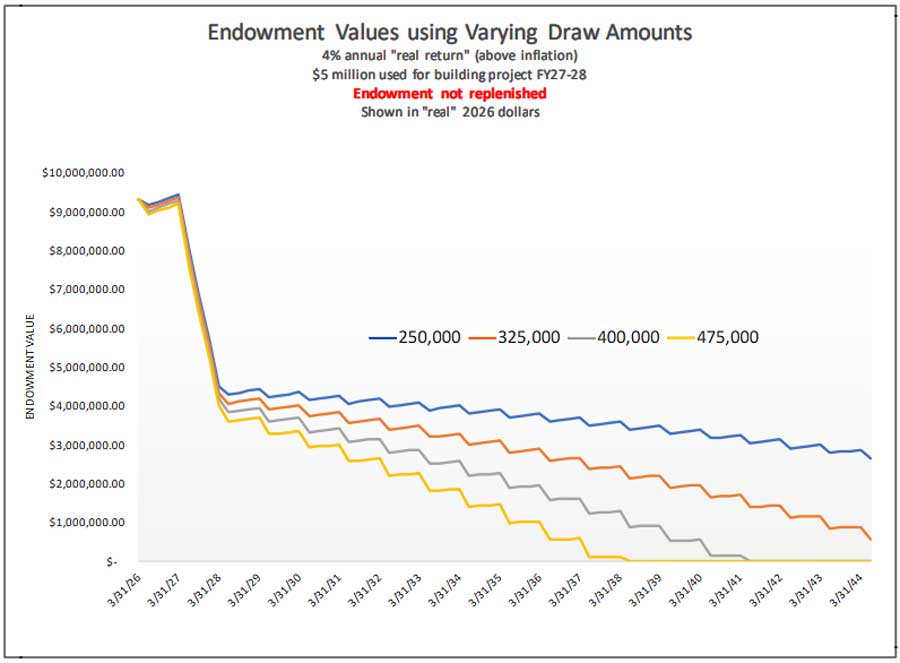
Treasurer Nat Larson presented several endowment models that highlight the high stakes of this decision:
- The Sustainability Threshold: Historically, the library has maintained a 4% draw rate (roughly $350,000 annually), which Library Director Sharon Sharry has described as necessary, and Larson characterized as sustainable.
- The “Downhill Spiral”: If the $5 million taken for the building is not replenished through fundraising, even a modest $250,000 annual draw would cause the endowment to continuously dwindle.
While Sarat argued that a 4.8% draw is “reasonable” compared to other institutions, the model clearly shows that if the library takes out more than $400,000 a year without replacing the $5 million capital hit, the endowment’s long-term health is in serious jeopardy.
Fundraising: The $5 Million Question
The library’s future now hinges almost entirely on the success of the capital campaign. There was a glimmer of hope with the announcement of a new $250,000 pledge from a donor who increased their commitment out of “conviction of the worth of the project”. However, the library still needs to raise millions more to avoid permanently crippling its endowment.
One potential “bridge” Larson proposed was for the Friends of the Jones Library to allocate $45,000 annually from the Woodbury Fund to the operating budget. This contribution from the $326,000 fund would, in theory, lower the effective endowment draw rate.
However, the Friends of the Jones Library are not yet fully on board. Representative Rich Morse was “circumspect” regarding this proposal, emphasizing the “autonomy of the Friends’ decision-making” and stating clearly that the $45,000 allocation is “not a done deal by any means”.
Cost-Saving Measures
In a move to mitigate financial strain, the trustees voted to terminate their investment management arrangement with Mercer and switch to Greenfield Savings Bank. This move is projected to save the library $25,000 annually in fees—reducing the cost from $30,000 to just $5,000—while maintaining the same asset allocation. Larson believes that the loss of service by moving from Mercer to Greenfield Savings Bank will be “very, very little.”
Endowment Model Assumptions are Questionable
Larson admitted to the trustees that his assumption that the endowment portfolio will grow at a year-over-year rate of 4% above inflation may be viewed as “a bit optimistic.” As recently as 2022 the endowment lost 14% in a six-month period, and Vanguard, who was managing the library’s investment portfolio at the time, warned the trustees to temper expectations over the next 10 years.
Larson did not discuss the possibility of unanticipated cost increases such as the steep rise in the cost of health insurance that the town has experienced the past couple years.
The assumption that in June 2027 the trustees will withdraw $5 million from the endowment to pay the Town has been a moving target with little supporting evidence. To date the Capital Campaign has reported reimbursing the Town $4.3 million of its total commitment of more than $15 million toward the renovation-expansion project. The repayment gap is larger than the size of the endowment.
Larson’s models do not indicate how much future fundraising will be required, but The Amherst Indy has obtained a November 2025 spreadsheet that indicates that $500,000 per year has been the working assumption. This is a significant goal that will likely require employing one or more professional fundraisers.
It is not clear that the Friends of the Jones Library have an appetite for sustaining an active capital campaign for the next ten to twenty years.
The Sanctuary Question: A New Executive Order
Beyond finances, the board discussed a pending executive order from the town manager. The order aims to prevent Immigration and Customs Enforcement (ICE) from entering town buildings. A similar policy was adopted earlier this month in Worcester.
While the order would automatically apply to the library’s branches, its application to the interim location at 101 University Drive is complicated, as the library leases space from building owner Slobody Development.
The board is now beginning a broader discussion on the library’s role as a “place of sanctuary” and its posture toward what Sarat identified as threats to democracy and the rule of law. These policy discussions will be a focus for the Personnel, Planning, and Policy (PPP) committee, under the leadership of trustee Tamson Ely in the coming months.
The Bottom Line
The Jones Library is expanding its physical footprint and its service aspirations, particularly for what it views as an underserved teen population and cramped Special Collections department. But as the trustees authorize new staff and celebrate rising steel, the long-term math remains precarious. Without a massive influx of donations to replenish the endowment, the very funds that sustain the library’s survival may be sacrificed to pay for its new walls.
When Amherst, like all towns, has faced financial difficulties in the past, people wondered why the library endowment wasn’t being used to fill the gap. “Why should the schools and other town departments have to cut programs and positions when the library is sitting on all that money in the bank?” Library supporters responded by showing the permanent damage that would be done to the library and the town by failing to exercise proper stewardship of the endowment. Inevitably the town will be in difficult financial situations in the future. Given how the library endowment is being handled now as described in Jeff Lee’s piece, any such argument about preserving the endowment will be rightly dismissed as total hypocrisy.
Let’s get the reporting on my part of this meeting correct. Mr. Larson elected to show a contribution to the budget from the Friends at $45, 000. This possibility was first put on the table for the Friends at its monthly meeting on Monday, February 2, 2026. I think that the general tenor of the discussion at that meeting was favorable to the idea. But the amount from the Woodbury Fund was not approved at that meeting. In that sense, and in that sense only, it is not a done deal. So, in keeping with your general tendency to spin all town matters toward conflict and controversy, you elected to report that the Friends “are not yet fully on board.” That is simply NOT accurate, but readers who are outside of the general fury that fuels this website should be wary IN GENERAL about the reporting here. Speaking for myself here, and only for myself, I agree with the strategy of the Friends stepping into whatever funding breach develops here. I simply have questions about timing and amounts of the Friends’ contribution or contributions. In addition, to suggest that there is going to be “permanent” damage to the endowment again reflects AmherstIndy’s inclination to catastrophize. But you do it all the time. Let’s see if you have the decency to print my comment in its entirety.
I hope Rich Morse sticks to his guns. At the time of the Woodbury Bequest the Friends was both financially and organizationally independent of the Jones Library, and the Woodburys bequest was specifically to the Friends, not the Jones. It was meant to support programming, which was the principal focus of Friends’ s contribution to the library and the use of it to support operational expenses would be contrary to the terms of the bequest.
Richard, the public is not privy to what goes on at Friends of the Jones meetings so we have only the Board of Trustees meeting to go by. Your closing comment was,
“So that 45,000 that you saw on Nat’s chart, that is not a done deal by any means. We have we had a discussion. We made no decisions. But I will tell you that we are having the kind of detailed conversations about the finances of the libraries that you trustees just had.”
If your abbreviated comment in this report is somehow misleading, readers may refer to your full statement.
I don’t consider it catastrophizing to repeat the trustee treasurer’s warning that the library endowment will dwindle to nothing without serious and extended fundraising. If you are prepared to assure us that the Friends’ donations can cover the hole in the endowment left by the building project, I wish you full success. But given the financial assurances from library project advocates that have failed to come true, it is wise to take the resulting threats to the Town and Library from our $50 million commitment seriously.
We’d be remiss if we didn’t footnote that the increased financial draw on the endowment has been a result of numerous delays, some self-inflicted by the community, others by the Town and the Trustees, but mostly due to the misfortune of the project being impacted by the pandemic-related inflation . . . the good news is that we are now able to celebrate a major milestone with the Topping Off Ceremony, which ironically has had to be rescheduled due to the recent blizzard . . . https://www.amherstma.gov/m/newsflash/home/detail/3910