
Opinion: The UMass Death Spiral
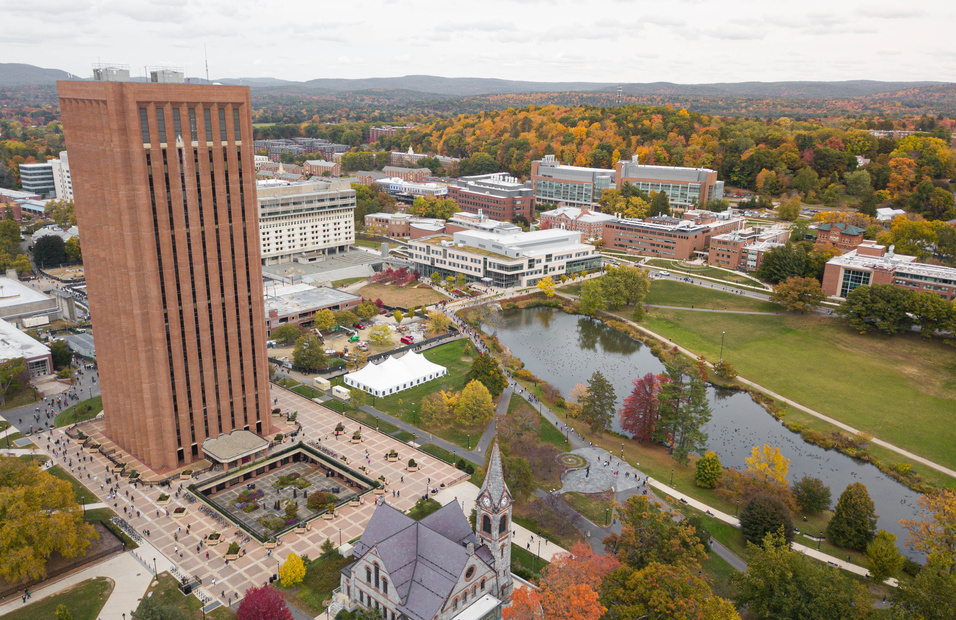
Umass Amherst. Photo: umass.edu
The following column appeared previously in the Amherst Bulletin.
As a retired professor with 35 years of teaching experience at UMass Amherst and having served as Graduate Program Director in the Political Science Department, I found the March 30 story in the Daily Hampshire Gazette, on cuts in graduate admissions, distressing. The story suggests a death spiral at UMass as well as deeper realities about higher education.
While the article discussed current cuts, it does not address the deeper issue of why the loss of graduate students would have a pernicious effect on university education, and why the administration continues to ignore the issue.
Graduate education is core to the university’s mission and contributes in numerous ways. Graduate and undergraduate education are complementary: undergraduates, graduate students, and faculty benefit from one another. Graduate students are essential for the conduct of large Research 1 universities such as UMass. They serve as teaching assistants (TAs) and research assistants (RAs) for professors. Professors pursue research and graduate students learn research skills and receive mentoring. Many faculty members find graduate teaching to be the most satisfying aspect of teaching.
A critical mass of graduate students is essential to maintain an effective graduate program. With only two-four annual admissions for instance, it is difficult to maintain morale and to justify offering graduate classes with small enrollments. Without graduate student TAs universities can offer fewer classes, which negatively impacts undergraduates. Without graduate students faculty will spend more time grading in introductory classes. With diminished resources departments will shrink. With diminished graduate programs, faculty are more likely to leave for positions at other universities.
But these lessons are lost on the administration and the Legislature, not to mention many in the commonwealth who favor practical education at the expense of liberal arts education. Graduate students at UMass find themselves in a second-class category because the Legislature supports the undergraduate education of its citizenry, whereas graduate students are overwhelmingly from out of state and from other countries. While there are long-term benefits from graduate education by promoting research and more trained citizens for the economy, short-term concerns prevail particularly in financially dire conditions. The growing number of administrators, with their higher salaries, absorbs resources for other activities.
UMass is not alone. Most universities — those without significant endowments — are facing a similar challenge. The demographic cliff, where boomers had fewer children than anticipated, means that the undergraduate pool has shrunk. Few enrollments mean fewer resources, especially from out-of-state students who pay more in tuition. Less tuition means fewer faculty, less research support, and less support for graduate students. With fewer graduate students undergraduates suffer, as well as the overall curriculum which becomes skewed away from graduate education.
Peter M. Haas is a resident of Florence and a retired Professor of Political Science at UMass Amherst.