
Town Councilors Issue Nakba Remembrance Day Statement
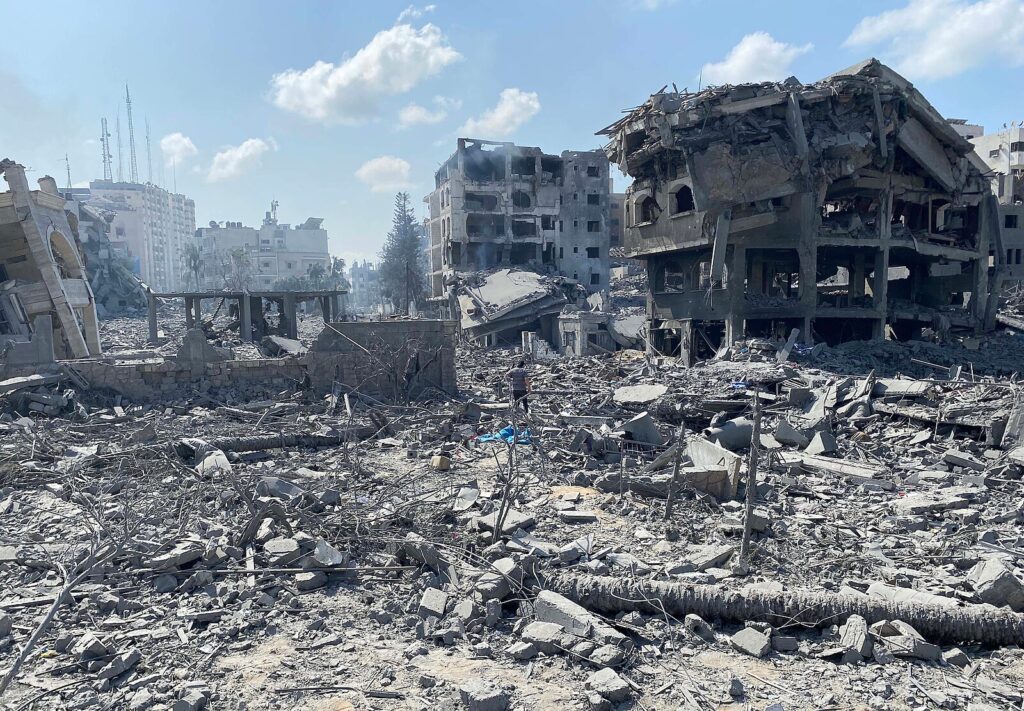
Israeli airstrike on the El-Remal area in Gaza City. Photo: Naaman Omar / Wikimedia Commons (CC BY-SA 3.0 DEED)
Source: Jill Brevik
Town Councilors Jill Brevik (District 1), Amber Cano-Martin (District 2), and Ana Devlin Gauthier (District 5) read the following statement in commemoration of Nakba Remembrance Day, at the Amherst Town Council meeting of May 18, 2026. The statement was also endorsed by Councilors Hala Lord (District 3) and Ellisha Walker (at large).
In honor of Nakba Remembrance Day, we recognize the ongoing genocide and ethnic cleansing of the Palestinian and Lebanese people.
May 15, 2026 was the 78th commemoration of the Palestinian Nakba, meaning “catastrophe” in English, a term which refers to the violent dispossession and exile of more than 750,000 Palestinian people from their homeland in 1948 by Zionist militias, in order to form the state of Israel. For almost 8 decades, Palestinians, their culture, their resilience, and their suffering have been invisible in spaces like this town room.
Displacement, an ongoing nakba, is still the reality for millions of people today who have been forced to leave their homes again and again, in the West Bank, East Jerusalem, and Gaza. In Lebanon as well (a country the size of Connecticut that is connected to Palestine by shared borders and traditions) villages are being ethnically cleansed and civilians are being killed on sight for leaving their homes. With US backing and weapons, the Israeli military continues to attack civilians, and has done so more than 2,400 times after the ceasefire that began in October 2025, in the same way that it has violated all ceasefires before that.
While the news cycle moves on, Gaza is in the longest period without relief aid, lasting 19 months. 1.1 million children remain at risk of starvation. There is not enough food; or fuel, which is necessary to run the desalination plants that provide Gaza’s drinking water, leaving 91% of the population to face acute water insecurity. More than 250,000 Palestinian and Lebanese people have been killed or severely injured since October 2023 (with some sources reporting much higher numbers) and all of our most trusted human rights organization have called these actions genocide, including the United Nations, Amnesty International, Human Rights Watch, Doctors Without Borders, B’Tselem, the International Federation for Human Rights, Oxfam, Save the Children, and the International Association of Genocide Scholars.
Those killed by the US-backed Israeli military include the loved ones of Amherst community members. We see you, all of you, who have to go on, and who continue to show up for your community here in so many ways.
We are witness to the grief and pain of our neighbors who have been watching the news relentlessly for the past two and a half years to see if their loved ones are safe, who endure trauma responses from calling their father, or cousin, or aunt and hearing the phone ring and ring and go to voicemail. Who have family members who are still under the rubble in the south of Lebanon and in Gaza.
We also see those affected by rising anti-Islam and anti-Arab hate, yes, here: families in and around Amherst have endured racial slurs, property damage, and physical aggression. Residents have received threats and had events canceled because of their identity.
Several of us here are also connected to a school in Gaza, named the Sumud School, Sumud meaning “resilience” in English, and we receive regular communication from the teachers and students who have continued to educate and learn and play despite having been forcibly displaced multiple times, despite neighboring buildings being bombed, despite continuous deaths of parents, children, siblings, and friends in their community, despite having to reduce their school hours because the children and teachers were starving as a result of of Israel’s blockade of food and supplies, and did not have enough energy to continue into the afternoons. I think of them all the time, when I put my kids on the bus, and when we debate the school budget here.
I also think of the more than $40 billion our government has given or pledged to the Israeli military and spent on our own participation in these atrocities, when we talk about budget cuts and diminishing town services. I think of the white phosphorus and bombs we’ve helped purchase, the ecocide we’ve supported, when we talk about combatting climate change.
Simply marking this moment and telling these stories and the history behind them, are the types of actions that have helped the world wake up to what is happening. That the United States has been complicit, through Democrat and Republican administrations, and continues to be complicit in Israel’s ongoing nakba by providing Israel with weapons and diplomatic impunity even as its leaders openly describe and enact plans to ethnically cleanse and depopulate Palestinian and Lebanese communities today. And as we tune into news about US escalation in places like Iran, remember that this is enabled by our society’s general justification of, or ignorance to, war crimes in Palestine and Lebanon, as well as our media’s bias and complicity in their erasure.
The ongoing Nakba affects our community deeply. If you weren’t aware of this history, this day of remembrance, or its relevance to our community, there are endless opportunities to open your eyes, right here in our area. To my fellow councilors, our voices inherently carry louder than others–please take every opportunity to acknowledge these atrocities and support your constituents who are grieving, and advocate for the end of US involvement in this genocide. And to anyone listening, I urge you to reach out to me and I would be happy to connect you to one of the many groups expending tremendous energy to offer education, and who celebrate Palestinian and Lebanese culture while fighting for their freedom from oppression. Thank you.
Thank you!
Bravo, Jill, Amber and Ana. Thank you from the bottom of my heart. As a Jew and former Zionist, my soul is in agony over this ongoing atrocity. Israel has totally lost its way.
Glad to see leadership from new and veteran councilors!
Thank you.Jill, Amber and Ana for this statement and to the Indy for reprinting it. As a tax payer, it is really awful that there is public funding for the ongoing genocide in Gaza and the West Bank and in southern Lebanon. Yesterday was Shavout (May 21) and I was thinking about the idea of the “Peoples of the Book” in ancient times and the shared teachings in these texts about human decency and love. I didn’t learn about the Nakba growing up but in the last 15 years and now more than ever realize it is not just an historic and historical event but an ongoing present tragedy.
Thank you for your moral clarity and ethical leadership.
Thank you, Councilors Brevik, Cano-Martin, and Devlin Gauthier, for taking this initiative and writing this powerful statement. Particularly important is your reminder that the Nakba is by no means a thing of the past, but an ongoing horror that we must continue to bring to public attention, especially as it has been lrgely eclipsed in the news cycle. We must continue to call for U.S. defunding of the genocidal Israeli assaults on Gaza and the West Bank, and on Israel’s ongoing attempts to deploy what it calls its “Gaza model” ( Destroy, Displace, Dismantle) in Lebanon.
For those who missed the recent Nakba Memorial Ceremony sponsored by Combatants for Peace and the Parents Circle, the message that the Nakba is ongoing is nothing new. Yet for many diasporic Jews of a certain generation, coming to terms with the realities of the historic and current Nakba is challenging and provokes profound discomfort, sometimes to the point of existential threat. The weaponization of antisemitism, and the conflation of antisemitism with any criticism of Israeli policies all combine to threaten erasure of legitimate Palestinian aspirations. Thank you for this statement. The universal principles of justice, equality, freedom and especially safety should apply to everyone.
Toward a Local Governance of Inclusion, Not Division
It was reported in the May 20th edition of the Amherst Indy, that at the May 18 Town Council meeting, several of our councilors issued a statement commemorating Nakba Remembrance Day. It is entirely appropriate—indeed, it is vital—for a community as diverse and compassionate as Amherst to acknowledge the deep historical trauma, grief, and ongoing pain felt by our Palestinian neighbors. The human suffering currently unfolding in the Middle East is devastating, and the desire of our elected officials to express solidarity with those who are hurting comes from a place of deeply felt empathy.
However, the language, context and framing chosen for this statement raises a critical question about the role of municipal governance in times of global crisis. When local officials adopt highly polarized, one-sided characterizations of a profoundly complex international conflict, they risk alienating other members of our community who are carrying their own immense generational and immediate trauma.
The council’s statement understandably highlights the catastrophic displacement of Palestinians in 1948. Yet, by isolating this event from its broader historical context—including the foundational context of the Holocaust, the United Nations partition plan, and the simultaneous, and violent expulsion of nearly a million Jewish people from Arab nations during the very same era, the narrative becomes exclusionary rather than educational. Characterizing the complex history of Israel solely through the lens of “atrocities” ignores the reality of a nation built by refugees that has faced existential threats from its very inception.
More importantly, it impacts our neighbors here at home. Amherst is home to Jewish and Israeli residents who have spent the last several years watching the rise of global antisemitism with acute fear. Many have loved ones who were victims of the horrific violence of October 7, 2023, the deadliest day for the Jewish people since the Holocaust.
Furthermore, to understand the profound anxiety felt by Israeli and Jewish members of our community, one must acknowledge the harrowing daily reality Israel faces: a state under constant bombardment from almost every direction. Over the past few years, tens of thousands of rockets, missiles, and drones have been launched at Israeli towns and cities by hostile actors spanning multiple fronts—including Hamas in Gaza, Hezbollah in Lebanon, the Houthis in Yemen, and direct strikes from Iran. This relentless barrage has displaced over one hundred thousand Israeli civilians from their homes, shattered daily life, and inflicted deep, continuous trauma on an entire nation.
When our local government issues proclamations that utilize inflammatory language without acknowledging these harsh realities, the trauma, and the fundamental security fears of the Jewish state, it signals to a segment of our town that their grief and their vulnerabilities are invisible to their elected representatives.
Tying complex international military defense spending to local municipal budget challenges is also a rhetorical stretch that misrepresents how local government works. The difficult choices our towns face regarding schools, roads, and services are structural local issues, not the result of Federal foreign policy. Suggesting otherwise distracts from the tangible, constructive work we must do together to strengthen Amherst’s infrastructure.
True progressive leadership does not require us to choose one community’s pain over another’s. It demands that we expand our circle of empathy to encompass both. The role of the Amherst Town Council should not be to adjudicate complex international conflicts or pass resolutions that mirror partisan talking points. Rather, its role is to ensure that every resident—regardless of their background, heritage, or faith—feels safe, valued, and heard within the town borders.
Let us remember history, the entire history and let us mourn for all who are affected by the ravages of this ongoing conflict. But let us do so in a way that brings Amherst together. We can support grieving Palestinian neighbors while simultaneously affirming the rights, history, safety, and acute trauma of our Jewish and Israeli neighbors.
In a world deeply fractured by conflict, let our local community be a place of nuance, mutual respect, and shared humanity.
Hello Aaron, my apologies for taking so long to reply to your letter. I wanted to think carefully about what I’d like to say.
I love your first paragraph. I am distressed by the rest of your analysis and I think it is flawed.
You speak of officials, by adopting highly polarized, one-sided characterizations of complex international conflicts, risking alienating other members of the community, at the same time that you appear to believe its vital that they speak out Thus, you seem to want a highly sanitized reading of history. In my reading of what follows, you seem to be suggesting that the councilors should have spoken about Jewish and Israeli Jewish suffering at the same time, so as to not alienate other members of the community. That by not doing so, the broader historical context is lost. This is a troubling idea. How much history should be included in a commemorative statement about a single horrific day for hundreds of thousands of people? You suggest the Jewish Holocaust as part of that history. Palestinians are not responsible for that Holocaust, yet it is brought up time and time again, as if they are. As if the Holocaust is a good reason for Israel’s brutal policies. You bring up the violent expulsion of millions of Jews from Arab countries, without mentioning that it occurred after Jews violently occupied Palestine and that the UN was warned by the Arab world, who unanimously rejected the partition plan , that this would happen if the partition happened. Thus, even when decrying the loss of historical context, you have cherry picked history to make your point. That is only one of the problems when anyone tries to give historical context. When we commemorate 9-11, should there be a historical piece added to the remembrance; that of the US role in the Middle East for decades? Of the US implanting Sadam Hussein in Iraq. leading to untold suffering of the Iraqi people; of our role in the overthrow of the democratically elected Prime Minister of Iran in 1953,leading to the installation of the Shah, a thoroughly corrupt ruthless leader; of the US support of the Apartheid State of Israel? And on and on? Yes, it would be a great history lesson each time, but is it feasible? And what really is dividing our community? I would suggest that it is Israel’s treatment of Palestinians that is dividing communities around the world, not councils.
The Nakba, I suppose can be linked to the Holocaust if we think of the Jewish occupation of Palestine as a desperate attempt by Jews to establish a Jewish homeland after WWII, but that is a dangerous Idea, because that would exempt Israel from any scrutiny, because of that Holocaust, and that Jews had no choice but to do what they did, and thus what they do today.. A more direct approach might have been establishing an independent Jewish State inside Germany, replete with the violent expulsion of it’s population. After all, it would have required the occupation of much less of Germany than in Palestine, as well as directly affecting the country much more responsible for the Holocaust.
If the councilors did decide to include the long complex history of the Jewish occupation, they would have had to go back to the late 1800’s. I would also say that a complete discussion of the history would not put Israel in a very good light, since I assume you would want a recitation of Palestinian terrorism in Israel, which of course would have to be complemented by the history of Israeli terrorism, dispossession, apartheid, ethnocide and genocide. This is not about Oct 7. This is not about the suffering of Jews for the past 5000 years. It is about one horrific day that has led to 78 horrific years. When there is a commemoration about Oct 7, it too can be a stand alone event; or that same 125 year history would have to be included. I suspect that would be offensive to many people, who might wonder why Oct 7 cannot stand alone, just as you are saying that Nakba remembrance day should not stand alone.
Let’s pick a different day for the remembrance of Jewish suffering, shall we, one not implicating Palestinians for it. And while we’re at it, how about remembrance days for all of the suffering of people around the world, both past and present?
Mr. Weiss,
Aaron Saunders shared a column I wrote to the Amherst Indy.
I appreciate the thoughtful response to my column and the recognition that we share a concern for human suffering. We may disagree on history and on the interpretation of events stretching back more than a century, but I believe you may have misunderstood the central point I was trying to make.
I did not argue that Nakba remembrance should not stand on its own, nor that Palestinian suffering requires qualification before it may be acknowledged. Grief should not require permission. Communities ought to be able to mourn tragedy without having to produce a complete history lesson.
My concern was different. When elected officials speak in their official capacity (I am aware that they were speaking during an open comment part of the meeting), they should be mindful that whether this is a time of open comment, or official town business, they represent an entire community, including residents who carry different histories, fears, and traumas. Empathy need not be a zero-sum exercise.
The response to my column suggests that acknowledging Jewish and Israeli trauma somehow diminishes Palestinian pain. I reject that premise. I do not believe compassion is a scarce resource. One can recognize the profound dislocation and suffering associated with the Nakba while also acknowledging that Jewish history, including the Holocaust, the expulsion of Jews from Arab lands, and the trauma of October 7, shapes how many Jewish and Israeli residents hear these discussions. Recognition is not justification. Context is not exoneration. Understanding history does not require agreement with every action of any government.
Mr. Weiss asks whether commemorations must include every preceding event in history. Of course not. But when elected officials employ language that assigns singular blame or present one people solely as victims and another solely as oppressors, they cease to be acts of remembrance and become political declarations. That was my concern then, and it remains my concern now.
I also respectfully disagree with the assertion that Israel itself is what divides communities. Communities are divided when people become unable or unwilling to recognize the humanity and fears of those with whom they disagree. Polarization deepens when empathy is extended only to those whose narratives align with our own.
I continue to believe that Amherst can be a place where Palestinian neighbors are free to mourn, where Jewish and Israeli neighbors feel seen and safe, and where our local government exercises the humility to recognize that complex international conflicts are best approached with nuance rather than certainty.
In a time when so much of the world demands that we choose one grief over another, perhaps our community can insist on something more difficult and more humane: that every human life possesses equal dignity, and that compassion need not come at someone else’s expense.
Mr. Solender, thank you for clarifying who wrote Mr. Saunders letter. I had not seen your version.
I’d like to try a different way to have this conversation if you are willing. Question and answer by question and answer. My first question to you is thus: You have twice mentioned the Holocaust. Can you tell me more why that horrific event should be mentioned during Nakba Remembrance Day?
I’m glad that we can air our dirty laundry in The Indy. No issue has divided American Jews more than this one. Unfortunately we Americans can’t vote in Israeli elections but we haven’t done very well ourselves in the last ten years. (Locally as well as nationally.)
When October 7 happened I begged the Council president to stay away from the town speaking out—another cause I lost. I really believe our energies and taxes should focus on the holes in our roads and holes in our school budget avoiding the more divisive holes in our foreign policies.
Hilda, I appreciate what you are saying and I recognize that the question of local versus national/international is always present. I even get that The Indy and The Current are geared toward local issues; the Current more so. When I wrote a piece about Gaza last year for The Current, I had to first convince the editors that this was a local issue. And apparently, I was able to do so. You and I are often on the same side of issues. I’m surprised that you are taking this position, reducing it to “airing our dirty laundry”. The effects of Israel’s violent destruction of Gaza and increased violent occupation of the West Bank, are traumatic for Jews and Palestinians in Amherst. I believe we can talk about this and get our potholes filled.
The “house divided” over Netanyahu is the dirty laundry. An embarrassment at best.
I think I understood that. I’ll assume unless corrected that the embarrassment is that anyone supports N’s policies. let us not forget that N is the culmination of all the policies before him. One cannot condemn him while saying “we had no choice” but to do what has been done for 78 years. He is merely saying out loud what the policies and actions were saying. The next leader will likely be more circumspect in public language but enact the same policies as N.