
Historical Commission Approves Demolishing Rear of 174 Amity for Construction of Affordable Townhouses
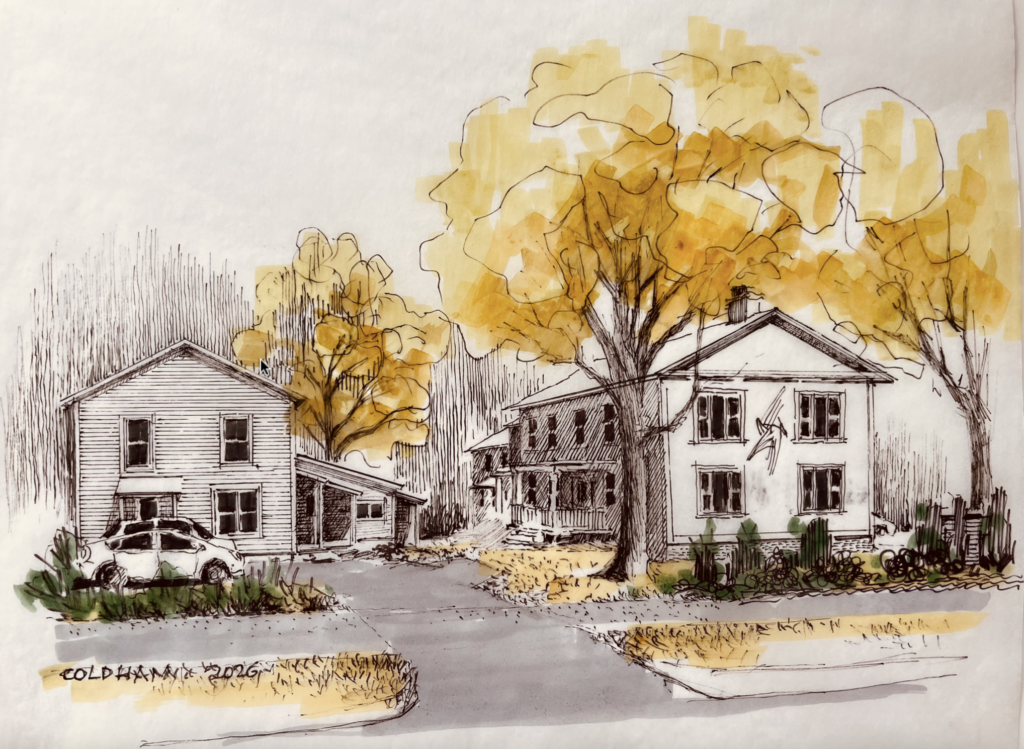
Architect's rendering of renovation project at 174 Amity Street with duplex to be constructed by Habitat for Humanity to the left. Photo: amherstma.gov
Report on the Meeting of the Historical Commission, April 14, 2026
This meeting was held over Zoom and was recorded.
Present
Robin Fordham (Chair), George Baitinger, Joel Greenbaum and Hetty Startup. Absent: Makenzie Landsittel
Staff: Walker Powell (Planner)
Permission Granted to Demolish Rear Section of 174 Amity Street
The Amherst Historical Commission (AHC) voted unanimously that the rear portion of the large 19th-century Greek Revival house at 174 Amity Street need not be “preferentially preserved” and could be demolished in the creation of an affordable homeownership project.
Linda Slakey, president of Amherst Community Land Trust (ACLT) presented the trust’s application to remove the rear third of the house as part of the plan to redesign the larger structure into three townhouses for affordable home ownership. Habitat for Humanity is also planning to construct a duplex on the site to the east of the main structure.
Slakey briefly described the community land trust model of shared ownership, with ACLT holding title to the land and the resident owning the home through an inexpensive long-term lease for the land. The ground lease stipulates that the owner must occupy the house and that the resale price is restricted so that it cannot appreciate more than the proportional increase in AMI. This keeps the home affordable in perpetuity.
The rear of the existing house once served as a carriage house and has no foundation and a dirt floor. The architect, Bruce Coldham, and contractor Seth Lawrence-Slavas of Wright Builders, felt the best course of action was to remove that section, install a proper footing, and then rebuild it on the same footprint in a similar style to the rest of the structure. With no foundation under that portion, water has seeped in and is threatening the foundation of the main part of the house, Lawrence-Slavas said.
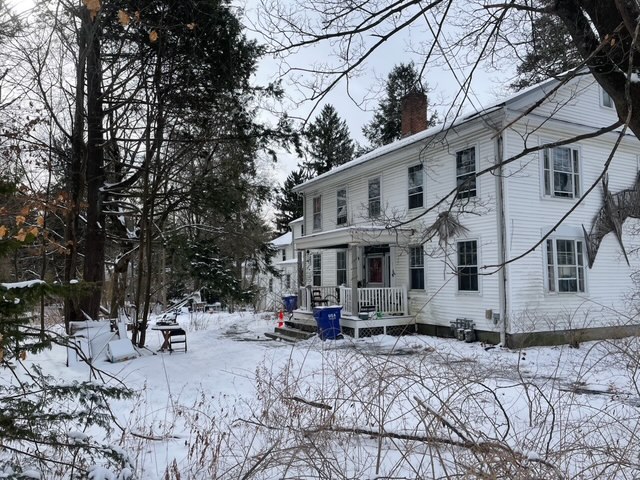
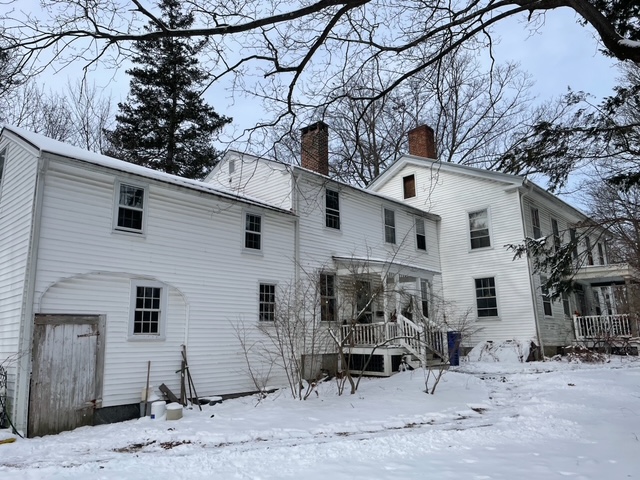
AHC member Joel Greenbaum stated that the plans looked like “a great improvement.” He asked about the other features of the house. Slakey and Lawrence-Slavas said that the house has many wonderful historic features, such as embossed tin ceilings and wonderful woodwork. The plan is to keep the staircases, trim, woodwork, and most of the flooring. The windows will need to be replaced for better energy efficiency, and probably the replacement windows will be vinyl to save money and match the Habitat duplex. However, the window pane pattern will be the same as the original windows.
AHC member Hetty Startup gave a brief history of the house, which, even though it is close to the center of town, began as a farmhouse in about 1830. In the early 20th century, the house passed to the Grose family. The husband Lawrence worked for Mass Aggie and his wife Elena was president of the League of Women Voters of Amherst and part of an Amherst College Theater Group. The Groses took in boarders from Boston and ran a preschool from 1926-1930. After World War II, they took in refugees from Nazi Germany.
Later, the house was rented to artists who graced the exterior with several wood sculptures. These are slated to remain with the new development. The descendants of the Grose family have offered the property to ACLT for about 25% under its assessed value so that it may be used for affordable housing.
The commissioners uniformly supported the plans for the property. Georg Baitinger said the project could be used as a model to show a viable way of preserving houses and to let people know that there are contractors who know how do it. Startup said she especially likes the partnership between ACLT and Habitat for Humanity. Robin Fordham said she appreciated that the new construction mimics the massing of the existing house.
End of Demolition Delay for the Blair House Portends Its Demolition
Last May the AHC imposed a one-year demolition delay on the Blair House at 70 Northampton Road. The house is owned by Amherst College and is in a very prominent location at the gateway to downtown. It is highly visible from the street and is in “deplorable condition”. The end of the 19th-century carpentry on the porches, the sweeping lawn, and the downtown barn are among the qualities the commission found worth preserving. Former AHC member Madeleine Helmer stated at the time of the hearing that the loss of this house will be a “great loss to the town.”
There has been no work on the house in the past year, and there are plans for Amherst College to demolish it. Fordham lamented that it is a shame there is no developer who offered to move it to a new location.

Review of Downtown Design Standards Shortcircuited by Thunderstorm
Peter Flinker of Dodson & Flinker Landscape Architecture and Planning was only a few minutes into his presentation of the proposed Downtown Design Standards when a thunderstorm struck and his Zoom feed was lost. After a few minutes of being unable to contact him, it was decided to adjourn the meeting and bring him back to a future meeting.
Dodson & Flinker are presenting their three-volume set of proposed standards to boards and committees to get feedback and suggestion. In his abbreviated presentation, Flinker said that a diverse group of residents who participated in the work sessions about the standards, and the firm, tried balance the town’s need for growth with preserving the historical features that people love.
Why did this beautiful house fall into a “deplorable” state? How long was it owned by Amherst College. Amherst needs a Demolition By Neglect bylaw to prevent losses like this.
That is the ‘million dollar’ question, Janet. In the hearing – now almost a year ago – the College’s representatives explained that with such a large inventory of buildings, it had been impossible to keep up with maintenance. I would call this neglect, plain and simple. And the home is in a very prominent public location.
In my dreams I wonder if Amherst College graduates and alums might pool resources and fix it up. It is on a large lot with an interesting barn in back. This time of year there are trilliums growing on the west side of the house.
Perhaps Amherst College should reduce its inventory of non-dormitory residential buildings. This could allow houses to become homes for year-round residents or those who wish to be such while they live on working-class wages (e.g., town employees).
The Town’s once-upon-a-time ARA had eminent-domain authority to acquire such buildings, and repair or redevelop them (if funds were so appropriated).
If one is serious about preventing demolition-by-neglect, then perhaps it’s time to revisit the ARA concept or to explore other eminent-domain authority the Town may have….
This article has a great example of adaptive reuse to preserve a beautiful and old building on Amity Street and the sad neglect and now destruction of an old and lovely building by Amherst College. Hard to understand why Amherst College with its hefty endowment could not maintain this building or just sell it to someone else to reuse or expand for housing. Amherst College bought a beautiful mansion on West Street and allowed it to fall apart. Will this happen to more of their older buildings?
Amherst College has shown a longstanding preference for demolition and rebuilding-in-place over preservation. The College’s destruction of the Little Red Schoolhouse, an architectural gem designed by McKim, Meade and White, and an important preschool resource for the Town, is another example.
It should be no surprise that two prominent members of the Amherst College Community developed a demolition and expansion plan for the Jones Library that ignored the need to review impacts to the historic building until after the scope of the project had been determined and an appropriation secured.
And when the Jones Library Building Committee learned they had underestimated the cost by $10M, Trustee President Austin Sarat voted with the committee to jettison the Philippine Mahogany millwork and replace the slate roof with asphalt shingles. Town Manager Bockelman expressed misgivings which prompted Sarat to ask if he was reconsidering the value engineering direction chosen by the JLBC.
“I realize I misspoke,” replied Bockelman.