
Opinion: Amherst College Helped Found Hampshire College. Will It Help with a Just Closure?
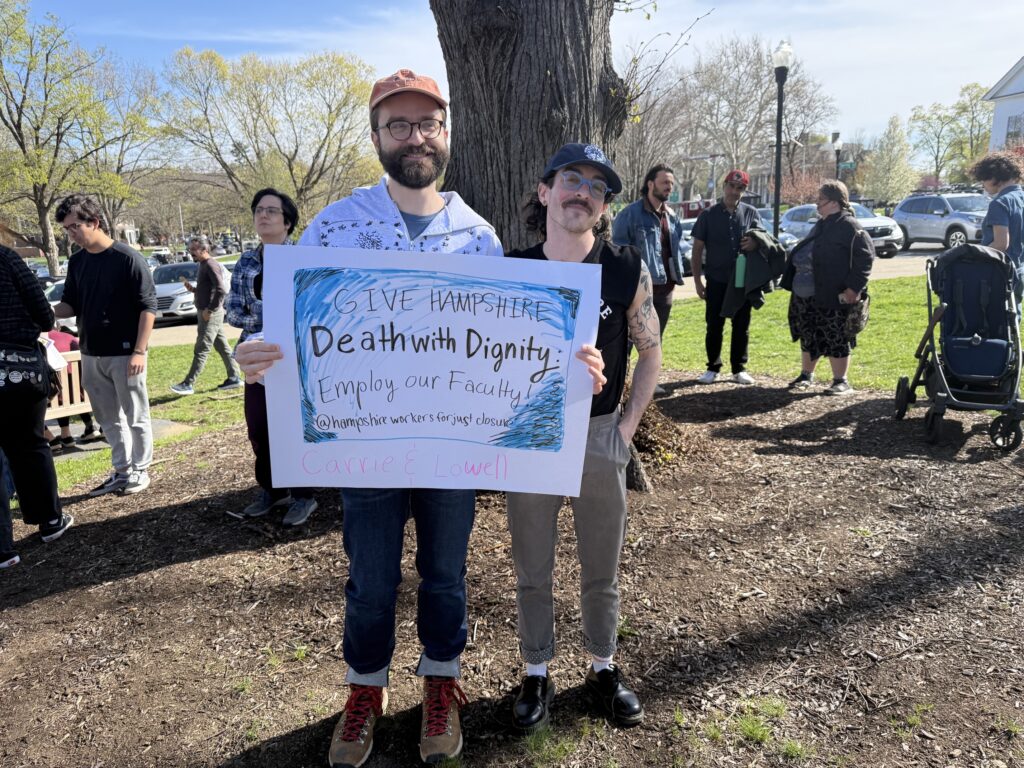
Rally for Hampshire College staff and faculty, Amherst Town Common, April 23, 2026. Photo: Art Keene

Amherst College played an outsized role in creating Hampshire College through its planning, early donors, founders, and geographic proximity. Hampshire, in turn, has had an impact on Amherst College and on higher education writ large, which was part of its mission. Now, even as Hampshire College moves toward closure, the opportunity for Amherst to positively influence Hampshire’s future has returned.
Hampshire’s founding is chronicled in “The Making of a College” and more recently in “A Radical Departure.” Presidents of the other four colleges in what is now the Five College Consortium appointed members to a committee that formulated the New College plan in 1958, but there was no funding to start the college. In 1965, Hampshire’s founders convened a conference to plan its formation. Harold F. Johnson, an Amherst alum, gave $6 million, which enabled the college’s founding, and its library was named after him. Presidents of the four colleges were members of Hampshire’s first board of trustees.
Two of Hampshire’s founders were Amherst graduates: Charles Longsworth and Ken Rosenthal. Besides helping to found Hampshire, Longsworth served as its second president; before that, he worked at Amherst as an assistant to the president. Rosenthal worked for Longsworth at Amherst, later served as Hampshire’s first treasurer, and was interim president in 2019. Franklin Patterson was another founder and Hampshire’s first president. He did not attend Amherst, but his son Eric Patterson ’70 graduated from Amherst the same year Hampshire opened.
Amherst professors I have spoken with are grieving about Hampshire’s closure — and not only because it was an experimental college that pushed the boundaries of pedagogy and social justice (it was, for example, the first U.S. college to divest from apartheid), but also because Hampshire students are wildcard participants in class discussions throughout the consortium.
Hampshire also shapes the area and the culture that Amherst students benefit from — not just through Hampshire alum-owned establishments like Herrell’s Ice Cream and Black Sheep Deli, but through countless artists, entrepreneurs, practitioners, and activists throughout the Valley. Amherst’s town manager, Paul Bockelman, is a Hampshire alum.
When Hampshire was first created, a large proportion of its administration consisted of former Amherst employees. Since then, Hampshire has also attracted talent that later came to Amherst College — among them professor Lee Spector, a key figure in Amherst’s artificial intelligence studies.
On Feb. 19, the Boston Globe published a letter by the presidents of the four colleges, “It’s Not Too Late to Save Hampshire College.” It stated that “the consortium’s unique strength lies precisely in the curricular, research, and programmatic diversity of our institutions, and Hampshire is a vital contributor to that collaboration,” and mentioned how Hampshire has been a national leader in educational innovation. But why didn’t the four colleges step up to help Hampshire financially? They could, for example, have made investments that would have saved Hampshire and strengthened the whole consortium, as I proposed in MassLive.
An editorial by the Amherst Student, “Our Duty to Assist Hampshire,” does a thorough job of elucidating the moral implications of how a sister institution responds, as well as the administration’s lack of clarity on the matter.
I spoke with Mary L. Ruiz, the former chair of New College Florida’s board, who is now chair at Alt Liberal Arts. She suggested that a college like Amherst could host a program inspired by Hampshire — an excellent way to include talented Hampshire students and faculty. As reported in the Amherst Student, Hampshire employees are receiving no severance, and a fundraiser is underway.
Many perceive the Five College Consortium as implying mutual aid, and there have been examples of such cooperation in the past. When a dormitory at Mount Holyoke was damaged by fire, students were accommodated at Hampshire. But the consortium’s response to Hampshire’s closure has been weak. Hampshire employees are not even guaranteed an interview for open positions at the other colleges.
The transition has also been difficult for students. Teach-out agreements with Hampshire exist, but students are not guaranteed admission, full course transfer, or equivalent financial aid. Hampshire students have told me that Amherst College is capping the number of Hampshire transfers at approximately 30. Should Amherst College reconsider that limit to ensure Hampshire students make a successful transition?
The consortium did not invest in saving Hampshire — but I wonder whether Hampshire’s leaders had presented a growth and innovation strategy that would benefit the whole consortium, rather than simply doubling down on a financial stabilization plan that had stalled. A compelling plan can still be put forward by a grassroots movement.
A broad coalition of Hampshire stakeholders has rapidly mobilized in the weeks since the closure announcement. More than 1,000 people have been active in discussions through Hampshire Next. We have a model to propose, and we have already raised $1 million in pledges in just the first week of our new campaign. (I have participated in their finance committee.)
As the closure moves forward, much is at stake in how the campus is used — and parts of the campus, or the entire campus, could be sold off soon. The Valley would benefit far more from progressive, educational, and ecological uses than from McMansions or an AI data center. We hope Amherst College president Michael Elliott will want to meet with us to discuss how Amherst can once again positively influence Hampshire-related outcomes.
If you have ideas for helping Hampshire’s community or for planning progressive uses for the campus, please fill out the form at frogcollabs.org.
Jonathon Podolsky is a Hampshire alum, journalist, member of the Education Writers Association, and a BoardSource Certified Nonprofit Board Consultant. He can be found at www.Podolsky.cc.