
Town Has Much to Consider with the Closing of Hampshire College
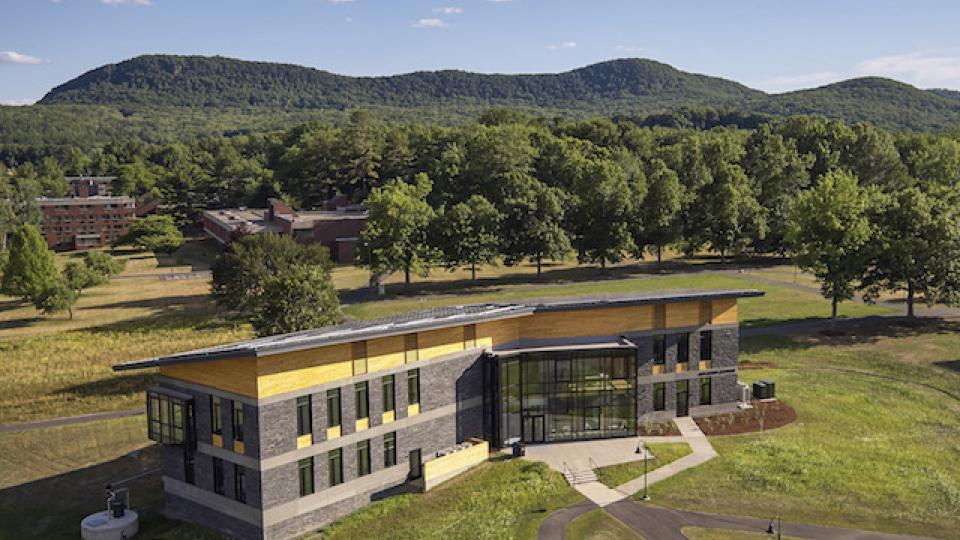
R.W. Kern Center, a net zero building at Hampshire College and one of only 23 living buildings in the world. Photo: hampshire.edu
Report on the Meeting of the Amherst Town Council, April 27, 2026, Part 2
This was a hybrid meeting held in Town Hall. It was recorded.
Present
Mandi Jo Hanneke (president, at large), Jill Brevik and Cathy Schoen (District 1), Amber Cano-Martin and Lynn Griesemer (District 2), Hala Lord and George Ryan (District 3), Pam Rooney and Jennifer Taub (District 4), Ana Devlin Gauthier and Sam MacLeod (District 5), and Andy Churchill and Ellisha Walker (at large).
Staff: Paul Bockelman (town manager) and Athena O’Keeffe (clerk of council).
Events Leading to the Closure of Hampshire College
Town Manager Paul Bockelman, a Hampshire College graduate, gave an overview of the financial shortfall that led to the closure of Hampshire College, announced April 14, 2026.
Bockelman said that in January 2019, he received a phone call from college President Mim Nelson informing him that she had decided not to accept an incoming class for the following year. Students, faculty, and alumni rebelled against the decision; ultimately, the trustees relented and launched a robust fundraising effort.
The fundraising campaign was going well, according to Bockelman, but enrollment never recovered. Attempts to monetize the college’s land fell short when a mixed-use project behind Atkins Farm failed to win approval from the Conservation Commission because of its encroachment onto wetlands. He noted that there are fewer college-age students now, and fewer are choosing Hampshire’s educational model.
Timeline for Closure
The trustees voted to close the college April 12 and announced the decision to the community April 14. Graduation is set for May 15, and the dormitories will close May 17. The Early Learning Center is set to close June 2, leaving 40 families without childcare. Signed contracts for the Red Barn will be honored through the end of the calendar year.
One hundred ninety-nine of Hampshire’s 269 employees will be terminated as of June 15; 55 of those employees live in Amherst. MassHire Rapid Response is providing on-site services — including job placement, retraining, and unemployment assistance — to support displaced workers. Job fairs are scheduled for April 28 and May 18.
Some students and a few faculty members will remain on campus through the end of December to complete their projects, so some buildings will need to stay open. The college will try to close as many as possible, though all will need to be heated to prevent pipes from freezing and fire alarm systems must remain active. The college intends to sell or transfer its real estate and buildings to pay off more than $20 million in debt.
Student transcripts and records are being transferred to UMass. In addition to buildings, artwork, books, and farm animals will be sold. Of the 667 students, 157 are expected to graduate in May. Another 28 can complete their programs by the end of December. The rest are encouraged to transfer to other schools. Colleges that have agreed to accept some Hampshire students include Amherst College, Antioch College, Bennington College, Massachusetts College of Art and Design, Massachusetts College of Liberal Arts, Mount Holyoke College, Prescott College, Smith College, UMass Amherst, and Warren Wilson College. Bockelman said some smaller colleges, eager to boost enrollment, are likely to welcome Hampshire students.
Hampshire College holds 692 acres in Amherst and 200 acres in Hadley. Of the Amherst acreage, 614 acres are tax-exempt as on-campus land. Taxable land includes parcels south of Bay Road and east of West Street, as well as the president’s house on the South Amherst Common.
In addition to hiking trails, solar fields, and open space, the campus includes five dormitories, five academic buildings, two recreational facilities, a farm, a yurt, the Early Learning Center, and the Kern Center. Of the 23 certified “living buildings” — fully sustainable structures — in the world, two are on the Hampshire campus: the Kern Center and the Hitchcock Center, which holds a 95-year lease from the college signed in 2015.
Most of the land is zoned for educational use, meaning it can only be used for higher education unless the zoning is changed.
The Eric Carle Museum and the Yiddish Book Center own their own buildings and land, but access runs through college property. The Yiddish Book Center uses some of the campus dormitories for its summer programs. The Bay Road Tennis Club uses the multi-sports building, and the Recreation Department has been using the swimming pool for some of its aquatics programs.
Hampshire Plans to Sell Campus
Hampshire President Jennifer Chrisler announced on April 28 that the college plans to sell its 800-acre campus “on an expedited timeline” to pay off its nearly $25 million in debt, and that they have hired a broker to facilitate the sale.
Impacts on the Town of Amherst
The Amherst Fire Department responds to about 120 calls at Hampshire College each year. Bockelman relayed a quip from former Fire Chief Tim Nelson: “Hampshire students don’t know how to cook.” The fire department will also be involved in ensuring the proper disposal of chemicals and other hazardous materials when buildings are closed. The college is also the third-largest user of town water and sewer services, and the loss of that revenue will strain those enterprise funds. Town businesses will lose patronage from fewer campus visitors and reduced purchases of local services by the college. Bockelman estimated that visitors to the college contribute $4 million to the Western Massachusetts economy annually.
What Are the Options for the Town?
Bockelman said the town can influence the future of the Hampshire College site through land purchase and rezoning. Planning Director Jeff Bagg said the land will need to be rezoned before housing or other taxable development can be built there, but noted that the town has not yet assessed the area, which is near a village center, cultural institutions, and residential neighborhoods.
Bagg said any rezoning should align with the town’s Master Plan, Housing Production Plan, and Open Space and Recreation Plan — to protect sensitive areas, concentrate development on already developed land, reuse existing buildings, and address the town’s housing needs and need for new tax revenue. “We need to be strategic, but also fast,” he said.
Bockelman mentioned Viridian Village, a housing development proposed in 2016 for Hampshire’s land on the east side of West Street. Assistant Town Manager Dave Ziomek noted that some land — including areas near the Hadley town line — is under permanent conservation restriction, though the prime farmland is not protected.
Bockelman noted that the executive session planned to follow this meeting would give the council an opportunity to discuss the possible purchase of some of Hampshire’s land.
Some Ideas and Questions from Councilors
George Ryan asked whether there was any possibility of keeping the Early Learning Center open. Bockelman replied that the building is owned by Hampshire College and its staff are college employees, but said the town is working to help the center survive.
Ana Devlin Gauthier said the Early Learning Center should be a priority, as it is one of the few facilities in town that offers infant care.
Cathy Schoen asked whether the tennis and pickleball courts could be kept open, but Bockelman said liability concerns make that difficult.
Pam Rooney raised the possibility of leasing the dormitories to UMass to ease housing pressure on that campus and in Amherst neighborhoods. Bockelman noted that insurance costs are a complicating factor for Hampshire College.
A Cautionary Tale from Northfield
Bockelman and Bagg stressed that the town has no coherent plan yet. They called for a thorough assessment and a community-driven process to set priorities for use of the land, but said time is of the essence.
Andy Churchill described what happened when Northfield Mount Hermon School put its Northfield campus up for sale in 2004: Hobby Lobby purchased it and donated it to a Christian organization. “It remained tax-exempt, the town didn’t get any revenue out of it, and they had new neighbors who were maybe not quite in sync with the values of the town,” he said, adding that the closure of Hampshire College represents a once-in-a-generation opportunity to meet community needs.
Lynn Griesemer said that with the right planning, the property represents a revenue opportunity for the town. She noted that the Town Council controls zoning and suggested that the Hampshire College property be assessed in conjunction with the soon-to-be-vacant Wildwood Elementary School.
Amber Cano-Martin and Sam MacLeod expressed concern about the human cost of the college’s closure. MacLeod called it a “trauma for the community.” Cano-Martin worried about members of the Hampshire community who may be left without housing when the dormitories close. Bockelman noted that during the COVID-19 pandemic in 2020, the college kept some dormitories open for students who had nowhere to go, and said the town is in contact with the college about current students’ housing needs.
Cano-Martin also raised the question of preserving the Hampshire College farm. “Maybe the town isn’t in the place to buy a farm, but the town knows a lot of farmers,” she said.
Devlin Gauthier offered a closing thought: “Hampshire really helps to keep Amherst ‘weird’ in the best way, and I hope that we can hold onto that innovation as we go through the process we’re about to go through. I hope that we can bring innovation and creativity into that process to find the best solution for our community possible.”
Public Comments on the Future of Hampshire
During the public comment period, Jason Dorney said the closure of Hampshire College is a significant loss but also a once-in-a-lifetime opportunity to address fiscal challenges created by a scarcity of buildable land. He called for a plan to develop taxable housing of varied types at the site — “single-family homes, senior age-restricted, income-restricted, affordable housing through Valley CDC or any other partners that we can build with.” He urged the council not to impose “a one-use zoning restriction to build single-family homes on quarter-acre lots. I want to make sure that we are looking at all of the possibilities to address housing for all types of people,” he said.
Emily Landeck, director of the Hampshire College Farm program, advocated for conserving the approximately 80 acres of farmland on the college property. “I understand the need for housing, and I also know that farmland is extremely important, and that farmland has no protections on it as of right now,” she said. She added that the farm is working to collaborate with other organizations to preserve at least some of that land.
Bagg Gives a Brief Overview of Zoning
Planning and Economic Development Director Jeff Bagg gave councilors a brief overview of zoning regulations. He explained that land uses are separated into categories and regulated by a “permit granting authority” — the Planning Board, Zoning Board of Appeals, or building commissioner. The town’s zoning bylaw establishes zoning districts, each with allowable uses and dimensional regulations.
Zoning amendments may be proposed by citizen petition, the Town Council, town committees, or the town manager. Once proposed, the town must follow a legally mandated process that includes a public hearing before the Planning Board and Community Resources Committee (CRC), or a joint hearing of both. The Planning Board then votes on whether to recommend the proposal to the CRC, which decides whether to send it to the Town Council. If it does, the council holds another public hearing and votes on whether to approve the amendment. Most zoning amendments require a two-thirds majority to pass; some amendments involving the creation of housing require only a simple majority.
Bagg said that once notice of a proposed zoning change is posted, it is technically in effect, so developers sometimes request that the previous zoning be “frozen” for a site so they can continue development plans without concern that the zoning will change mid-process.
Executive Session
Following the discussion, the council voted to adjourn into executive session in accordance with M.G.L. c. 30A, § 21(a)(6), to consider the purchase, exchange, lease, or value of real property at 893 West Street, with the chair noting that an open meeting could have a detrimental effect on the negotiating position of the public body. The Town Council did not return to open session.
It sounds like forces are at work to make this a rushed fire sale. One would hope that Anherst has learned to not make community decisions behind closed doors. But as Ted Lasso says, it’s the hope that kills you.
The town has demonstrated it cannot manage property. Look at the leaking schools, one of which sits empty on the south common, and more. The town could expedite rezoning and permitting for areas of the campus with existing buildings so businesses or people in need of homes could move in and contribute to the tax base.
For the love of God, if there was ever a place to put high rise apartments, this is is it. We have no tax base. Im begging.
“Andy Churchill described what happened when Northfield Mount Hermon School put its Northfield campus up for sale in 2004: Hobby Lobby purchased it and donated it to a Christian organization. “It remained tax-exempt, the town didn’t get any revenue out of it, and they had new neighbors who were maybe not quite in sync with the values of the town,” he said, adding that the closure of Hampshire College represents a once-in-a-generation opportunity to meet community needs.”
What does that even mean? An Amherst Town Councilor speaking for the values of another town. Yikes. Pray tell what are a town’s values.