
Letter: Interventions at Drunken Student Parties Cost Town More Than Dollars
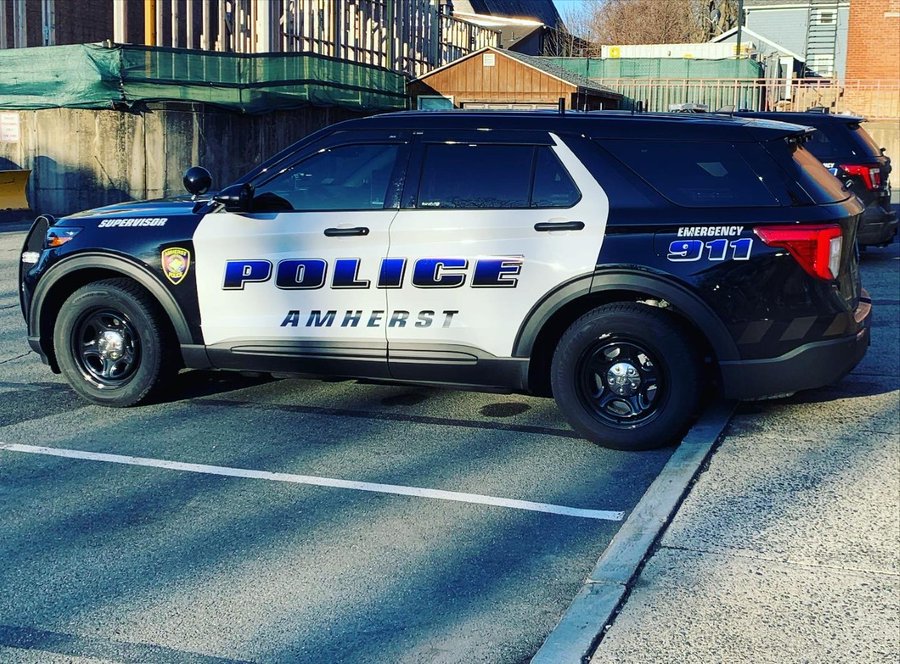
Photo: amherstma police.
The following letter was sent to the Amherst Town Council on May 3, 2026.
Last Saturday (5/2), a Kentucky Derby party at a house on South Pleasant Street got wildly out of hand. Hundreds of inebriated revelers were eventually dispersed by the police, who showed up in at least 10 police cars, including three State Police units. While it is a virtual certainty that many of the partiers were underage drinkers, it remains to be seen how many were charged, or even reported to UMass authorities for subsequent action.
Amherst residents in many work-force neighborhoods routinely put up with the noise, litter, public urinating and commotion of student parties. But even the residents in Amherst’s tonier neighborhoods are currently picking up the tab for massive police responses like the one on May 2.
Why?
While it is true that Amherst can assess fines up to $300 for a noise/nuisance violation, this does not cover the cost of a large police intervention, and it is typically not levied on landlords, but on the tenant(s). With so little “skin in the game”, there is little disincentive for landlords to rent to students.
The town needs a policy that would charge the landlords not just tenants when parties get out of hand. The financial cost of having even one cruiser, let alone 10, show up and spend an hour or two at a party is not trivial. It is difficult to determine how tying up local police resources in cases like this interferes with the police responding to other calls, and those costs are not strictly financial.
If Town Council cannot bring itself to more effectively address the incursion of student rentals into residential neighborhoods, it should at least craft a policy to avoid residents having to pick up the costs of rowdy partying and to avoid tacitly allowing underaged binge drinking. If landlords are potentially liable for the expense of police responding to nuisance calls to their properties, perhaps then they will resist the temptation to maximize their rental incomes by charging outrageous per-bedroom rents to students. At the least, it will behoove them to be more judicious in renting and managing their rentals. And just maybe it will spur some to instead lease to families at reasonable rates, limiting student rental sprawl and easing the shortage of workforce housing.
John Varner
John Varner is a resident of Amherst’s District 3
On Sunday, at a district 3 meeting, I got a chance to ask Chief Ting about the party intervention. Partying was only a minor topic at the meeting. Most of Chief Ting’s time was spent talking and answering questions about ICE and how the APD is navigating immigration enforcement issues and federal edicts.
Chief Ting was actually quite impressive and level-headed, though I wonder about the statement that this police action Saturday didn’t involve extra expense for the town and State Police. It’s not like they have nothing to do on a Saturday but wait for large public disturbances…. He said that up until 6 or 8 years ago, Amherst PD tried to “arrest their way out of parties”, but that tactic only antagonized the students, and since the “party smart permitting” started, there have been better relations with students and fewer raucous parties. (I’d like to see some stats on this.)
Afterwards I told him I don’t envy him his job but he’s doing it well.
I fully appreciate that we can’t “arrest our way out of students’ partying”, and that dealing with a crowd of hundreds of drunken students is a daunting problem. It is encouraging that Town Council has, on paper, adopted policies to work with the University on disciplinary problems and to hold landlords accountable. But I share some Town Councilors’ concerns about a lack of follow-through. When the “party smart” policy fails, as it did on Saturday, is there follow-up with UMass and landlords, and will this latest incident result in actions against the landlords and their tenants who pulled “party smart” permits and then let things get crazy? Was anyone cited for under-aged drinking, or charged with providing alcohol to minors? Will the landlord(s) be put on notice? Will the partiers and/or landlord(s) bear the cost of this law enforcement action?
Consider the fact that none of these rental houses and few complexes have children in the Amherst school system and yet the property owner is paying the same tax rate. Public school students cost thousands of dollars yearly, so the occasional police visit is FAR less of a financial impact.
Read the facts, APD puts out a noise report each Monday, it’s honestly quite minimal considering the size of the town.
How does the writer know that the drunken partiers were UMass students. Amherst College students drink, too.
Residents of neighborhoods afflicted with “with the noise, litter, public urinating and commotion of student parties” need to organize and go to Hampshire Country Superior Court in Northampton to seek injunctive relief (and possibly money damages as well) based on the well-established legal doctrine of “private nuisance.” Landlords who permit a private nuisance are legally responsible for misconduct by their student tenants whose antics make life miserable for neighbors. Property ownership is a matter of public record at the Amherst Town Tax Assessors property search web page.
An actionable private nuisance is any activity that unreasonably interferes with homeowners’ quiet use and enjoyment of their property. For example, if noise keeps either children or adults awake at night, or interferes with ordinary activities like watching television, reading or conversation, that constitutes unreasonable interference entitling the homeowners to injunctive relief, money damages, or both.
To pursue a private nuisance claim in Superior Court in Northampton, one needs an experienced attorney. There are excellent litigators in Amherst and Northampton. One need not go far afield to hire a big (and likely very expensive) law firm. I suggest residents contact local attorneys based in Amherst or Northampton, asking first “Do you do Superior Court civil litigation?” If the answer is “yes,” the next question is “Who is your most experienced Superior Court litigator?” That is the lawyer you want to consider hiring. Interview several, discuss legal fees and expenses frankly, and make your own decision.
One lawyer can represent a group of people if their interests are aligned and if they can make all decisions by consensus. If the group members cannot resolve disagreements during the course of litigation, each faction must hire another lawyer. That provides a powerful incentive to reach unanimous decisions.
Jon Hite>True, I did not survey the students, and I’m only relying on sheer numbers, and where they were walking to and from, plus the fact that a few dozen partiers migrated to the house across the street from mine, which is occupied by UMass students to assume it was strictly a UMass affair. So What?
Another individual emailed me directly to chide me for being a curmudgeon. Part of my post here relates to this being an atypical party, even by our town’s standards. Hundreds of kids and 10 or 11 police units responding is NOT a typical college party, thank god. I admit (and have done so in previous posts) that I would NOT want to have the 20 year old me as a neighbor. Yes, people in their late teens and early twenties party hardy. I certainly did. And I lost 3 close friends to separate drunk driving accidents by the time I was 21. Nothing like being a 20 year old pall bearer at a good friend’s funeral to get one to reassess one’s life.
The other main concern I seek to point out, aside from the disruption caused by this raucous party itself, is how the town and University handle such affairs. I agree with Chief Ting that we cannot arrest our way out of such parties. The party smart initiative is a good step forward, but we need follow-through when the part smart policy fails. Do we let everyone off, because it was a BIG party and no one ended up so drunk they had to go to the ER? Do we coddle the students who took out the permit and then failed to control the party? Should the landlord(s) be put on notice that additional incidents like this will mean they actually DO lose their rental permits?? It’s encouraging that Amherst PD and town council came up with a policy that has curbed large (and in the past, literally riotous) parties. But no policy is fool-proof. Let’s learn from this, tweak the party smart policy to make it better, and not just accept this as a norm.
For us, it’s common sense and mutual consideration. Right now we don’t feel the town is doing enough to enforce the regulations. Why does the house next to us have six people living in it when the rule is four unrelated? And yet they were happy when I snowblowed the giant snowbank in front of their driveway this winter. I don’t go out and start mowing or chainsawing at 7:00am to be considerate. Why do we have to listen to yelling and screaming at midnight even when there has been a party smart initiative? The damage is always too late. If it helps the police fine, but it doesn’t help the neighbors being affected.
There is also the time of year some of this goes on. That same Saturday night John is talking about, there was a Live Band just up the street from us. Went on till about 12:30am. At first we said, “here we go again!” but we then discussed that it was the end of school year, near graduation and let them have their fun.
We have always loved living where we are. We are close to everything that is important to us. But Amherst is getting exhausting and we feel it’s one-sided when it comes to who management really cares about.
Alan St. Hilaire> Seriously?
Families and their kids are the core of a community. Educating kids is not a frivolous expense, it is investing in the future where the young take care of the old. You, too, will be old some day, if you are fortunate enough. If we follow your post to its logical conclusion, Amherst should shoot for getting rid of families entirely so that the landlords just house students exclusively, so they can maximize their profits.
I know nothing of Mr. Hilaire or his history with living in Amherst.
I have been one of the working-class residents here since the late 1960s. First I rented downtown. I was involved in the live music scene and saw my share of “partying.” Interestingly, the “students” and others had plenty of fun but tried to keep it on the down-low. Many of us routinely made friends of our neighbors, especially the elderly, and, without being asked, shoveled their walks in the winter, cut their lawns in the summer, and occasionally invited them over for social time.
The culture I grew up in as an Irish immigrant whose family expected me to be a thoughtful citizen is vastly different than what I see from many young people today. I challenge anyone to disprove (see archived police logs or fire/response reports) that the frequent behavior of those today enjoying their “right to party” is vastly different than 25 or more years ago.
Mr. Hilaire is missing some important points when he offers, “Consider the fact that none of these rental houses and few complexes have children in the Amherst school system, and yet the property owner is paying the same tax rate.” I would hazard a guess that the student rental landlords systematically receive more monthly income than many people with children in the public school system. They can handle the costs of doing business. As well, the negative effects on traffic and parking issues, wear and tear on roads, air quality, water and waste, and emergency services generated by student rentals are likely beyond that imposed on the town by home owners, with or without children.
Sadly, I have had experiences at the CDH emergency room. Stacked up with students who had overdosed on alcohol or related injuries, it takes a toll on ER services, including those from Amherst EMS. Even on-duty doctors complained to me about having to triage those with heart issues or other serious emergencies to treat students who didn’t even know where they were.
I could go on, but while we save UMass money (“dormitories are not money makers”), a business tax rate, because certainly owning more than one or two student rentals is a business, should perhaps be applied to those in that business. Beyond that, facts prove that young people, couples, families, and even some of us older folks are dwindling in numbers as year-round residents because we can’t afford the related costs of student rentals and how those properties are eliminating the ability for those listed above to afford the housing market here.
Meanwhile, Mr. Hilaire should tread carefully on using the police log for his purpose, as it could just as easily be used to demonstrate that the police department budget, which should not be sacrosanct, is often inflated beyond the need for actual law enforcement in Amherst. For too long, the concept of community policing, seen by some as a cash cow, often results in fewer officers routinely on the street because of (in the words of one retired officer) assignments to “touchy feely” initiatives.
How often do any of us see a police cruiser regularly patrolling (at the speed limit or below) through neighborhoods? There are many studies that posit that increasing police staffing does not automatically result in managing crime rates or public safety needs, but appropriate allocation of police resources can. Despite best intentions, community policing, more studies, or new (unenforced) by-laws have yet to reduce unacceptable behavior of those who continue to negatively impact year-round residents and neighborhoods.
Perhaps parents of students and UMass, as well as landlords of student rentals should play a bigger role in mitigating the crazy.
Amherst has way more in common with the towns on the Cape and Islands than even a close town like Northampton. It feels like I live in a tourist town that has a quiet season for year-round residents and then the waves of temporary neighbors move in for less than a year. I take my role as a year-round resident seriously and we welcome our student neighbors each year with a letter and a friendly hello. We are teaching them how to live responsibly in a neighborhood which is an important part of their education and college experience. And sometimes that involves feedback that they are driving too fast, partying too loudly, and ignoring those who live around them. It is effort. So, I was chaffed to read Alan St. Hilaire, Owner of Valley Property Management, lament that property owners of the student rental houses pay for taxes that educate the children of those who live in Amherst year-round yet they do not have children in the school system. As neighbors to one of his properties, we are educating his renters every year and every weekend. We do that most often in lieu of calling the police but seeing this comment from their landlord, I’m asking myself if we should change that. And if he was renting to families instead of “now leasing off campus housing” (as the homepage of his website announces), then those properties would have children in the Amherst schools.