
Town Discusses Planning Process for Redeveloping Hampshire College Campus
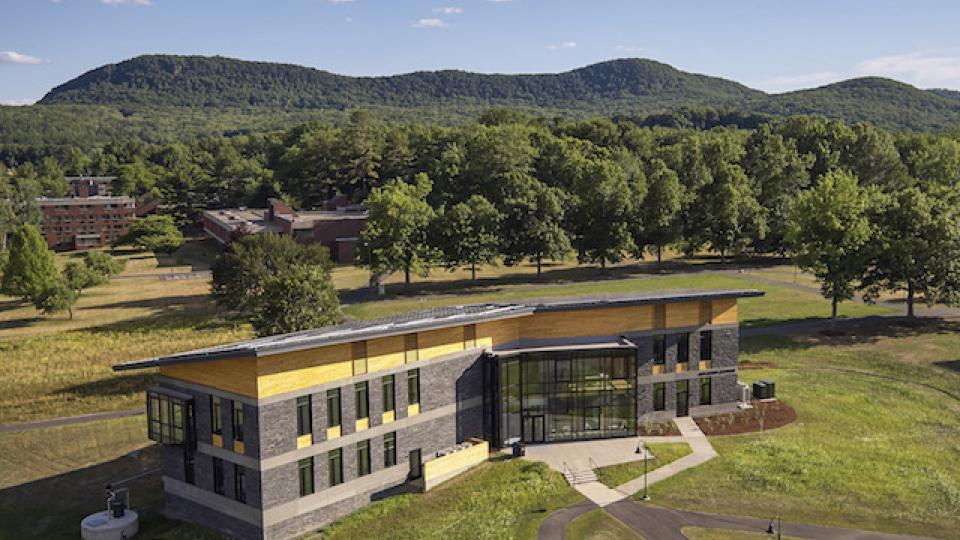
R.W. Kern Center, a net zero building at Hampshire College and one of only 23 living buildings in the world. Photo: hampshire.edu
Report on the Meeting of the Amherst Town Council, June 1, 2026, Part 1
This was a hybrid meeting held at Town Hall. It was recorded.
Present
Mandi Jo Hanneke (President, at large), Jill Brevik and Cathy Schoen (District 1), Amber Cano-Martin and Lynn Griesemer (District 2), Hala Lord and George Ryan (District 3), Pam Rooney and Jennifer Taub (District 4), Ana Devlin Gauthier and Sam MacLeod (District 5), and Andy Churchill and Ellisha Walker (at large)
Staff: Paul Bockelman (Town Manager) and Athena O’Keeffe (Clerk of Council)
Highlights
- Planning the Redevelopment of the Hampshire College Campus
- Public Comment Notes Dire Circumstances Faced by Hampshire Students
- New Sidwalks and Parking for Kendrick Park
- Human Rights Commission Gets New Charge and Revised Bylaw
- Public Forum on FY 27 Capital Improvement Plan Generates Little Public Comment
Town Announces Collaboration with MassDevelopment to Shape the Future of the Hampshire College Campus
On the day of this meeting, the town received a $75,000 grant from MassDevelopment, the state’s development finance agency and land bank, for an extensive but focused initiative to prepare for future potential uses of the Hampshire College campus. Director of Planning and Economic Development Jeff Bagg told the council that the two-phase initiative will begin in June with a thorough assessment of the campus and its infrastructure with the intent to balance development that yields housing and tax revenue with preservation of wetlands and farmland.
After a preliminary assessment by the Horsley-Witten Group, Dodson and Flinker Landscape Architects and U3 Advisors, there will be several public listening sessions and charrettes in the late summer and fall.
The second phase of the initiative will be financed by a new grant from MassDevelopment to help communities in which a college campus has closed to plan for its reuse. The consultants from the three firms will recommend upgrades necessary for development on the campus, suggest zoning changes, and provide guidance for potential buyers.
Bagg said, “This project will help the town assess the land and determine where and what types of housing and other uses can be supported on the site–creating a balance between habitat protection and development where the infrastructure such as roads, water, and sewer already exist or can be easily extended–and then create a zoning plan that will allow implementation in phases,”
Bagg added that Horsley-Witten plans to host an interactive website about the project. To enable more public participation, some of the public sessions will be hybrid so as to allow remote access.
The Town Council unanimously authorized Town Manager Paul Bockelman to enter into a contract with MassDevelopment. In Executive Session at the end of the meeting, the council continued to discuss the possibility of the town acquiring some of the campus.
The town’s press release about the collaboration with MassDevelopment stated:
“The opportunity for new growth on portions of the campus land is in line with many of the town’s long-standing planning principles:
- Focus on already developed areas, close to village centers, and with access to existing infrastructure (roads, water, sewer, sidewalks).
- Allow reuse of suitable existing buildings easily, and with as little discretionary approval process as possible.
- Identify areas and allow a wide range of housing as outlined in both the 2021 Comprehensive Housing Policy and 2025 Housing Production Plan.
- Preserve sensitive habitat or resource areas beyond the core campus and create a balance between potential redevelopment and preservation of critical areas.”
Claire O’Neill, Senior Vice President of Real Estate Planning at MassDevelopment, told the council that MassDevelopment works with communities across the state and also with some nonprofits. In addition to consulting on the reuse of closed campuses, she told of working with the town of Clinton where a century-old plastics factory employing 600 workers moved out of town and had major effects on the town’s economy. She said MassDevelopment has a number of financing tools available to help towns purchase property if it is appropriate.
Councilor George Ryan asked what would happen if Hampshire College was sold while the town’s plan was still in process. Bagg replied that “for the time being, this is full steam ahead. We believe that this is a great signal that the town is sending that we’re prepared and looking for the developable portions for housing and for tax revenue.” Both he and Bockelman felt that any potential buyer would want to enter a conversation with the town, but that the town was prepared to adapt to other circumstances if necessary. It is possible that a buyer would only want to purchase part of the campus.
Councilor Cathy Schoen noted that the assessment of the property would be valuable to any buyer, but she was worried that the rezoning process would take longer than the three to four months in Bagg’s scenario. Councilor Lynn Griesemer stated that, even if a buyer planned to keep the property for educational use, the town should continue its planning, because she thought that chances were slim that a new small college would be successful in the future.
Councilors’ Priorities for the Campus Align with Planning Department
Councilors Andy Churchill, Jill Brevik, Lynn Griesemer, and Ellisha Walker crafted a motion stating the council’s priorities for future use of the Hampshire College campus. Their motion closely paralleled the objectives in Bagg’s presentation. Brevik said the motion summarized the discussions the council has had during executive sessions at previous meetings. It passed unanimously.
The motion states:
“MOTION: The future uses of Hampshire College land are of critical importance to the Town of Amherst, and comprehensive, consultative, and inclusive land planning efforts are being undertaken by staff. As this effort continues, and as Hampshire College decides what to do with its land, the Town Council identifies the following key priorities and stands ready to provide zoning and regulatory support for them:
∙ Buildable land should be prioritized for housing, small business development, and other appropriate tax revenue-generating uses.
∙ Sensitive habitat, farming, or resource areas should be prioritized for preservation, creating a balance between potential redevelopment and preservation.
∙ Housing development should prioritize a wide range of housing types, as reflected in the Town’s 2021 Comprehensive Housing Policy and 2025 Housing Production Plan.
∙ If components of the property could support identified Town space or facilities’ needs, those needs should be considered.”
Public Comment Cites Dire Conditions for Hampshire College Students and Staff
In public comment, Steven KaCey stated, “One of the huge impacts on our economy is Hampshire College. The school is of great value to me personally, and it should be to all of you. Those are our neighbors, our community members, students losing their academic community. All that that school has given us—our local town leaders, our favorite places to eat, and much more. The current plan is not feasible, so there has to be a change, but the current situation continues to deteriorate weekly. Right now, there are about 100 students on campus who are working diligently to complete their programs for the fall, and now they’re being told that there might not be enough funding to see them through that plan.”
He continued, “The students that have transferred to other schools are facing challenges where they are not receiving the same financial aid packages that were offered at Hampshire. For some students, that places a huge block on their academic progress. I’m not savvy enough with all the different fundraising programs that are coming. Town residents have expressed their interest in parts of the land, and I would like to further that conversation. I just urge you to support all the students at Hampshire, because Amherst is about education.”
New Sidewalks and Parking at Kendrick Park Preserves Large Tree and Creates Accessibility
The DPW plans new sidewalks on both sides of North Pleasant Street at Kendrick Park. Schoen questioned why green space along the park needed to be reduced for the sidewalk when people could walk along the sidewalk on the west side of the street. Superintendent of Public Works Guilford Mooring explained that this creates an ADA-accessible walk around the entire park.
Angle parking along North Pleasant Street was changed to parallel spaces to preserve the green space and the large sycamore tree near the road. To compensate for the loss of parking, extra spaces were added to the west side of the road.
The plan was endorsed by the Transportation and Parking Commission, and passed the council unanimously.
Human Rights Commission Gets New Charge and Bylaw Change
The Human Rights Commission (HRC) has worked on a new bylaw to expand their ability to contribute to maintaining human rights in town. Currently, they have little input into violations of human rights. All mediation of disputes is done by the DEI Director.
In consultation with the town’s attorney, the Governance, Organization and Legislation Committee (GOL) decided to incorporate the HRC-suggested bylaw into a new charge for the commission.
Although the HRC would still not mediate complaints, it could recommend mediation, make referrals, and “serve as a forum for residents to give voice to their concerns, complaints, or questions regarding discrimination or unequal treatment. The Commission may report, refer, and render recommendations on certain issues involving the Town, including concerns as set forth in the complaint resolution procedures established by the Commission. This may include the recommendation to employ the services of a qualified outside mediator or negotiator. The Commission does not have the authority to subpoena witnesses or take sworn testimony, or the power to adjudicate or directly mediate the resolution of disputes between individuals or entities.”
Then the existing general bylaw 3.3 (p.12) was replaced with the following statement:
3.3 – HUMAN RIGHTS & HUMAN RIGHTS COMMISSION
A. No person shall be denied any rights guaranteed pursuant to local, Commonwealth, or federal law on the basis of nationality, race, color, ancestry, national origin, sex, sexual orientation, gender, gender identity or expression, age, religion, disability, marital or familial status, military or veteran status, socioeconomic status, and/or ex-offender status.
B. There shall be a Human Rights Commission whose work is governed by their approved charge.
Both measures passed unanimously.
HRC members and the members of the Community Safety and Social Justice Committee are scheduled to meet with the Town Council in a special meeting on June 8.
Public Forum on the FY27 Capital Improvement Plan Generates Little Public Comment
Finance Director Sean Mangano presented the $11.5 million Capital Improvement Plan for FY27. The plan does not include improvements to the water and sewer plants, which are funded by water and sewer rates in the respective enterprise funds. The plan does include the debt due on borrowing for the elementary school and Jones Library building projects, as well as the debt owed to the regional school system for its projects and the money borrowed for Community Preservation Act projects.
The plan includes $200,000 to hire a consultant to advise on the reuse of the Wildwood Elementary School building, $1.2 million for road and sidewalk repair (in addition to the amounts in the general budget and from the state), and $200,000 for sustainability efforts to meet the town’s climate goals.
The town will need to borrow more money for rebuilding the DPW headquarters, so Mangano said it cannot borrow for any other building project until some of the existing debt is paid off. This means that the town is at least $10 to $12 million short of the capital needed to begin designing a new fire station.
In the lone public comment in the public forum, Vincent O’Connor advocated for funding both the elementary and regional school budgets at the level recommended by the school committees. He said that the schools need to set their budgets by June 1, while many of the capital expenses are spread over the year, so that budget surpluses can be applied to them when free cash is certified in the fall.
What?!
Does the proposed parallel parking on the west side of North Pleasant near Kendrick Park replace the innovative, useful* south-bound counter-flow bike-lane there?
The plans are not visible to me at the moment, but I hope the answer is NO!
*Not just to cyclists, but to emergency vehicles too….
So glad we are planning ahead and prioritizing tax revenue and affordable housing. Thank you Council!