
Memorial to Amherst’s Poets Takes Shape on Strong Street
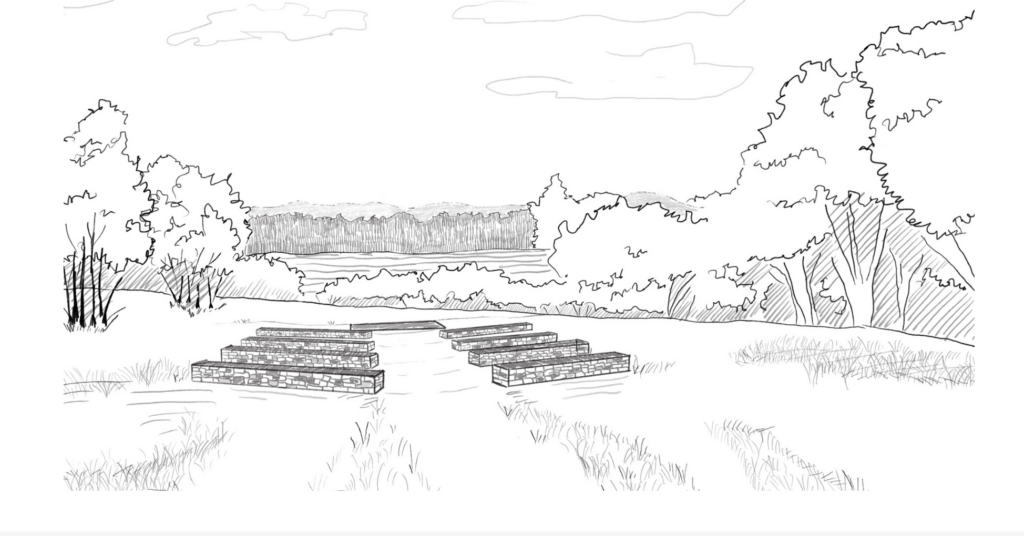
Architect's sketch of the proposed poets' memorial at Wildwood Cemetery and Wildwood School. Photo: amherstma.gov
Report on the Meeting of the Historical Commission, June 9, 2026
This meeting was held over Zoom and was recorded.
Present: Commissioners Robin Fordham (chair), Pat Auth, Joel Greenbaum, Hetty Startup, George Baitinger, and Kenzie Landsitte
Staff: Walker Powell (planner)
Amherst Poets’ Memorial at Wildwood Cemetery
Wildwood Cemetery is constructing a memorial to 16 deceased poets with a connection to Amherst. Ten stone benches and a 10-by-10-foot natural stone platform that can serve as a stage for poetry readings and other gatherings will be placed on a rise across Strong Street from the cemetery entrance, adjacent to Wildwood Elementary School, on two acres of land owned by the cemetery that had not previously been formally used.
Cemetery trustee Jonathan Klate told Historical Commission members that the 16 poets will be honored with bronze plaques on the benches giving the dates they lived as well as a few lines of their poetry.
The memorial will “honor Amherst’s unique and outstanding poetic heritage,” Klate said. The poets selected were “outstanding poets who were recognized as having a unique voice in their lifetime, and have left a legacy of poetry that is still being read to this time.” When the site is completed, visitors will have a view over the town and valley to the Holyoke Range in the distance.
The poets being memorialized are, in order of birth:
- Helen Hunt Jackson was born in Amherst and was a classmate of Emily Dickinson. She was a tireless advocate for Native Americans who published many books of fiction and nonfiction, as well as five books of poetry.
- Emily Dickinson was born in Amherst in 1830 and needs no introduction.
- Eugene Field is best known for his children’s poetry and spent his childhood in Amherst.
- Robert Frost taught for extended periods at Amherst College.
- Archibald MacLeish was a transformative Librarian of Congress who won three Pulitzer Prizes. He taught at Amherst College.
- Robert Francis lived in Cushman and built a home he called Fort Juniper that still serves as a residence for poets today. Frost called him “America’s best neglected poet.” Francis lived most of his life in Amherst.
- Joseph Langland taught at UMass Amherst and founded its MFA program for poets and writers.
- Richard Wilbur is generally acknowledged as among the most distinguished poets of the second half of the 20th century. A graduate of Amherst College, he lectured there periodically and was the lyricist for Leonard Bernstein’s operetta “Candide.”
- James Baldwin was one of the most celebrated African American novelists and also published several well-regarded books of poetry. He lived in Amherst in the 1980s and taught at Hampshire College.
- Jack Gilbert was the author of five volumes of poetry and a finalist for a Pulitzer Prize.
- Andrew Salkey was a Jamaican writer born in Panama and one of the founders of the Caribbean Artists Movement. He authored more than 30 books and taught at Hampshire College for many years.
- Anne Halley was a German-born American poet and faculty member at UMass Amherst. She served as poetry editor of The Massachusetts Review, which now co-sponsors a poetry prize in her name in collaboration with the UMass English Department.
- Pat Schneider was a long-term Amherst resident who published 42 books of poetry and is buried at Wildwood Cemetery.
- Linda Gregg taught at Hampshire College and published several volumes of poetry.
- James Tate was a widely celebrated surrealist poet and UMass Amherst professor for decades, winning many awards including a Pulitzer Prize.
- Deborah Digges was an English professor who taught at many colleges and published numerous books of poetry. She won several awards, including two Pushcart prizes and the Kingsley Tufts Poetry Award — the largest award for a single work of poetry — for her collection “Rough Music.” She wrote a memoir about her son and their life in Amherst. She died in a fall from the top of Warren McGuirk Alumni Stadium in what was reported as a suicide and is buried at Wildwood Cemetery.
Klate said Amherst’s poetic legacy is probably unmatched among small towns in America but has been undercelebrated, outside of Emily Dickinson and Robert Frost. “We thought it was beyond time that there be a venue to celebrate Amherst’s poetic heritage and the presence of Amherst poetry, which is ongoing, with a place for readings.”
The memorial is expected to be completed in July. It will seat 30 to 40 people and will be open to the public. Klate said there is an accessible path to the site and parking is available at Wildwood Elementary School and Amherst Regional Middle School.
New Signs for West Cemetery
Seth Gregory of Seth Gregory Design presented designs for new signs at West Cemetery. He proposed several small descriptive signs to identify the people and events depicted in the mural at the rear of One East Pleasant St., created by David Fichter in 2005 and recreated in 2019 when the building was reconstructed. The mural depicts significant moments, figures, and historical events from the town’s past.
Gregory also plans directional signs at each cemetery entrance pointing to notable graves, such as that of the Dickinson family. He is considering making mock-ups of the signage to see how they look on site.
Core Properties Chosen for Mid-Century Modern Study
The Historical Commission received $50,000 in Community Preservation Act (CPA) funds to begin a study of mid-century modern buildings in town. These are structures mostly built from 1952 through 1958, though some were constructed later. The commission has engaged Shannon Walsh, a historic preservationist at the Pioneer Valley Planning Commission, to conduct a preliminary survey. The commission would like to concentrate on residential buildings, since those are more at risk of alteration and demolition than large public buildings.
It was estimated that there is enough funding to survey 17 houses. Larger buildings — such as Stavros, Ann Whalen Apartments, the Clark House, the Bangs Center, and the elementary schools — would be the next priority, followed by neighborhoods with a large number of mid-century modern homes, such as Hills Street, Red Gate Lane, and Flat Hills Road.
Chair Robin Fordham noted that Hampshire College was built in this era. She suggested that the Massachusetts Historical Commission might be willing to provide a surveying grant for that large, multi-structure property, and that the commission apply for additional CPA funds to supplement it.
New Members Coming to the Historical Commission
This was the last meeting for commissioners Fordham, Startup, and Auth. Joining the Historical Commission in July will be Kalyani Subramanyam and Camila Hwang-Carlos. Subramanyam will serve a three-year term; Hwang-Carlos will serve a one-year term.
Yes, a wonderful project and list of names of those whose words stay with us. Please note that the correct spelling of number 7. is Joseph Langland.
Beautiful plan for a beautiful spot!
We are quite intimately familiar with the Wildwood Cemetery, but we didn’t realize its lands extended south of Strong Street.
Perhaps this generous gesture will inspire an equally beautiful community-preserving future use for the retiring Wildwood School building and site?
The now-mostly-culverted Tan Brook springs from both the Wildwood Cemetery and Wildwood School sites, and flows though the heart of Amherst, then the UMass Campus, eventually to meet the Mill River beyond the Mullins Center.
Imagine what it would be like if the natural beauty of this landscape — the little valley of the Tan Brook — were a more celebrated feature of our community….