
Letter | Saving Allebach Farm: A Model for the Hampshire College Campus?
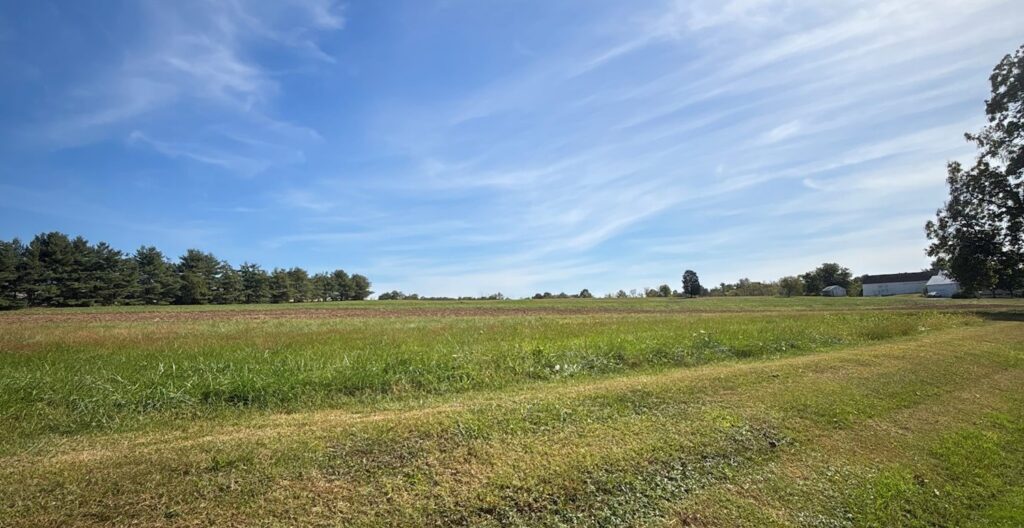
Allebach Farm, Lower Salford Township, Montgomery County, PA. Photo: Lower Salford Township
Instead of turning the Hampshire College campus into a real-estate-development boondoggle, what are the chances of Amherst doing something like this (see below)? There are likely constitutional challenges for a town in Massachusetts to impose a local income tax, not to mention its unlikely political popularity, but if a small township in SE Pennsylvania can swing for $21 million to preserve a 63-acre farm, why can’t “great-again-Amherst” swing for 50% more to preserve much of an 800-acre campus? Please check out the attached article.
Rob Kusner
Rob Kusner is Professor of Mathematics at UMass and a former member of the Amherst Select Board.
Saving Allebach Farm
Residents of Lower Salford Township, Montgomery County, PA, voted overwhelmingly—more than four to one—to approve an Open Space Referendum on May 19. The vote meant there was finally a clear pathway to save the 63-acre Allebach Farm, an iconic property that the township wanted to purchase to preserve as community open space. The township had negotiated with the Allebach family a sale price of $21.5 million. Anticipated grants would cover about 35 percent of that price. The remaining cost would be funded through an Earned Income Tax on township residents, but only if voters approved the ballot measure to tax themselves. “When Lower Salford Township reached out to us to help them with the open space referendum, we were thrilled,” said Kate Raman, planner for Natural Lands. “We guided them through the process and even secured additional grant funds for them to reduce the expense of monthly bond servicing.” Added Kate, “The residents and leaders of Lower Salford value conservation and the Township’s rural heritage. We were so pleased to be able to work with the community to create open space funding to protect natural areas for future generations to enjoy.”
Reprinted from Natural Lands.
My dear friend, Rob,
You are dreaming if you think Amherst taxpayers will support and will come up with $25,000,000 to save 800 acres when we still don’t have a South Amherst fire station to protect them after 51+ years of talk!l
I agree with Ms. Greenbaum here. The town of Amherst would do best to use this land both for its municipal needs (such as the fire station she mentioned), and for tax-revenue generating purposes (such as dense, mixed-use housing + businesses).
Amherst needs to ensure it has increased revenue in the coming decades in order to remain a financially resilient town that can fund all the services we enjoy, and to become a place where more people can afford to live (especially if a lot of housing is built, which would help stem rising rents).
As I learned in last year’s Civic Academy, Amherst has a surprisingly small amount of land area that it can generate tax revenue from, in comparison to the total land within our town’s borders. Any addition to that revenue-generating land total would be a great boon to the town.
The author’s characterization of the need to use the Hampshire College land in a financially prudent way as a “real-estate- development boondoggle” is uncharitable.
I agree with Rob Kusner. The Hampshire College campus is a unique place that ought to be preserved as much as possible. Some of the buildings could be used for housing but the land ought to be preserved as is. The existing
farmlands can be used to support local agriculture and provide food for school cafeterias (farm-to-table & local).
More importantly, this is an opportunity to practice ‘rewilding’ – a much needed antidote to the current over development that is destroying our biodiversity and ecosystems. (If you are interested in rewilding, here are a few sites: https://wildworldrewilding.org/ and https://rewilding.academy/ecosystem-restoration/sir-david-attenborough-rewilding-our-planet/).
I worry that the rezoning, and subsequent development, will provide a short-term fix for the on-going fiscal woes of the Town of Amherst when longer-term solutions are required (e.g., modifying some of the existing agreements with U.Mass. and Amherst College, vs. continuing to raise our already high real estate taxes), as well as more fiscal realism (e.g., the library reconstruction budget deficit).
Dear Hilda: a tiny fraction of Hampshire’s 800 acre campus could easily accommodate a new fire station, if that proves to be an appropriate location.
And dear Joe: existing campus housing and other campus buildings cover a fraction of the campus; these might be repurposed or redeveloped for future community housing and business functions, along the lines you suggest.
As I thought I made clear in what I wrote: I too am skeptical that Amherst could do something exactly like Lower Salford Township did. However, I do believe the remaining agricultural and open-space lands on the Hampshire campus merit more protection than what the zoning changes which have been proposed so far might provide.
And regarding language, perhaps both “bonanza” and “boondoggle” apply here: the former, to the private profits real-estate developers will promptly reap; and the latter, to the nontrivial public expenditures already devoted to the ongoing planning exercises, as well as significant public expenditures such a project might eventually entail — possibly an even larger South Amherst fire station than had been planned for the last 51 years, as well as other public infrastructure, including another elementary school — if anything like the proposed 2000 housing units were to be developed on the Hampshire campus.
I am told by the EMTs that the station needs to be nearer the center of town because this is where most of the calls originate. And the “new” north station is fifty years old now, an antique maybe needing more than the new red paint.