
Town Must Revisit Library Budgeting Warns Sarat
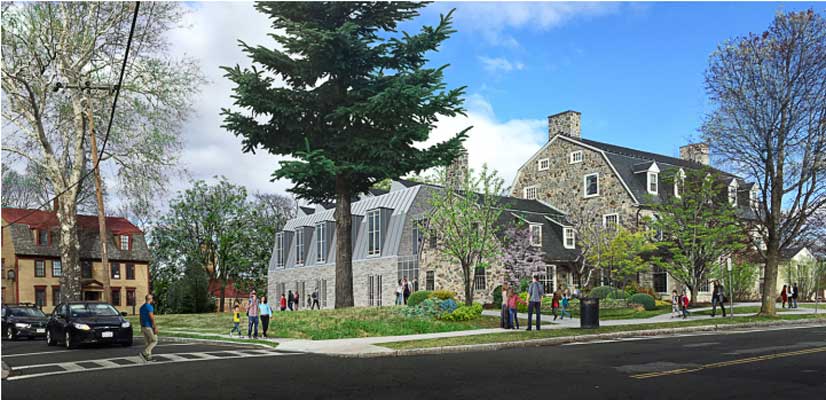
“As we contemplate what will occur in the town’s budgeting process over the next several years, we will need to think with the town about the financing of the Jones Library,” declared President Austin Sarat at the August 13 Jones Library Board of Trustees meeting. This pronouncement comes in the wake of Sarat’s acknowledgment at the July 30 trustees meeting that the gap between capital campaign fundraising and the library’s obligation toward project costs is likely to be substantial.
A large deficit when the library’s remittance to the town comes due, anticipated before June 30, 2027, will mean the trustees must plug the gap with funds from their $9.6 million endowment, leaving less money available for annual operating expenses. After the recent transfer of $600,000 to the town, the library obligation sits at $8,443,331.64 according to an April update from Finance Director Sean Mangano.
“As we contemplate what will occur in the town’s budgeting process over the next several years, we will need to think with the town about the financing of the Jones Library,” Sarat cautioned. “We’ll think on our own, but we’ll also think with the town about the support needed for the library. More about that in due course as the town’s budgeting process begins in the fall,” he added.
Capital Campaign Logs $1M from CPA
The trustee packet included a capital campaign report from July 1, but Lee Edwards reported more current results verbally. She made the encouraging announcement that $1.006 million had been converted from pledges to cash in July. However, this result became less impressive when Edwards disclosed that $1 million was from a 2021 Community Preservation Act grant. CPA funds come mainly from receipts from a local property tax surcharge.
Friends and Jones Library Look to Reorganize Fundraising Entity
Looking ahead, the trustees and the Friends of the Jones Library have been discussing a change to the library’s fundraising organization. Under the current arrangement, the Friends of the Jones Library, which is structured as a 501(c)(3) nonprofit, has sole responsibility for capital and operational fundraising. An alternative being considered is to form a foundation in which the trustees and library will take on a more active role in fundraising.
The capital campaign had been entrusted to a private, non-profit corporation, explained Edwards, so “all of the sensitive financial data that a campaign committee has to gather [can] stay confidential.” A 501(c)(3) is not subject to state Open Meeting or Public Records law.
Library Community Feedback Sessions Lined up for September
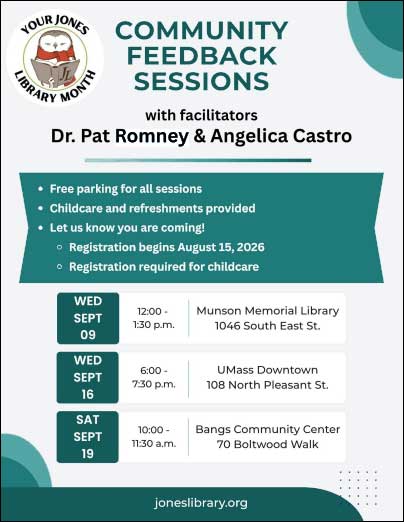
Farah Ameen, chair of the Jones Equity, Diversity and Inclusion Committee (JEDI) announced that the library will be sponsoring three Community Feedback Sessions to gather input on how residents feel about belonging and security in the library space. Dr. Pat Romney and Angelica Castro will be facilitating the three listening sessions, which are scheduled for September 9, September 16, and September 19.
Ameen announced that the JEDI Committee is in the process of adding a student from Amherst College as a new member.
Director Predicts Circulation to Double
When asked how renovations to Western Massachusetts libraries have impacted usage, Director Sharon Sharry responded that “the industry rule of thumb is that circulation doubles within the first three years 100% of the time.”
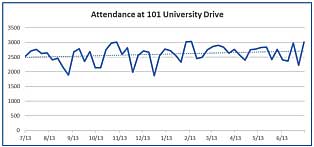
Patron attendance since the library moved to its temporary location at 101 University Drive has been fairly stable.
Sharry predicts that once the doors to the new library open next year, “the community is absolutely going to be overjoyed.”
Library Leaders Concerned Over Declining Literacy
In the meeting packet, Sharry attached several essays on trends in reading. Included were “College professors face an emerging challenge: We know students are no longer reading entire books” by Amherst College Professor Austin Sarat, a commentary on the impacts of ChatGPT by Amherst College President Michael Elliott, and a lengthy analysis by Rose Horowitch in The Atlantic titled “The End of Reading is Here.”
Sarat notes a finding that some entering college students have not read a single full book from cover to cover during high school. Elliott argues that growing reliance on easy and instant answers from artificial intelligence threatens the mission of higher education, dulls critical thinking and erodes the health of democracy. Horowitch offers sobering statistics suggesting that the age of reading may be drawing to a close.
In Amherst, where a book is featured on the town seal, these observations undoubtedly resonate. What remains open to debate is how best to direct limited public and library resources to address the issues.

Promises were made by the town that they would not pay a penny more. Now that the friends of the Jones are unable to make good on their fund raising promise the tax payers will surely be asked to shoulder the burden. In this case the check does not appear to be in the mail.
When or where does this end? Has something been purchased without the appropriate funding to pay for it? A leading member of the Town Council told the Library long ago “Do not ask us for any more money”. Has this reasonable budgetary limitation been ignored?? The Town is now thankfully and gratefully addressing the critical need for a DPW Center and hopefully the long overdue Fire Station will be next. The combined costs of these two buildings could be $55M or more. These are real costs with taxpayer impacts. How sad that the long overdue Fire Station sits inches behind the palatial Library. Does Mr. Sarat care? Of course not. My life has been framed by libraries from the Riverdale NY Library to the Irvington Library where as a Village Councilor I helped the Library move into expanded and historic space at the Lord and Burnham Building. I worked in upstate Auburn New York which has the gorgeous Seymour Library. We love libraries and are strengthened by them but construction projects should be budgeted within taxpayer and completion realities.
I am deeply disappointed that the Jones Library project has brought the town to this point. Amherst needs and deserves a strong, accessible library, but it also deserves a project plan grounded in realistic costs, reliable fundraising assumptions, and clear public accountability.
Other nearby communities have renovated or built libraries without leaving residents to contemplate significant additional financial obligations after the fact. The reported gap between the library’s fundraising and project commitments, together with the prospect that the town may need to provide further support, warrants a candid public explanation.
The statement that the library will need to “think with the town about the financing of the Jones Library” is not enough. The trustees should clearly explain the remaining obligation, the expected fundraising shortfall, the possible consequences for the endowment and operating budget, and what forms of town support may be requested.
Most importantly, the library’s leadership should acknowledge that public concerns about affordability and financial risk were serious and warranted. A transparent accounting of what happened, what was learned, and how future decisions will be made differently would help rebuild trust.
Before any additional town commitment is considered, residents deserve complete financial information and a credible plan that does not shift unforeseen costs onto future library services or taxpayers.
One expects that when an organization commits a colossal screw up heads will roll. I can only hope that if shame doesn’t result in resignations that the voters will remember come next year’s town election.
The Town can demand the Library’s fundraising shortfall from the Library’s$9m endowment. At that point fundraisers can change the goals to “asking donors to support operational expenses” instead of renovation costs. Taxpayers need not shoulder the fundraising shortfall resulting in an operations deficit usually funded by the library.
Operations expenses should match available library funds. Shorter hours, less staff etc. The rest of us adjust lifestyle to meet our income..so can the library. Not the best solution but it is one option to consider. Who makes this decision? Town Council, Voters, Town Manager, Library Trustees?
Is there no end to their hubris? First Sarat warns (threatens?) the town that come budget-time the town must consider Library financing. To put it another way, because of the Trustee’s mismanagement and the failure of the capital campaign, the endowment will no longer be available to fund operating expenses and therefore the town is expected to make up the deficit regardless of its effect on essential town services This shouldn’t come as a surprise – Trustees have never shown concern for how their decisions affect critical town needs
But the arrogance didn’t stop there. The million-dollar -plus “conversion of pledges” dwindled when clarified that it consisted almost entirely of a taxpayer-funded CPA grant. And to top it off, the lack of fundraising transparency, hiding within the Friends 501(c)(3) status, is touted as a good thing. All of this – the mismanagement, the evasive statements, the opacity – was present and obvious well before the Town Council took the first vote. And we all must live with its consequences – an expensive, cavernous library where, according to the articles Sherry provided (one penned by Sarat), few of its books may be read.
There are both federal and state tools which may be worth considering in this situation. For instance, the Massachusetts False Claims Act (M.G.L. c. 12, §§ 5A–5O) allows the state attorney general or private whistleblowers to sue individuals and companies that knowingly submit fraudulent claims for payment to state or local governments. Violators face triple damages, legal costs, and civil penalties up to $11,000 per false claim.
The act covers fraud against the Commonwealth as well as local political subdivisions like cities, towns, and school districts. While “knowingly” requires actual knowledge, deliberate ignorance, or reckless disregard of the truth; no specific intent to defraud is needed. Private citizens can file actions under seal and may receive 15% to 30% of the state’s monetary recovery. Enforcement is handled via the Attorney General’s False Claims Division, which maintains a public fraud tip line (617-963-2600).
We have reached the stage in the library saga that confirms Marx’s quip that history repeats itself, first as tragedy and then as farce. The tragedy of the demolition/expansion project has been evident for over a decade; Indy writers have described it with facts and figures extensively and accurately. If it culminates in the use of the endowment to fund it, is there any recourse similar to the state’s taking over the administration of “low-performing” school districts? Do the General Laws provide for remedies in the case of neglect (or worse) of fiduciary duty by elected public officials? Could the town take over the management of the library? And if the answer is “no” surely the town can set severe conditions for its rescuing of this “too big to fail” project. The immediate resignation of the library trustees and library management would be the first condition.
The problem is that the town’s government is complicit; so is the state. The Massachusetts Board of Library Commissioners, by stipulating that its funding was dependent on increasing the size of the library, set this ball rolling on its inevitable course. Are there any graduate programs in library or information sciences that taking temporary receivership of this facility while the town got its house in order? Is there a consortium of individuals who would discuss funding the remainder of the project in return for a significant voice in reconceptualizing its future? Apparently similar conversations were proposed for Hampshire College. The Jones situation is not dissimilar.
You are absolutely right, Michael, about the role of the Massachusetts Board of Library Commissioners in the Jones Library fiasco. Not only did MBLC library consultants require the excessive size as a condition of the grant, but emails show that they also demanded that the print collection be reduced by about 40,000 items to “provide more flexibility in use of space.” We patrons and taxpayers had zero opportunity to weigh in on whether this is the direction we wanted to take the Jones.
As keepers of the state’s public library data, this powerful gang of library directors knew, or should have known full well that annual visits to the Jones Library had decreased by more than half since 2006. Yet they happily put up $15.6 million of state funds to demolish and enlarge the historic building. There have been suggestions that a reason the MBLC awarded Amherst their biggest construction grant ever was to please our local state rep. and senator who had pledged support in the upcoming legislative battles for library funding.
All this while we in Amherst have seen firsthand how painfully inadequate are the state’s contributions to public K-12 education and transportation infrastructure.
As a town resident I feel we really need an answer to this huge problem. Who takes responsibility for this? Is Mr. Bockelman, the Town Manager, in the position for finding a solution to protect taxpayers? If not, who is?
The town is paying for approximately 30 percent of the Jones library renovations. The renovations make the building into a palace-sized pimple on the town’s modest footprint. The town should take 30 percent of this now-giant building and locate things in it like a new teen social center, the CRESS offices and outreach space, Leisure Services (or whatever it is called now), and other town functions that are currently crammed into the Bangs center. Doing this will at least get tax payers some benefit and control over how its money was handled.
Perhaps another option to utilize the empty space required by the MBLC in order for Amherst to recieve those funds for the renovation is for the library to rent space out in to Starbucks or Dunkin. The income can partially subsidize library operations. The drive thru could be next to the book drop. Starbucks rents space in the tax exempt UMass Campus Center. That rent income probably helps pay for University building expenses and is totally unrelated to an educational mission. Commercializing the empty space in the library should be considered at this point.
I sure hope the location of the bookdrop remains at the end of the driveway, since, I thought we weren’t planning to make a hole in the stone, very visible bike from the street. I can just imagine the traffic jam resulting from a drive through at this cul de sac.
Otherwise, I like thinking positively about something that only gives me negative vibes.
Over the years there have been ideas to put a cafe in the western “bump out” of the former children’s room.
Thank you to Jeff Lee for sitting through meeting after meeting, year after year and reporting to us the details. This takes incredible stamina and dedication.