
What Massachusetts’ New ICE Law Protects, and What It Doesn’t
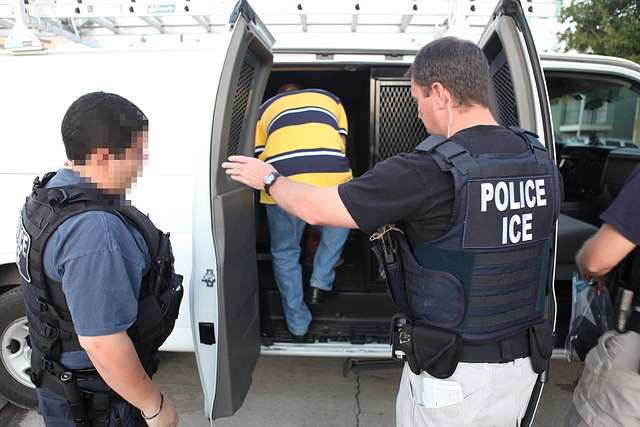
Photo: PICRYL /Public Domain
by CommonWealth Beacon staff
This article first appeared on CommonWealth Beacon and is republished here under a Creative Commons Attribution-NoDerivatives 4.0 International License
When Gov. Maura Healy signed the PROTECT Act in Chelsea last week, she called it the strongest law in the country to protect people against the “dangerous” tactics of President Trump’s federal immigration enforcement actions.
“Now we have parents who are afraid to send their kids to school. Moms who are afraid to take their kids to doctor’s appointments,” Healey said. “All of this done by ICE agents who are untrained, unqualified, and unfit to do their jobs.”
The law limits how much state and local police can cooperate with ICE and bars new agreements that allow local officers to be deputized as federal immigration agents. The existing agreement with the Department of Correction remains in place.
It also creates a state version of a longstanding policy that the Trump administration rolled back on the federal level, which prohibited federal officers from detaining people at “sensitive locations” like schools, health care facilities, child care centers, or courthouses without a warrant signed by a judge.
For advocates like Iván Espinoza-Madrigal, executive director of Lawyers for Civil Rights, the law is a positive step to restore the security of sensitive locations. But what the law actually stops ICE from doing, and how, is narrower than the sweeping political language suggests.
“This is really where the rubber hits the road,” Espinoza-Madrigal said on The Codcast, describing the gap between what the law bans inside a building and what it can’t touch outside it. While this may limit immigration actions on certain property, immigration enforcement is able to operate in most public spaces and, in an urban area like Boston, it will not always be clear if an ICE staging near a sensitive location is targeting that location.
Ideally, Espinoza-Madrigal said, “this is not just a legal protection that applies when you cross the threshold into the school. It has to be something that is much more robust to make sure the kids are safe from the minute they step outside of their house to the minute they return home.”
The rationale for protecting sensitive locations like courthouses, in advocates’ views, is about victims and witnesses being able to access court proceedings. Courthouse arrests statewide more than doubled between 2024 and 2025. By the last reported count from the Massachusetts Trial Courts, there were at least 726 ICE arrests from January 2025 through February this year in state courthouses.
Critics argue limits like this make it harder to catch people who pose a serious threat.
“Criminals will no longer be able to hide in America’s schools and churches to avoid arrest,” the Department of Homeland Security said as it rolled back a policy of limiting immigration enforcement in sensitive locations. “The Trump Administration will not tie the hands of our brave law enforcement, and instead trusts them to use common sense.”
Espinoza-Madrigal rejects that framing outright. “It’s actually the federal government that’s creating the public safety harm,” he said, pointing to ICE encounters that have turned fatal this year in Maine, Minneapolis, and Texas.
For workers at sensitive locations who may face immigration enforcement, Healey and lawmakers have said the law “clarifies” their options.
Espinoza-Madrigal describes it as less about blocking a door and more about creating a record. Know which areas are public and which are private, he said. Designate one person to greet ICE and ask for a warrant. State out loud that the encounter isn’t consensual.
Healey’s guidance to schools and hospitals, along with the PROTECT Act, makes the same point: Set clear escalation procedures, and remember that an administrative warrant doesn’t authorize ICE into non-public space. The state has also opened a portal for residents to report alleged ICE misconduct.
But a call about ICE should be to a lawyer, not the police. The new law is explicit about what local police are not required to do. They don’t have to interfere with ICE, and the statute gives them no authority to enforce the bans. That job belongs to the courts after the fact.
The attorney general can take the federal government to court, and someone arrested in violation of the law can ask a judge to order their release.
Espinoza-Madrigal wouldn’t be surprised if the federal government sues Massachusetts over the new law. The Trump administration is already suing states including Massachusetts over their policy to allow in-state tuition rates regardless of legal immigration status.
And the line between state and federal power is most murky when it comes to immigration enforcement. Researchers at the University of Wisconsin’s State Democracy Research Initiative reviewed various state actions to limit ICE, including Massachusetts’s PROTECT Act and similar laws in other states. Based on previous cases and the Trump administration’s posture so far, researchers said they expect that the federal government could argue that its immigration powers should pre-empt most if not all state attempts to limit their power. Officials in Massachusetts say this falls squarely within state’s right to regulate for the public welfare.
The broader legal terrain doesn’t offer much guidance either way. The Supreme Court ruled in December that Trump likely lacked authority to federalize the National Guard in Chicago and in June it upheld birthright citizenship.
But the court also let the administration terminate Temporary Protected Status for Haitians and Syrians. Roughly 45,000 Haitian TPS holders in Massachusetts could now be deported, regardless of the state’s PROTECT Act.
In the Codcast episode, CommonWealth Beacon reporter Jennifer Smith and Espinoza-Madrigal discuss what the PROTECT Act does and doesn’t cover (4:30), how residents and institutions should handle an ICE encounter (17:50), and the unsettled legal fights ahead (28:30).
.