
Finance Committee Debates How to Prioritize Budget Cuts

Following sobering assessments of Amherst’s budget challenges given to the Budget Coordinating Group (BCG) and the Town Council, Finance Director Sean Mangano walked the Finance Committee through concerns as the FY28 budget process gears up.
The recorded meeting took place on October 6 with voting members Lynn Griesemer (vice chair), Jill Brevik, Ana Devlin Gauthier and Sam MacLeod and resident non-voting members Cathleen Mitchell and Jeffrey Robert present. Representing town staff were Mangano and Town Manager Paul Bockelman.
“Storm Clouds Coming”
Mangano presented a draft budget calendar and the BCG’s Opportunities and Concerns list. It includes health insurance, slowing new growth, energy costs, rising interest rates, and an expense side of the budget that is growing “tighter and tighter.” He then added detail:
- Wages are mostly spoken for. With most unions under contract, there is little discretion over the cost of living adjustments or step increases, Mangano noted.
- Last year’s 3.5% was generous. FY27 operating budgets grew 3.5% which was still not enough to maintain the public schools at existing service levels, Mangano remarked, “It would be great if we can get to 3.5% again, but I don’t know that the way things are shaping up right now that that’s where we’ll be.”
- Only two levers. If the budget doesn’t balance, the council’s flexible tools are “how much we put towards operating” and “how much goes in towards capital.”
- Capital has little slack. Much of the capital allocation is already debt, including the planned Department of Public Works building. The five-year plan shows how much is left for everything else, Mangano said, “and it’s not a lot.” Interest rates “are not dropping. They’re going the other way.”
- Regional school debt is uncertain. The regional capital plan which may need to include a new high school roof at some point “could spend our entire capital allocation,” depending on timing, he said.
Bockelman added that the Town has frozen five positions, but “pretty soon we’re into the people part of our budget and that’s the most difficult part of cutback management.”
The warnings prompted MacLeod to observe “storm clouds coming in” and “a lot of stars aligning potentially negatively.” He expressed worry about big building projects. “If we go 10 million over budget, that’s going to cascade,” he said of recent DPW estimates.
Of potential opportunities such as new growth, Griesemer said, “None of these are going to happen overnight.” “We really are looking at a very tight budget situation going forward.”
Regarding a proposed tax override, MacLeod said he would “have a hard time voting to recommend” one, and Mitchell said, “I’m not sure there’s an appetite locally for an override.”
“We think in these siloed ways”
A difference of opinion surfaced when Mitchell questioned the accepted policy of giving the Town, Schools and Library the same percentage annual increase. “We talk a lot about how we have to have these very difficult conversations, but I think that to some extent [this practice] prevents us from having some of the difficult conversations.”
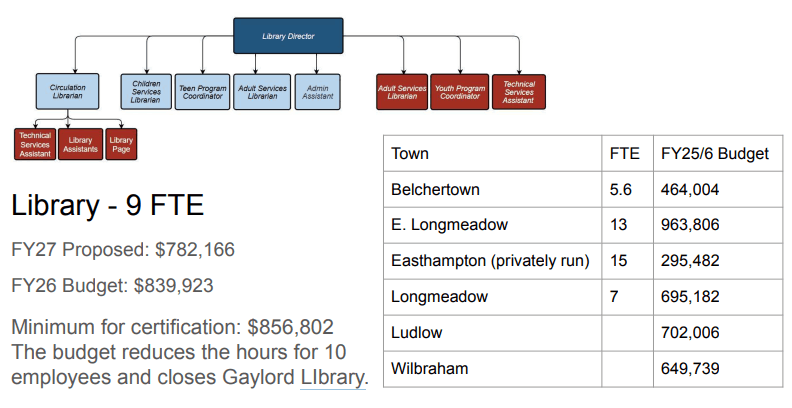
She recalled other communities debating whether to “reduce library branch hours so that we can preserve public safety” or “cut this service so that we can fund our schools.” Amherst, she said, risks limiting “ourselves from having some of those conversations about essential services… because we kind of think in these siloed ways.”
An example of the hard look at priorities that Mitchell referred to occurred last year in South Hadley. To meet school needs, local officials proposed closing the Gaylord Library branch. Only a last minute infusion of $1.5 million in free cash prevented the closure.
Mangano replied that the practice is “one of the most critical reasons why the town has worked so collaboratively and so well together over the years.” In other towns, he said, “you see a lot of fighting between departments and you see failed overrides.” He conceded “it can sometimes feel restricting.”
Bockelman said the Town isn’t dodging the question. If the council wants to prioritize, “it’s good to prioritize and then give the staff the opportunity to develop the budget.” But once a community starts taking positions, “it really is hard to get out of that because people have long memories.” Robert backed Mitchell: “Nobody wants to cut anything in a town,” he said, but someone must decide whether “A over B or B over A.”
The consequences of a shortfall also differ. As Robert put it, “kids still need to go to school,” and the council has already chosen to put more into fire and EMS, where staffing is hard to trim. A library can, in principle, adjust hours or programs, and it has donors to lean on. If residents don’t weigh the three equally, an across-the-board increase may quietly protect the lowest priority at the expense of the highest.
The Budget Discussion Continues
November 2: Financial indicators presentation with first projections.
November 3: The Finance Committee meets again.
The following week: The BCG reviews the indicators and begins drafting input.
November 16: Public budget forum.
Later in November: The committee meets and the BCG finalizes its input.
By the end of December: The committee aims to send budget guidelines to the council for a vote.