Craft Revivals, the Creative Economy, and Social Welfare: Boosting Well-being in the Valley at the Turn of the 20th Century
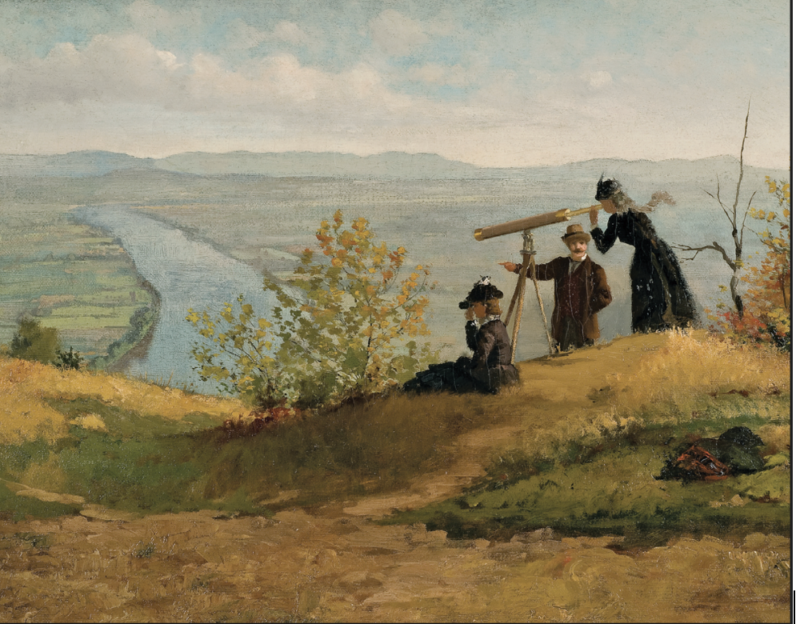
View from Sugarloaf, Along the Connecticut River looking towards the Holyoke Range, ca. 1877, by James Wells Champney (1843-1903)/ Champney was an artist and teacher known for his landscapes, genre scenes, and portraits. This painting shows a panoramic view of the Connecticut River from Mount Sugarloaf in South Deerfield that demonstrates its significance as a vantage point from where people are seen exploring the heights with a telescope. Photo: Historic Deerfield
This is the second in a five-part series on the creative economy and social welfare. Read the first installment here.
Local arts and culture sites are considered essential parts of our region’s creative economy today. According to the Mass Cultural Council, cultural district programs can “build cross-sector relationships, support artists, and strengthen people’s connection to their communities.” Several downtowns have designated parts as cultural districts to increase tourism, though the districts can also serve other goals, such as long-term wellness and neighborhood vitality. Massachusetts has 53 designated cultural districts, including Greenfield, Cummington, Amherst, Holyoke, Westfield, Northampton, Easthampton, Springfield, and Shelburne Falls.
In the past, other strategies brought renewal and prosperity to small villages and towns in rural areas like the Valley. These strategies became necessary in the late 19th century, when small towns along the Connecticut River had seen better days. This was especially true after the Panic of 1893, a severe depression that triggered a nationwide financial crisis lasting until 1897. Tariffs, such as the McKinney Tariff of 1890, among other factors, affected the cost of living and the local economy.
A change in direction was critical for Deerfield. When one of its neighborhoods, Cheapside, was annexed to Greenfield in 1896, the town lost residents, a manufacturing base, and a lively river port. In the decades after the Civil War, fewer homes had a male head of household, and some women inherited property on The Street in Deerfield, which was unusual at the time. This matters because many 18th-century homes there were restored, turned into summer houses, or given other uses. By the beginning of the 20th century, “about one-third of the houses on The Street were owned by women.” Many of these houses had parlors converted into workspaces and salesrooms as their owners embraced the Arts and Crafts movement.
Deerfield’s early 20th-century economic revival also followed the out-migration of some young people, who headed west in pursuit of cheaper land on the prairies. Meanwhile, newer immigrants arrived from Ireland and Germany and, later, from Ukraine, Poland, and other Eastern European countries. Beginning around 1850, Irish, German, and Polish immigrants came to work the land here. They also faced prejudice from some who saw them as a threat to the livelihoods of earlier generations, the sort of fear-mongering and rhetoric that has resurfaced today.
A group of local stakeholders believed Deerfield could once again become a unique destination and weather these economic challenges. They expected rail service to Deerfield to help. Electric streetcar service began in Springfield in 1890, and a “car line” was later offered from Northampton to South Deerfield. The train was embraced, but the trolley got mixed reviews because some key Deerfield figures feared it would desecrate the village. [] The line, operated by the Connecticut Valley Street Railway Co., reached South Deerfield by October 1901 and eventually connected to Greenfield. Before then, visitors traveled by river, stagecoach (stopping at Deerfield’s Barnard Tavern or the Deerfield Inn), or horse and cart, though most people walked.
Attitudes toward transportation likely reflected the lingering influence of the “River Gods.” These were seven interrelated families in the Connecticut River Valley, including the Williams family, who had gained control of the region in the early 1700s. They controlled the county courts, the militia, local Congregational ministers (organized into associations), and the local market economy. Their influence lasted long afterward.
The Arts and Crafts Movement
The cultural stakeholders in Deerfield who embraced the railroad and the modern technology of the time also supported the Arts and Crafts movement. That may seem like a contradiction. The Arts and Crafts movement arose in Britain as a response to ornate, mass-produced Victorian design. It soon became an international design movement with locally distinct trends in art and craft production. Key figures such as William Morris (in the UK) and Gustav Stickley (in the US) sought to revive preindustrial styles and production methods for home goods and furnishings. That desire took hold among both its stakeholders and residents of more modest means in Deerfield. Residents were eager to learn and revive traditional arts while also finding a way to make ends meet. Together, the creative ambitions of the stakeholders and other townsfolk put a spotlight on the old village.
Because Deerfield residents focused on traditional arts and crafts, the town is also seen today as an important center of the Colonial Revival style. In fact, the Arts and Crafts and Colonial Revival movements shared an interest — an obsession, really — in reaching back to a preindustrial past for inspiration while operating firmly in the present. The two movements have different philosophical roots, but the Colonial Revival style is generally traced to the 1876 Centennial Exhibition in Philadelphia, which marked the nation’s 100th anniversary. Deerfield’s cultural history parallels that of small English towns that sought similar cultural uplift through craft revival, such as Haslemere in Surrey, Ditchling in East Sussex, and the Cotswold town of Chipping Campden in Gloucestershire.
George Sheldon and the Bid for a New Economic Status for Deerfield
In Deerfield, a core group led this bid to give the town a new economic and cultural status. It included George Sheldon, a native of the village, and several women of means with summer homes there, such as Madeline Yale Wynne (1847–1918). Sheldon founded the Pocumtuck Valley Memorial Association in 1870 and went on to support several volunteer groups of artisans into the first decades of the 20th century. But he largely ignored, or rather actively suppressed, the Indigenous Pocumtuck people’s material presence in the association’s records. This absence was especially evident after 1880, when he opened Memorial Hall, one of the country’s oldest historical museums. Memorial Hall was Sheldon’s post-Centennial project of “memorializing” Deerfield and the region’s past, a selective, even triumphal narrative, to be sure. He presented white colonial histories as true and authentic while “disappearing” the long history of Indigenous presence in the valley. That important term comes from Abenaki scholar and anthropologist Marge Bruchac. Such assumptions are among the reasons many people find the term “Pioneer Valley” problematic today.
Museum visitors to Memorial Hall in the 1890s and early 1900s could see Sheldon’s curation of colonial artifacts and some collections of Indigenous stone tools, but the Native objects were chosen “for dramatic effect.” Bruchac sees this as an intentional choice that assigned Indigenous artifact makers only an antagonistic role in local and regional history. The most telling example, surely, was the display of the front door from the so-called Indian House, whose actual name is the Ensign John Sheldon House. The door is the only part of the house that survives today.
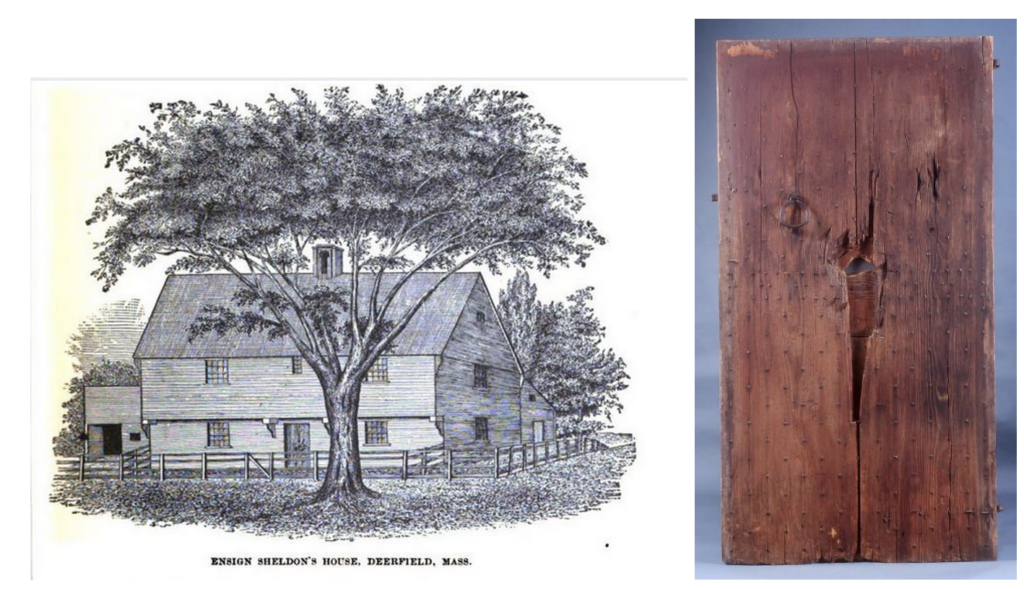
(Right) Indian House door, c. 1699. This pitch pine door has been exhibited in PVMA’s Memorial Hall Museum since 1880. As an artifact, it has come to symbolize, for some people, the historic 1704 Raid on Deerfield. The Raid was an armed conflict between Deerfield’s early English settlers and French soldiers allied with Native supporters (including some Pocumtuck men). The Raid was a part of a larger European war, the War of Spanish Succession. Photos: Hetty Startup
In 1929 a replica of the Ensign John Sheldon House, destroyed in 1848, was built. It now hosts children’s programming, but the museum still displays the original door. George Sheldon’s narratives persisted through the first quarter of the 20th century, negating Deerfield’s Native histories and instead foregrounding the lives of those he considered the real colonial “pioneers.”
He also omitted the later contributions of European immigrants who arrived in the central Connecticut River Valley after about 1850. First came the Germans, Poles, and Irish, who came to help with farming. Later came those who settled nearby in Turners Falls/Great Falls, including people from Bohemia (today part of the Czech Republic) who worked in specialized industries such as fine cutlery manufacturing. Since the early 2000s, and especially since the 300th anniversary of the 1704 raid on Deerfield in 2004, PVMA and Memorial Hall have shifted their focus. They now devote programming, exhibits, and online resources to Indigenous material culture and to immigrant cultures.
Early Craft Organizations
The Society of Deerfield Industries, founded in 1901, was among the first craft organizations to win Sheldon’s support. Other small arts and crafts groups in western Massachusetts were active in nearby Greenfield and at New Clairvaux in Montague. Unitarian minister Edward Pearson Pressey founded New Clairvaux at the turn of the century as an intentional community with a printing press and a cabinetry shop. Like Deerfield’s groups, these organizations modeled their work on Boston’s Society of Arts and Crafts. That meant following the precepts of writer and critic John Ruskin and issuing manifesto-like statements about their commitment to reviving handicraft “as the motives of the true craftsman are the love of good and beautiful work s applied to useful service and the need for making an adequate livelihood. In no case can it be primarily the love of gain.”
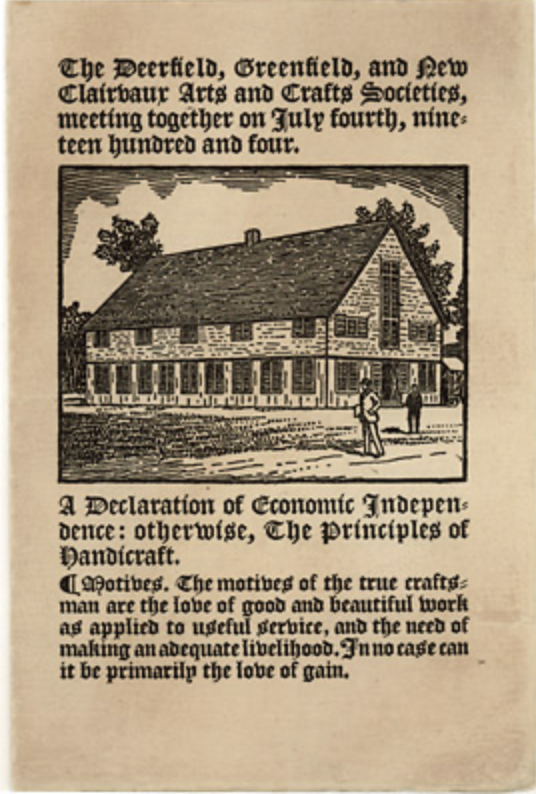
So they hoped to make a bridge between aesthetic and economic realms placing quality above profit. Still, the Deerfield Industries’ programs gave some local people a way to earn an adequate living in challenging economic times.
Madeline Yale Wynne, one of the founders of the Deerfield Society of Arts and Crafts in 1896, came to Deerfield from Chicago. She was inspired to put into practice in Deerfield what she had learned through her involvement with Hull House, the settlement house that was the subject of the first installment in this series. She and her partner, Annie Putnam, were “very influential in developing arts and crafts in the community, with Madeline organizing tours of the village’s craftworkers’ shops and arranging speaking engagements. The two women were expert metal smiths in their own right.
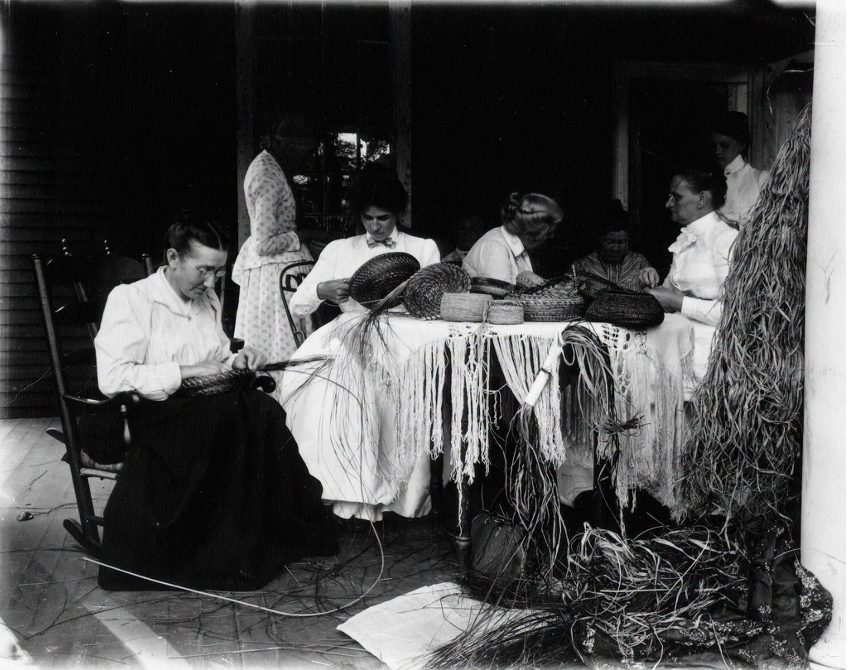
Within the organization, several people became basket makers. They exhibited and sold their reed- and raffia baskets at annual summer exhibitions in town. As far as I can tell, the Indigenous peoples of this area, principally the Pocumtuck, had been recognized basket makers for centuries. They also built their homes, called wigwams, from bent saplings woven with reeds. Native descendants continue to make baskets today.
Other Deerfield artisans revived the colonial-era craft of cotton netting, again as a way to sustain a livelihood. They could make this netting at home, and it decorated the bed testers of colonial homes since the late 1700s.
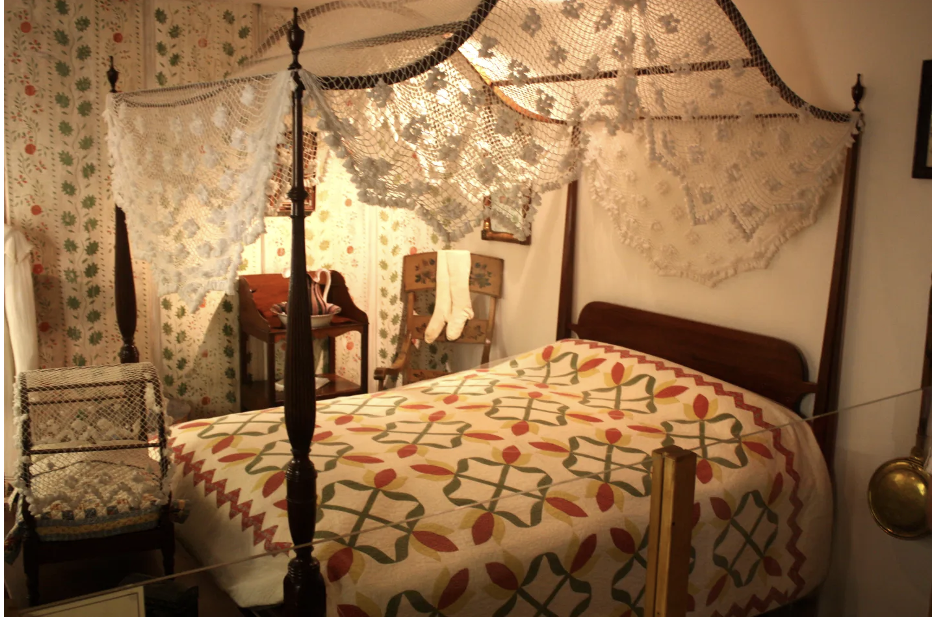
Over the centuries, netting techniques have paralleled the art of tatting, a way to make durable, patterned lace from knots and loops. Both European-based and long-established Indigenous forms of tatting exist, and Wabanaki artists celebrate the art form in their contemporary work. Deerfield’s elite, however, did not include Indigenous work in their vision of cultural uplift. In hindsight, we can at least see that Sheldon and his contemporaries lacked a deeper view of the past and its potential to reveal a more nuanced story. More research and work like that is happening today.
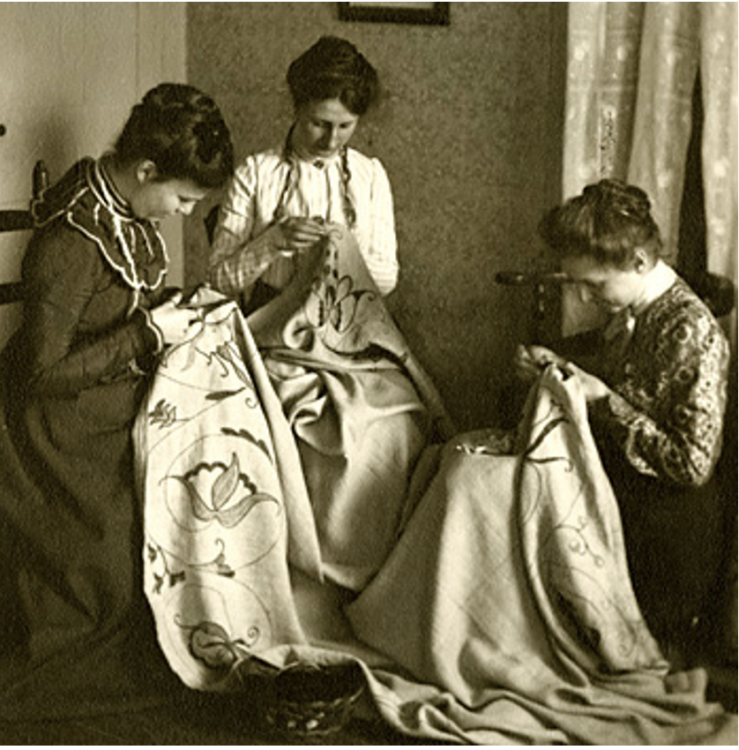
Another organization emerged in Deerfield in 1896: the Deerfield Society of Blue and White Needlework, founded by Margaret Whiting (1860–1946) and Ellen Miller (1854–1929). Local needlewomen made embroidered textiles in subtle shades of blue for home furnishings and for sale. The society also provided paid employment. Historic Deerfield’s houses today show examples of Blue and White Society embroidery.
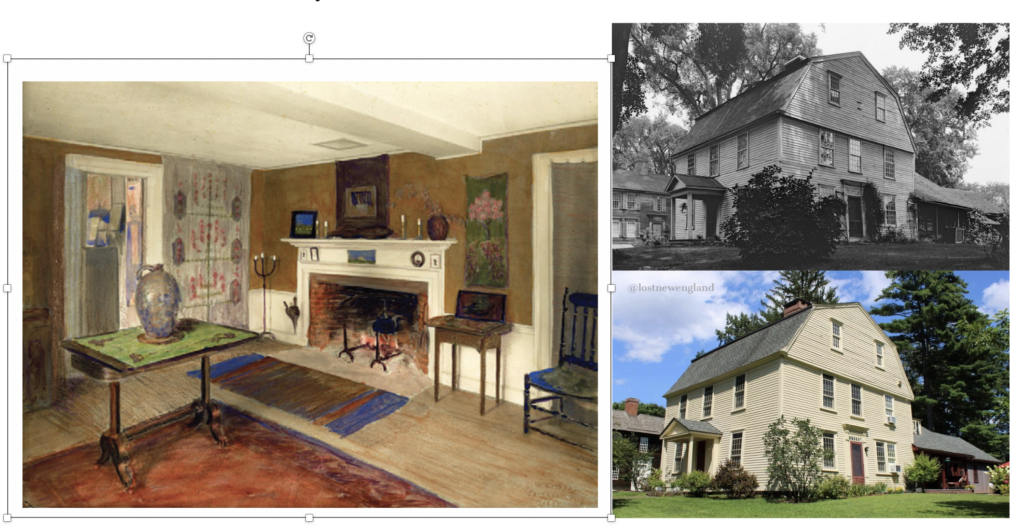
Cornelius Kelley, an Irish immigrant, worked as a blacksmith in the village. Chauncey Thomas ran a ceramics workshop called the Deerfield Pottery, which began in 1909. Next door to the pottery, residents made brooms, an essential tool for domestic work then and now. People grew broomcorn in nearby fields, and they still do today. At this time, Deerfield also made palm-leaf hats for men and straw bonnets for women. People could practice all these crafts at home, which especially helped women overcome financial hardship without turning to the town for aid. In the process, people gave historic buildings new uses, making them more sustainable.
These crafts were also not produced in purpose-built artist studios, which only began to appear in the late 1850s. Dedicated studios were a novel expense. They were usually large rooms with high ceilings and good north light. In New England, art students gained access to such facilities at art schools in places like Boston in the 1870s and 1880s. They could also study art from around the world in cast halls filled with replicas of ancient and Renaissance sculpture.
Visual Artists
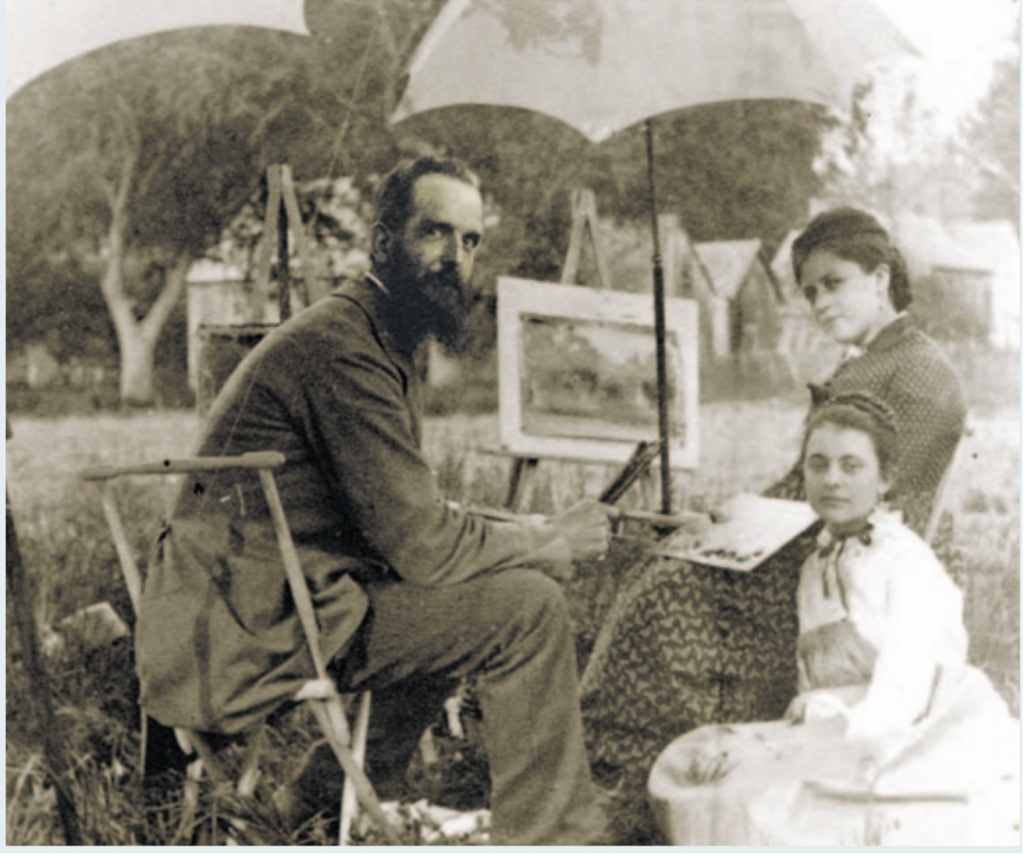
Deerfield had its own visual artists, especially in summer. One was the painter James Wells Champney, whose wife, Elizabeth Williams Champney, came from one of the River Gods families. The Champneys tended to work en plein air, or outdoors, which – in the claims of artists at that time – made their art truer to life. They then finished their pencil landscape sketches at home. Historic Deerfield’s curators see James Wells Champney as one of the artists who helped capture the rise of regional tourism in New England. His was a romanticized old New England, where natural and human elements together portrayed nature as a source of surprise, beauty, and abundance. It is awkward, to say the least, to consider that by this time the landscape had been emptied of almost all its Indigenous people: “disappeared,” or “removed.”
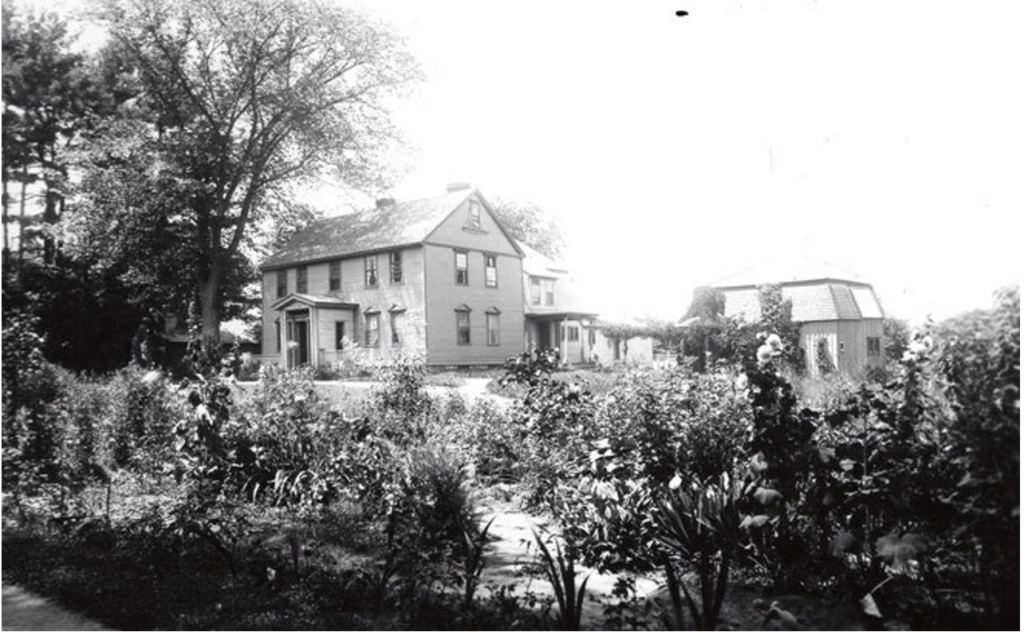
The Champneys did, in fact, add a separate studio to their summer house on The Street. The house, called Elmstead, was an ancestral home that Lizzie Williams, as she was known, had inherited from forebears who had helped found Deerfield two centuries earlier. The studio doubled as a space for entertaining. That was convenient, since James Champney taught art classes for Smith College students and sometimes gave his famous “Chalk Talks” there for them and other community members.
In contrast, Deerfield’s crafters worked in existing dwellings, bucking the new trend toward dedicated studio space. This choice honored and revived the cottage industries of the preindustrial colonial era.
These art-making endeavors sustained Deerfield townsfolk for a couple of generations and helped promote local and regional tourism. But with the 1929 stock market crash, the Depression years loomed. Around the same time, in 1928, the construction of U.S. Routes 5 and 10 drew traffic away from The Street, though the new road runs almost parallel to it. Most Deerfield stakeholders were happy about that. By then, apart from the 1929 reconstruction of the Ensign John Sheldon House, the organizations mentioned here had either folded or lost their founding “mothers and fathers,” who had been such important patrons of the arts. The photographers Frances and Mary Allen lived into the early 1940s. Fortunately, the Allen sisters had documented all these craft activities in Old Deerfield. Another photographer, Frances Benjamin Johnston (1864–1952), a mentor and friend to the sisters, promoted their work in the July 1901 issue of Ladies’ Home Journal. There she featured them as two of “the Foremost Women Photographers in America,” who had made Deerfield a picturesque subject.
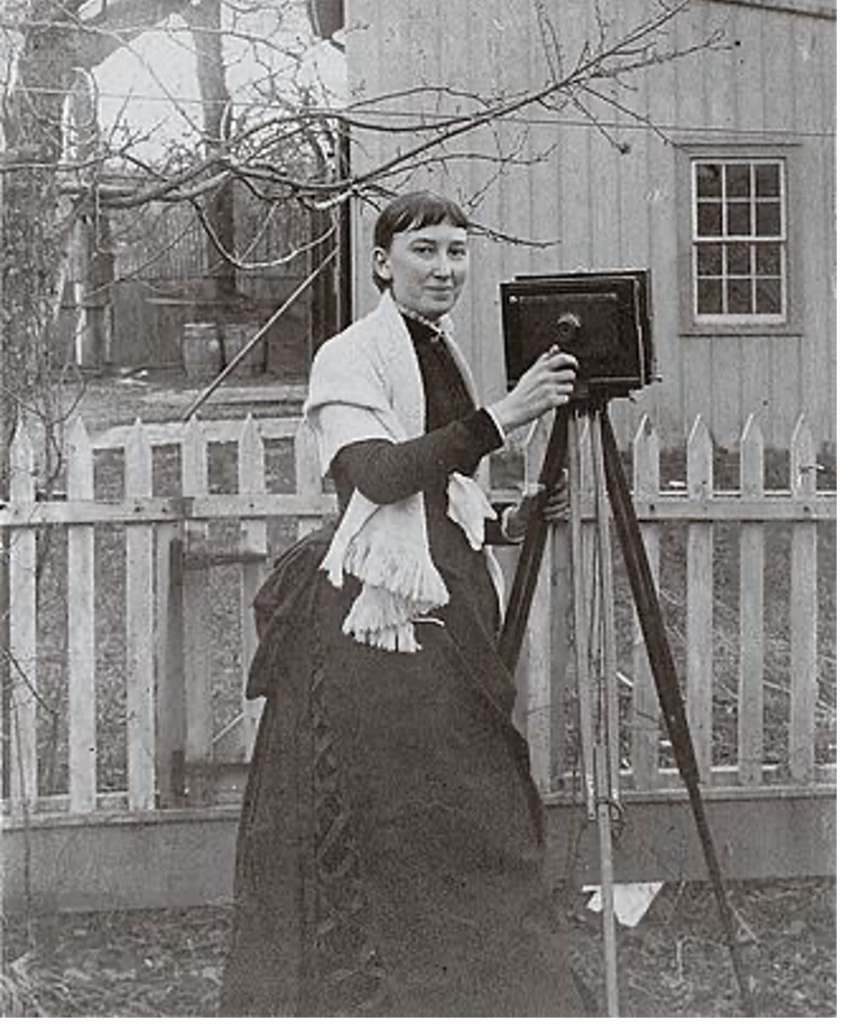
In the early 2000s, PVMA held an exhibit about the Allen sisters’ lives and work. It was followed in 2008 by an exhibit and book, “Poetry to the Earth: The Arts and Crafts Movement in Deerfield.” Publicly accessible resources on this history today include a study guide on the topic, updated in 2021. The Institute of Museum and Library Services, one of the federal agencies the Trump administration targeted for elimination, funded much of this work.
Amherst’s Town Farm: An Addendum to the First Article in This Series
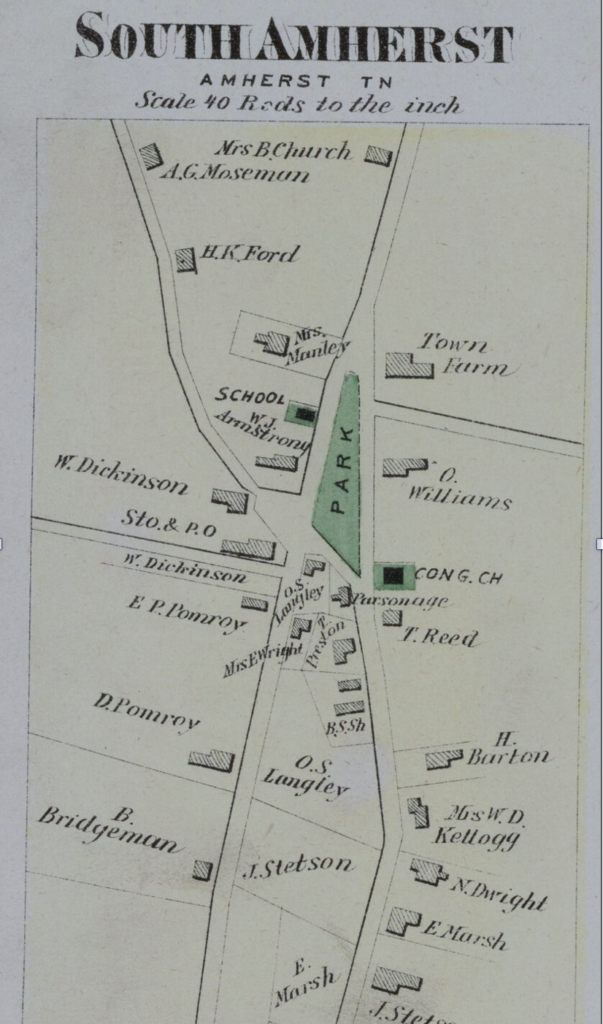
Amherst had its own official poorhouse, initially envisioned as an almshouse modeled on a Boston precedent. This idea for a location by Clark’s Mill in Mill Valley never really took off. It was genuinely thought that there “were very few persons needing aid” in Amherst. Eventually, a farm was purchased on the corner of South East Street and what is now Station Road in South Amherst. Here, Deacon Henry Dickinson and his wife managed the Town Farm (see the map below) while caring for the “inmates,” as they were known. By 1876, the site had running water, a hen house, and an icehouse. Inmates milked a herd of cows for their room and board. The building burned to the ground in 1882, and William Fenno Pratt completely redesigned it for $6,300.00. Pratt built eight inmate rooms, separated into a North wing for women and an East wing for men, with a designated space for the warden and family. This arrangement continued until 1914, when the town of Amherst voted to discontinue the institution.