
Finance Committee Recommends $330,000 for Library Project on Split Vote
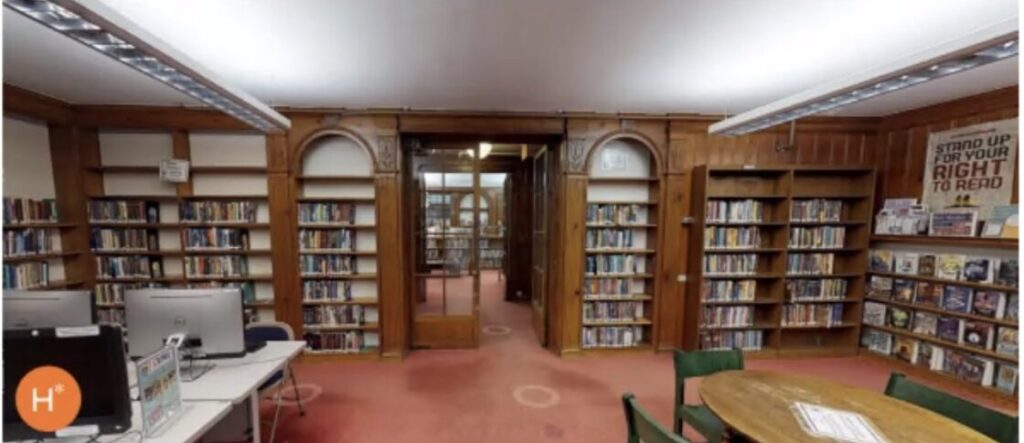
Historic millwork at the Jones Library, some of which was slated for preservation. The library has requested CPAC funds to pay for that preservation work, even though the costs were included in the orginal construction contact and that money has already been borrowed. Photo: amherstma.gov
Report of the Meeting of the Finance Committee, April 21, 2026
This meeting was held over Zoom and was recorded.
Present: Cathy Schoen (District 1, chair), Lynn Griesemer (District 2), Ana Devlin Gauthier and Sam MacLeod (District 5). Resident nonvoting members: Cathleen Mitchell and Tom Porter. Absent: Jill Brevik (District 1) and Joseph Jayne (nonvoting member). Staff: Sean Mangano (finance director), Paul Bockelman (town manager) and Athena O’Keeffe (council clerk).
Finance Committee Recommends Additional $330,000 for Library Project
At the April 7 Finance Committee meeting, all other projects recommended by the Community Preservation Act (CPA) Committee received unanimous support, but the vote on the $330,000 request for the Jones Library renovation was delayed because of questions about its eligibility.
After receiving mixed advice about eligibility, the committee voted 2-1-1 — Ana Devlin Gauthier and Sam MacLeod voting yes, Cathy Schoen voting no and Lynn Griesemer abstaining — to recommend the funding to the full council. The nonvoting members were also split, with Tom Porter supporting the funding and Cathleen Mitchell opposing. Porter informed the committee that he is treasurer of the Friends of the Jones Library.
The recommendation will now come before the full Town Council, which is expected to vote on these appropriations at its April 27 meeting. The vote on the library funds will be separate from the other CPA appropriations.
It was noted that preservation of the Philippine mahogany woodwork — for which the money would be used — was already included in the $46.1 million appropriation for the project, and the town had already borrowed that full amount. Although the town’s attorney, KP Law, had deemed the additional funding eligible, the Finance Committee sought more information from the state CPA Committee, the Department of Revenue (DOR) and the town’s auditor.
Mangano reported on the outside information he received but cautioned that none of the three sources conducted an exhaustive analysis of the project. Stuart Saginor, executive director of the CPA Coalition, told Mangano that because the work would be completed regardless, he felt the funding request fell into a “gray area in terms of the spirit of the law, and he did not like it.”
Mangano also consulted attorney Ken Woodland, bureau chief of the Municipal Law Division of the DOR. Woodland said the DOR does not police CPA projects but also felt the request fell into a gray area.
Tanya Campbell of CBIZ, the town’s auditor for several years, reviewed opinions from both KP Law and Anderson Krieger and agreed with KP Law that the project was eligible to receive CPA funds. Anderson Krieger had raised concerns about eligibility.
Porter said he considered it a “cut-and-dry issue.” After reviewing the Memorandum of Agreement (MOA) among the Massachusetts Historical Commission, the town, and the Jones Library, he said: “It seems like the library had done its part and has been conscientious and diligent and open about the application. It ought not be a referendum on the library project, but more of a question of whether the council chooses to support the work of the CPA.”
[Editor’s note: The MOA Porter referred to was about the Section 106 (Massachusetts Historical Commission) process and did not address the issues of CPA eligibility.]
Griesemer asked whether Mangano believed Saginor’s reservations stemmed from the view that the library should have applied for additional CPA funds earlier, before a contract was signed.
Finance Committee members Jill Brevik and resident nonvoting member Joe Jayne, both of whom previously expressed reservations about more CPA funding for the project, were not present at this meeting.
Schoen said: “I think it’s because the project is funded. The town has actually taken out debt to fund it. Most of the CPA projects, at least the times I’ve seen them, have come in at the beginning to secure the money so they could make a good case to other funders that the project was financially viable — seed money. I don’t think I’ve seen any other project where the town had already taken out the debt for it. It’s an unusual project, because we usually don’t take on this much debt for a building we don’t own.”
MacLeod, who previously served as chair of the CPA Committee, acknowledged that it was “not common” for a project at the Jones project’s current stage to request additional CPA funds. “It does happen, and members of the CPA committees during my time would have varying questions, and sometimes those questions would persist,” he said.
Griesemer then asked Town Manager Bockelman: “Do you feel that our passage of this would leave the town open to a legal question?” Bockelman replied: “Anything the town does is subject to anybody litigating anything. But in terms of whether it’s defensible, I feel very strongly that the town’s attorney has rendered an opinion. That is what we usually rely on when we are making legal decisions, making financing decisions.”
On the motion to recommend that the Town Council support the $330,000 in CPA funds to preserve the historic woodwork at the Jones Library, MacLeod said he supported it based on the CPA Committee process but noted that “councilors can make their own determinations.” Griesemer abstained, saying: “I would like the record to show that I’m totally in support of this. My only question is the legal issue.”
Porter reiterated his role as treasurer of the Friends of the Jones Library and said he “would not want for that to be an issue, but I am a nonvoter, so maybe that’s moot.”
Public Comment
Kent Faerber, former chair of the Jones Capital Campaign and a District 5B resident, reiterated remarks he had made at previous Finance Committee and Town Council meetings. He said: “The goal of the CPA is to encourage certain activity, including historic preservation, by helping to pay for it. Does funding the preservation of the historic woodwork at the library advance the purposes of the act? That’s the only issue. Denying support for this preservation work because the work will be done anyway and the library can pay for it out of its endowment does not fulfill the council’s responsibility under the act.” He added: “You will hear the legal opinion of the town’s lawyers as it addresses the unique terms of the bond authorization. This should be authoritative over a hardly independent legal brief commissioned and paid for by Jeff Lee’s Amherst Community Preservation Coalition, which as far as anyone can tell was formed only to oppose the library project.”
Financial Order for Regional Schools Capital Projects Passed
The Finance Committee unanimously approved the regional school district’s plan to borrow $497,000 for capital improvements at regional schools. The town has 60 days to act on the appropriation; otherwise it takes effect automatically. Mangano said the other three towns in the region historically have not taken votes and have allowed the money to be allocated by default.
The planned capital improvements are: domestic hot water heaters ($100,000) and HVAC ($80,000) at the high school; east wing roof patching ($10,000) and locker room and adult bathroom renovation ($10,000) at the high school; middle school elevator service ($10,000); middle school electrical service upgrade ($235,000); middle school wood shop door ($12,000); and DA work ($40,000).
Third Quarter Running Close to Budget
Mangano reported that the FY2026 budget is tracking largely as expected in the third-quarter report. The general fund has collected about 75% of expected revenue, compared with 80% at the same point last year, and he anticipates a smaller year-end surplus as a result.
The town has also spent 75% of its budgeted expenditures. Two collective bargaining agreements for Department of Public Works employees remain pending; those settlements may include retroactive payments, so funds are being held in reserve.
Two areas that deviate significantly from the budget are snow and ice removal, which is well over budget, and parking ticket collections, which are well below projections. Snow and ice removal, Mangano explained, is “one area where we are allowed to have a legal deficit at year end.” He expects the town to cover that shortfall with savings elsewhere but is also seeking state funds.
The drop in parking fine revenue has no clear explanation. There is no discrepancy in the number of tickets written among the three parking enforcement officers. Over the years, parking revenue has shifted from meters to kiosks to a primarily app-based system. The town also lost the parking lot in front of Town Hall, but Mangano said most of the shortfall stems from fines, not permits — revenue from permits has increased. He was uncertain whether the decline is an anomaly or a longer-term trend.
Mangano noted that investment income will decrease due to lower interest rates and the drawdown of reserves for large capital projects. The town will also begin making payments on loans for the library and the new elementary school. He added that Hampshire College’s closure at the end of the year will reduce water and sewer usage, affecting those enterprise funds.
As requested at the previous Finance Committee meeting, Mangano included a chart outlining the contents of each section of the report (see page 6).
Kent Faerber should get his facts straight, starting with the name of the organization for which I serve as president. We are the Amherst Historic Preservation Coalition and were formed out of recognition that Mr. Faerber and the other architects of the Jones Library renovation-expansion plan did not give due consideration to federally mandated protections afforded to the nationally registered historic property. A related concern is that both of the library’s CPA requests for the project, totaling more than $2M in taxpayer funds, have raised serious eligibility questions. The Community Preservation Coalition, the Mass. Dept. of Revenue and attorneys for Anderson Kreiger have concluded that the legality is not “cut and dried,” and remains in question.
Town leaders have never explained why these CPA funds which are derived from a surcharge on our property taxes are being credited to Jones Library, Inc. and not to the taxpayer share of project expenses. And Mr. Faerber has not disclosed how much his Capital Campaign fundraisers may be earning for writing the proposal.
It’s frustrating that residents who question additional public funding for the library are labeled “anti-library.” I support libraries. My concern is how this process has been handled.
I’m troubled by reports of unrecorded meetings, potential conflicts of interest, and financial assumptions that haven’t been clearly explained. These issues affect public trust as much as the project itself.
I want Amherst to have a strong, functioning library. But the way this has unfolded risks leaving the project—and its reputation—compromised.
P.S. CPA funds are taxpayer dollars, derived from a 3% property tax surcharge and designated for specific purposes. Using them in this case deserves clear justification, especially given earlier cost-cutting proposals that would have removed the same features now cited for preservation.
P.P.S. Saying this “won’t raise or lower taxes” overlooks that these funds are still collected from taxpayers and allocated by choice.
Several things to note about this meeting.
First, the two members who were absent (maybe having to do with it being school vacation week) had made compelling arguments against authorizing these CPA funds at the last FinCom meeting. The already split vote would very likely have tilted more strongly against recommendation if they had been able to participate.
Second, Griesemer didn’t just abstain. She was the first member called on to cast a vote but dodged it by saying she wanted to “pass”. Devlin Gauthier rightly pointed out that “passing” is not a thing, and that her choices were yes, no, and abstain. Still, she was allowed to vote after everyone else and then abstained. When a question arose as to the required quantum of the vote, she then tried (unsuccessfully) to change her vote to a yes. Maybe a review of Robert’s Rules is in order but actually this is a tactic (voting last) she had frequently utilized as president of the council.
Third, we can add another person to the list of committee members who have ties to the Library and are clearly not impartial but who fail to recuse themselves from discussions and votes. Furthermore, Porter’s comments demonstrated a lack of understanding of the issue at hand as he cited the MOA from the Section 106 process as his reasoning. That was an entirely different set of issues and decisions than the eligibility rules for Amherst CPA dollars. We’ll see if Councilor Ryan (who has also worked with the Capital Campaign) will recuse himself when this come to the Town Council on Monday.
Fourth, this entire process continues to ignore the fact that projects that violate the Secretary of the Interior’s Standards are NOT eligible for CPA funding. Not a single committee that has been involved (AHC, CPAC, FinCom) has spoken about the four times the Massachusetts Historical Commission rejected Jones’ applications for tax credits for this very same reason.
Fifth, and related to the opinion received from the Community Preservation Coalition, is a small detail that was revealed in Mangano’s verbal report. He said that he had spoken with the Executive Director “previously” which raises the question of when the town was aware that Saginaw did not support this application because it violated the spirit of the CPA law. If it was known before the FinCom’s prior meeting, it should have been made known then. That is information that very well could have impacted the vote that ultimately came out of this committee.
On Monday, we will finally learn which of our councilors will hold themselves and the project team to promises made to keep any more taxpayer money off the table for this project.