
Controversy Over Reflection Rooms in New Elementary School Continues
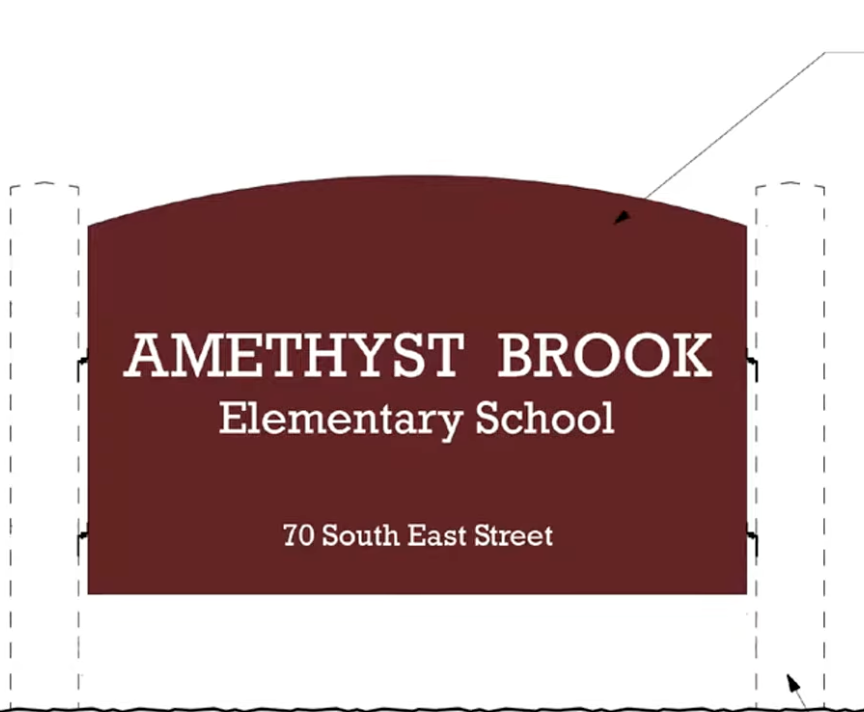
Photo: amherstma.gov
This meeting was held over Zoom and was recorded.
The Elementary School Building Committee’s (ESBC) monthly meeting on April 17, 2026, had a full agenda of updates and became impassioned over recent changes to plans for four small “reflection rooms.”
Construction Update
Kseniya Slavsky, owner’s project manager for Accenture, reported that construction is on schedule. Recent progress includes work on the solar canopies over the parking lot, interior finishes — including ceilings, millwork, lighting, and doors — and the playground. The next site tour is scheduled for May. A suggestion was made to invite school employees so they can begin planning for the use of these spaces when the school opens this fall.
Signage
The design of the sign at the north entryway — which will serve as the entrance and exit for staff, parents, and visitors — was revised based on previous input to keep it clear and simple. Committee members discussed whether a sign is also warranted for the south entryway, which will temporarily serve as the entry and exit for all non-construction traffic for about six months while construction continues on the northern half of the site and the old school is demolished.
Reflection Rooms
These rooms — variously referred to as “reflection,” “timeout,” “seclusion,” or “blue” rooms — have been used by staff at Fort River and Wildwood schools to place students who are having difficulty self-regulating. They were included in the original building design several years ago: three located within areas designated for specialized special education programs, and a fourth off a hallway in the academic wing. Recently, the rooms have been the subject of debate among parents, staff, and administrators who have voiced contrasting concerns at school committee meetings. The ESBC was tasked with redesigning the rooms to address safety issues.
Bob Peirent, special projects manager for the town, presented changes that emerged from a meeting with Allison Estes — ESBC member, current principal of Wildwood School, and future principal of Amethyst Brook Elementary School; Joanne Smith, interim director of student services for Amherst Regional Public Schools (ARPS), and the design team. The changes include adding padded rubber flooring, partial padding to walls and doors, and increased visibility into the rooms through glass door panels and domed mirrors to allow all parts of the room to be seen. Peirent said the changes would cost approximately $50,000 and that, because of how late in the construction process these arose, they had already been approved by the working group.
ESBC member Deb Leonard responded, speaking as chair of the Amherst School Committee (ASC). She criticized the process, which did not include an ASC member, and the changes themselves, saying they did not incorporate any of the ASC’s requested modifications, such as video cameras. She noted that the ASC will soon vote on whether to implement a policy change that would prohibit use of the rooms altogether within a few years. Leonard also said the rooms expose the district and town to liability and noted that an active investigation is already underway into serious violations of student protections related to their use.
ESBC member and Special Education Parent Advisory Committee (SEPAC) representative Angelica Bernal said she was “shocked and disgusted and ashamed to be associated with this committee” for creating “a building that is not going to be cutting edge but rather has rooms for something that, at least in our state, there is a movement towards getting rid of seclusion.” She also criticized the absence of closed-circuit video cameras and indoor swings to help children self-regulate.
Estes said she was surprised by those reactions. She noted that four swings are located elsewhere in the building and that the specialized programs did not want additional swings because they have mini hammocks that better meet their students’ needs. She said the proposed design would be compliant with the law. “I just wish that people would see us as people who are working towards the best interests of children,” she said, adding that the conflict makes it harder for staff to collaborate with families.
Bernal countered that staff turnover has been significant, that staff need more support, and that children are unable to access the hammocks when needed. “I hope that staff could also see us as families that have to deal with the other side of the trauma they cause in children,” she said.
ESBC member and Town Councilor Ellisha Walker (at large) spoke as the parent of a student who will attend the new school and be enrolled in one of the specialized programs. She lamented the missed opportunity to explore how the building’s infrastructure could better support students, and raised concerns about understaffing and under-resourcing in special education. She asked whether changes could still be made at this stage of the project. Designer Donna DiNisco explained that the rooms were understood to be used only as timeout rooms, as currently mandated by the Department of Elementary and Secondary Education (DESE), not for longer periods.
Bernal noted that Amherst did not apply for two rounds of available funding to meet new requirements and said the exclusion of a SEPAC representative from key decisions was problematic. Leonard said there had been an intention for the rooms to serve both seclusion and timeout functions and added, “Some school committee members feel pretty strongly that these rooms shouldn’t exist at all.”
Building Committee member Jonathan Salvon asked what role the ESBC plays in these decisions. ESBC Chair Town Councilor Cathy Schoen (District 1) agreed that continued discussion at the meeting would not be productive, and said her understanding when she posted the agenda was that the committee would be presented with options from which to choose. The design team noted that, given the late stage of construction, further changes to the plan might not be incorporated before the school opens in the fall.
Ultimately, Estes offered to meet with Bernal and Leonard over the following week to see if the issues could be resolved.
Fencing at Periphery of Site
ESBC member and ARPS Facilities Director Mike Gallo O’Connell had been asked to assess the fence at the perimeter of the site. He said that where the fence is in poor condition due to fallen trees, dense vegetation forms a natural barrier that is very difficult to access and serves as an effective substitute.
Parking and Vehicle Flow
Tim Cooper of DiNisco Design reviewed the planned traffic flow once the project is complete. Bus, van, and delivery traffic will use the south entrance and exit, which is entirely separate from car traffic for parents and staff entering and exiting from the north. When the school opens in fall 2026, however, construction will shift to the northern portion of the site, encompassing demolition of the Fort River school, rebuilding of the playing fields, and completion of the northern entrance. During that period, all traffic will use the southern entrance, and a temporary roadway will allow cars to reach the building entrance and parking lot. To accommodate demolition safely while maintaining traffic flow, 56 cars will need to double-park in the northern parking lot. An additional 22 parallel parking spaces will be striped along the bus loop; these will not exist in the final configuration.
Peirent said there will not be sufficient on-site parking for all staff in fall 2026, though Rick Rice of DiNisco Design noted that the temporary arrangement would provide only two fewer spaces than the 170 included in the final layout. Schoen said the town is exploring off-site parking options, including spaces at the former East Street School and town-owned properties on Belchertown Road and at the corner of Main and Northeast streets. Families will also be encouraged to have students ride the bus rather than be driven to school. Gallo O’Connell said his latest data indicate 155 spaces would be needed for staff, and that he wants to minimize double-parking — which prevents staff from leaving and returning during the day — and parking along the bus loop. Leonard encouraged the town to ask whether the Jewish Community of Amherst (JCA), located nearby, would allow school staff to use its parking lot on weekdays. Committee member Mangano asked whether staff could be permitted to ride the bus to reduce the number of cars on site. Estes proposed a “parking buddies” system for double-parked cars to help staff coordinate arrivals and departures.
Leonard asked whether the temporary traffic pattern would affect school start times. Gallo O’Connell said delays caused by the pattern could create problems because the same buses transport middle and high school students. He said he will work with Police Chief Gabe Ting on solutions. Salvon noted that road markings already in use to manage commuter traffic, particularly to and from UMass, appear to be helping, and encouraged consideration of keeping them in place. Schoen also suggested the town explore eliminating through traffic on the diagonal cut between Belchertown Road and Southeast Street.
Percent for Art
Tom Warger, chair of the Public Art Commission, volunteered to postpone his presentation to a later date because the meeting was running long. The item will be taken up in May.
Invoices
All invoices were approved unanimously. Billing for the project is approximately 75% complete. Approximate amounts for March 2026:
| Vendor | Amount |
|---|---|
| Anser Advisory (OPM) | $59,000 |
| DiNisco Design (architects) | $65,000 |
| CTA Construction (general contractor) | $3,433,000 |
| Allied Testing | $5,900 |
| BVH Integrated (envelope testing) | $3,500 |
| Advanced System Integrators (network) | $148,400 |
| Total | $3,715,000 |
Schoen requested that a complete summary of all change orders to date be presented at the next meeting.
Any confinement of a child against their will or not is child abuse. Please call it what it is.