
Opinion: The Wrong Engineering School is Closing
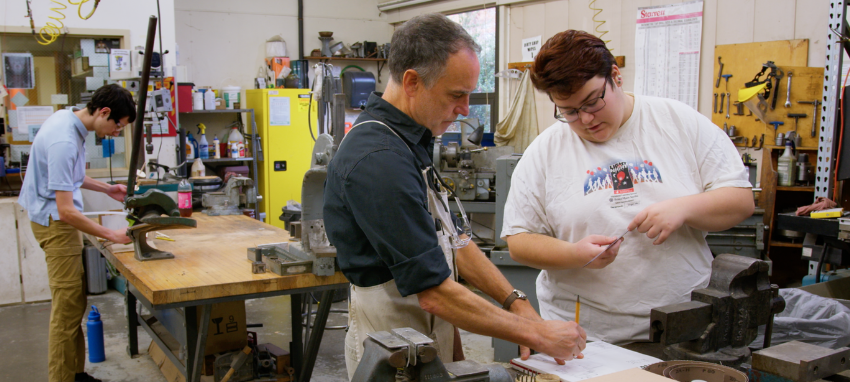
Hampshire College Center for Design. Photo: hampshire.edu
The following column appeared originally in Gordon’s Stem Blog on April 20, 2026 and is reproduced here with the author’s permission.

Hampshire College is closing down. I live a few miles from the campus in Amherst, Massachusetts. It is a beautiful piece of real estate, and watching it go dark will sure be a waste. So here is a better use for it: reopen it as an engineering school built on the same pedagogical model that made Hampshire unusual for 56 years.
Hampshire ran on a simple premise. Students learn more when they direct their own education. No required courses, no grades, narrative evaluations instead of transcripts. It produced Ken Burns, among a long list of graduates who learned to frame problems from scratch. Then it ran out of money. At $29,683 per semester, with 625 students and a $26.5 million endowment, the finances were never going to hold.
The finances failed. The pedagogy did not.
Engineering education runs on the opposite assumption. Students cannot be trusted to direct their own learning until they survive two years of calculus sequences, physics surveys, and weed-out courses designed less to teach than to filter. ABET accreditation requires programs to demonstrate prescribed curricular coverage across a fixed sequence, and schools optimize for compliance. Roughly half of engineering students switch majors or drop out, most citing the culture of years one and two. The students who make it through are good at structured problem sets. Whether they can identify a problem worth solving is a separate question the curriculum rarely addresses. The NAE’s analysis of engineering education and workforce pathways has long flagged a gap between what programs produce and what employers actually need: graduates with strong professional and problem-framing skills alongside technical ones.
A Hampshire-style engineering school would look different. Students identify a technical challenge in the first semester and spend four years building toward a solution, pulling in mathematics, circuits, materials, software, and fabrication as the work demands. Faculty serve as advisors. Credentialing comes from demonstrated competency, not accumulated credit hours. The model produces engineers who can operate without a defined rubric, which is the actual job description for most engineers after around year three. Olin College of Engineering in Needham, Massachusetts has run a version of this since 2002 and its graduates are consistently sought after. The model exists and it works.
The timing matters. AI handles the structured problem set. Tools like Gemini and Claude write the code, run the simulation, and check the math. The irreplaceable skill is knowing what problem to run. Engineers who are excellent inside a defined problem space and lost outside it are the engineers whose value will compress fastest. Quantum, biotech, and climate tech all require graduates who can work across disciplines without a map. The standard curriculum produces the wrong graduate for all three.
The objections are real: accreditation, licensure, employer acceptance. All solvable, given enough will. The campus infrastructure is already there, sitting on several hundred acres in the Pioneer Valley. Hampshire’s library, labs, and residential buildings are not going anywhere quickly. The harder problem is finding people with the will to try something genuinely different rather than build another school that looks exactly like the others.
Hampshire believed every student was capable of running their own education, even if they occasionally used that freedom poorly. Engineering education has never believed that. Maybe we should try.
Gordon F. Snyder Jr. is a semi-retired engineer. He directed NSF-funded Centers of Excellence at Springfield Technical Community College and University of Central Florida, taught as Visiting Engineering Professor at University of Hartford, and currently teach as an adjunct computer science professor at Pace University and adjunct engineering professor at Holyoke Community College in Massachusetts.
I endorse this proposal to repurpose the Hampshire College campus as an alternative engineering school using the model of student directed learning. I think, however, that a more radical – and needed – approach is summarized in the following letter which I have submitted to the editor of the Daily Hampshire Gazette:
To the Editor:
When Hampshire College faced closure in early 2019, I contributed a column to this newspaper (“Tear down Hampshire College to rebuild it,” February 27, 2019) in which I called for a new educational model that would preserve some of the best elements of the College while increasing the value of a Hampshire degree to its graduates and to the society in which they live and work. I said, “tear it down,” not the physical fabric of the campus, but the 55-year-old model of free-form, student-directed education. As Hampshire College prepares to close its doors, my message remains the same.
I call for a college where students undergo rigorous training in critical thinking that encompasses readings across the full range of disciplines: philosophy, history, literature, the sciences, mathematics, and languages. At the same time, students would be required to declare a vocational major in which they would learn the skills of a carpenter, electrician, plumber, computer systems engineer, farmer, etc. Whether or not graduates of such a program became carpenters, electricians, or plumbers is beside the point: by learning the rudiments of these trades, graduates would gain a deeper understanding of what it takes to keep the world functioning. After all, despite all the advances in artificial intelligence, someone must know how to build, wire, or plumb a building. Someone needs to know how to build and maintain a computer. These are the facts of the physical, human-built world.
Hampshire College has suffered from declining enrollment for various reasons, but surely one of the main reasons is its poor cost performance: While tuition costs at Hampshire are around $60,000 per year, the median salary for a Hampshire graduate several years after graduation is under $40,000. It is difficult to justify spending nearly $400,000 for a Hampshire degree (a bill which, with or without financial aid, someone must pay). Meanwhile, an experienced electrical contractor in Massachusetts can easily earn over $100,000 per year.
Do people in the trades need a liberal education? They certainly do. I would much rather hire a contractor who is widely read and well-informed than one who is not. Our communities, our politics, and our country would benefit from having educated, well-informed citizens in all walks of life. And whether they become tradespeople or not, graduates will have learned invaluable life lessons about the discipline imposed by working with real-world tools and materials.
Funding? I am convinced that money for this rebirth of the college could be found among the tech companies and billionaires that have profited so immensely in the digital economy. Our world will always need people who know how to get their hands dirty building and fixing things.
The end of Hampshire College as we know it presents a unique opportunity to rebuild the school into something new and world changing.