
UMass Amherst Launches Phase Two of Campus Decarbonization Plan
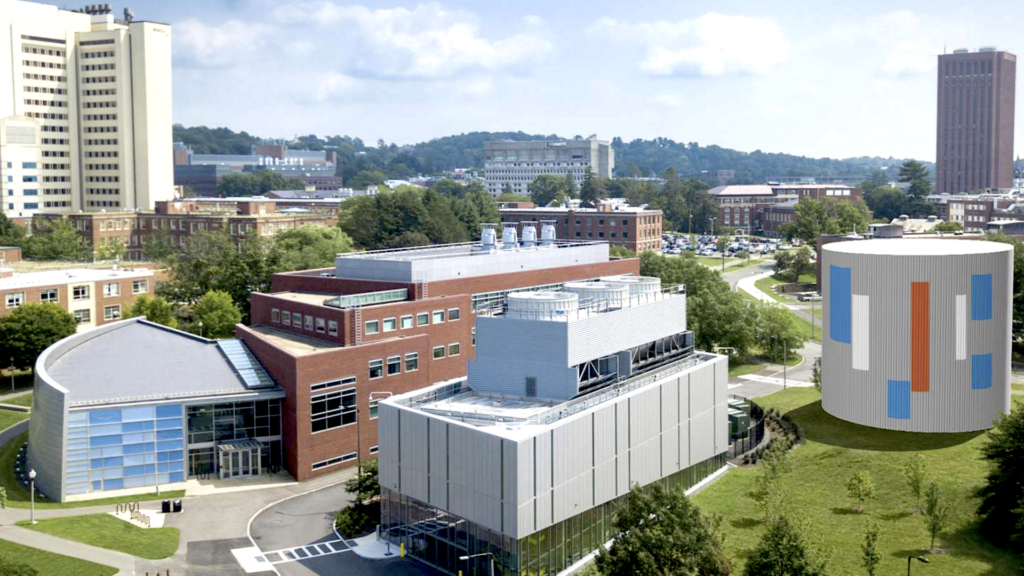
A rendering of the UMass North Chiller Plant, North Energy Exchange Center (NEEC), and Thermal Energy Storage (TES). Photo: umass.edu
Source: UMass News & Media
As part of UMass Amherst’s Path to Carbon Zero ongoing effort to reduce greenhouse gas emissions, the university has partnered with RMF Engineering, Brailsford & Dunlavey, and DOC Construction to develop the second phase of the campus decarbonization plan.
The updated plan will be completed in 2027 and will guide major decisions on important issues for years to come, including how buildings are heated and cooled, from where and how campus energy will be sourced, and how decarbonization will impact research, teaching, campus life and beyond.
As more than 90% of UMass Amherst’s direct emissions result from heating, cooling and electrical systems, discussions during Phase Two of the plan will focus heavily on how the university produces and uses energy on campus, as well as its broader footprint, including transportation and the everyday choices made by members of the UMass community.
“I’m excited to embark on our next phase of carbon reduction planning which aligns with the campus strategic plan and goals related to sustainability and decarbonization,” said Chancellor Javier A. Reyes. “This process will be informed by the progress we’ve made to date including several electrification and thermal energy storage projects and through opportunities for input from the campus community. I also want to thank the faculty, staff and student members of our decarbonization sub-committee of the Chancellor’s Sustainability Action Committee for their work to select this consulting team and their ongoing efforts and collaboration on this next phase of planning.”
The planning team is currently seeking input from the campus community via a short online survey to help establish priorities for the updated plan and answer key questions, including what should guide decisions related to decarbonization, which tradeoffs are acceptable, what a decarbonized campus should look like in practice, and how respondents would like to stay informed about the planning process.
The anonymously sourced responses to the survey will directly inform the team, which is comprised of the Decarbonization Subcommittee of the Chancellor’s Sustainability Advisory Committee and led by Dwayne Breger, emeritus director of UMass Clean Energy Extension, and Ted Mendoza, university capital project manager.
The survey, as well as further details about the university’s Path to Carbon Zero, can be found on the Sustainability at UMass site.
There are multiple deceptions in this press release.
First, calling this “phase 2” is specious. The original decarbonization plan, published in 2021 by the Carbon Mitigation Task Force assembled by the previous Chancellor, was simply discarded by this administration, which sought instead to implement a plan specifically rejected by that body.
That plan, announced in late 2024, involved transitioning the main combustion turbine of the campus power plant from burning methane, to “dual fuel,” allowing it to also burn diesel.
The diesel to be used in the plan would have been so-called “renewable diesel,” imported from a major oil producer in Singapore. These fuels not only make the air in our valley dirtier, creating problems for anyone with asthma, depending on source, they can be more carbon intensive than simply burning petroleum diesel. They are never carbon neutral and will never get us there. At best, produced locally from local waste oil, they might be 25% the carbon intensity of petroleum. But local supplies are very limited, and internationally sourced “renewable” fuels, used widely for transportation, are already driving deforestation worldwide.
Local opposition paused this plan but has not yet stopped it: the power plant was converted in the winter of ’24-’25 and UMass has been in talks with the State about using these fuels.
The new consultant group was hired as a result of faculty and student pressure, not as any sort of “phase 2” implementation. In fact, the phase 1 and phase 2 concept studies for the original decarbonization plan, developed by the same consultant making the “new” plan, were simply buried by this administration. Calling this “phase 2” is simply deceptive in that it gives the administration credit for a phase 1 that was never started, let alone completed.
If this is what the administration calls “phase 2”, what, then, was phase 1?
There are also numerous problems with the online survey, which was hastily assembled in response to complaints that the new plan was being formulated without engaging the public early enough. Unfortunately, many of the questions present Hobson’s choices. For example, one question makes the respondent choose between calling decarbonization “one of many priorities” or “a central priority” when in fact most other campus priorities, like deferred maintenance or academic needs, can and must – by law – be addressed while simultaneously decarbonizing. Or choosing between “reduce our campus’s measurable emissions” and “educate and involve students” when it would seem absurd, and should be nearly impossible, at a University, to do one without doing the other.
The claim that the survey is anonymous is also undermined by the shear volume of demographic data that is collected; the number of demographic questions far exceeds the number of decarbonization-related survey questions.
It is unfortunate that the University continues to offer proclamations and misleading press releases, when what we need are honesty, transparency, democratic engagement, and action based on scientific truth.
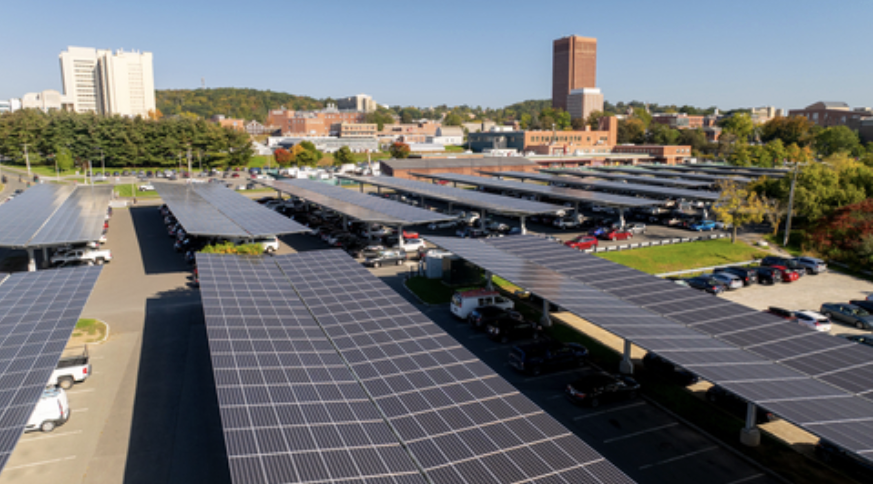
The photo of the PV arrays atop the vast UMass parking lots is quite charming: simultaneously promising and somewhat deceptive.
Beneath the solar panels are many thousands of vehicles belonging to UMass students, staff and faculty, who regularly use those vehicles to commute, to run errands, and to travel between campus and remote places (like parents’ homes) on a regular basis. All of these vehicle trips contribute to UMass-associated emissions, in addition to the “direct emissions” noted in the UMass Press Release above. These additional UMass-associated emissions comprise a significant part of the problem.
A rough back-of-the-envelope computation give an idea how extensive those additional UMass-associated emissions may actually be: multiplying together
~ 10,000 vehicles in those UMass lots used on a daily or weekly basis
~ 10 gallons per week on average for commuting, errands and other travel
~ 50 weeks per year
we get an estimate of ~ 5,000,000 gallons for annual fuel use by vehicles on those parking lots.
Now add a comparable amount of fuel use for UMass-bound delivery vehicles, for various UMass service vehicles, and for other vehicles providing public and private transport of all kinds around UMass, giving a rough estimate of
~10,000,000 gallons
annual fuel use by vehicles associated to UMass. When combusted this contributes
~100,000 tons
of carbon-dioxide (CO2), and a similar mass of nitrogen-oxides (NOx), to the atmosphere annually.
But the emissions associated to those extensive parking lots aren’t only from fuel combustion: there are also unburned hydrocarbon emissions from evaporating fuel and lubricants, when these thousands of vehicles are parked. And even when when the vehicles are away, some of those odorous evaporative emissions persist, as does an even more stealthy emission, which has no odor.
That is because beneath all those vehicles (and occasionally beneath a thin layer of asphalt) lies an extensive base of what looks like volcanic gravel, but in no small part consists of the coal slags remaining from over a century of coal burning on campus. These slags were piled up and spread widely at the periphery of the UMass campus, and they now form the base (and sometimes the surface) of many of these parking lots.
And these coal slags harbor an invisible, odorless secret: isotopes of Uranium, Thorium and their daughter isotopes, particularly, Radon, at concentrations many times higher than in the native coal: some chunks of slag more radioactive than the most radioactive rocks in the notorious “Reading prong” of Pennsylvania and New York, or the radioactive granites of Vermont and New Hampshire.
As long as you don’t inhale (or swallow) the dust, the Uranium and Thorium poses little risk: their gamma (high energy photons) and beta (fast electrons) radiation is negligible at these concentrations, and alpha-particles (slower Helium nuclei) barely penetrate clothing or skin. But Radon is a gas, and a strong alpha-emitter, which when inhaled over time can deliver an injurious does of ionizing radiation (the two protons Helium nuclei carry the charge which does the damage) to fragile tissues in the delicate linings of the lungs.
Should we worry about these low-level radioactive emissions? Probably not, though (ironically) paving over that slag with asphalt might be the best way to mitigate any UMass-associated radioactive emissions problem. (I’ve biked for nearly 3 and half decades along a farm road between my house and UMass that’s paved with the stuff, but after having faculty colleagues in Geosciences who were serving with me on our College of Natural Sciences Personnel Committee analyze its composition over 2 decades ago, I try to avoid inhaling the dust. Famous last words?)
But the best solution to the CO2 and NOx emission problem which all the UMass-associated vehicles pose may simply be to simply reduce the number of vehicles which come not only to campus, but Amherst and it environs. And that entails a radical change in our transportation infrastructure:
1) make more walking and rolling and biking feasible locally by expanding our networks of multi-use paths which serve as short-cuts, as well as bike-lanes and side-paths long existing road rights-of-way;
2) deploy more frequent and extensive intermodal public transit throughout our region, like buses with wheel-chair lifts and multi-bike-racks operating on more of our roadways; lane-priority for public transit vehicles on major roads (like Route 9 between Belchertown, Amherst, Hadley, and Northampton) with eventual restoration or creation of electric trolley lines on or along those routes; and
3) expand and extend inter-regional transportation modes (like high-speed rail between Springfield and Boston through Palmer and Worcester) which coordinate with buses and rail shuttles (like a shuttle on the existing rail line between Amherst and Palmer, once the route of the AMTRAK Vermonter, and recently upgraded to continuous welded rail that could make that shuttle trip possible in under 20 minutes, if only the owners of that rail line could be persuaded ).
Here’s hoping we’ll see that in our lifetimes!