
Shutesbury Adopts the PROTECT Bylaw to Govern Town Interactions with ICE

Photo: Picryl, Public Domain
In our criminal legal systems, who should decide when information is shared with federal immigration authorities (i.e., ICE), and under what circumstances? On May 9, the Shutesbury Annual Town Meeting determined that the people should decide if and how town resources are to be used when interacting with ICE. The Annual Town Meeting voted by a substantial majority on a card vote to adopt a new bylaw, entitled the “Shutesbury Protect Bylaw.” The proposed Bylaw was submitted to the Town Meeting via a Citizens’ Petition. Its purpose is to create a consistent town policy to ensure Shutesbury is a welcoming community for all.
What Is It?
The Shutesbury PROTECT Bylaw builds upon previously adopted bylaws and resolutions, including a Safe Community Bylaw, approved in 2025. The new bylaw reaffirms the town’s commitment to due process, equal treatment, and broad non-discrimination policies for all town employees and officials. Further, it provides detailed policies governing how town officials and law enforcement may interact with federal immigration authorities in the absence of a judicial warrant, court order, or other legally binding requirement. It curtails commonplace, informal collaborations between local law enforcement and ICE, in which information is shared voluntarily. The Bylaw further protects humanitarian and service institutions, such as schools and faith organizations, from retaliation for providing support to immigrants. It includes important provisions for staff training and transparency, including public annual reports.
Worrisome Trends
This new bylaw comes at a time when Massachusetts is witnessing two worrisome trends: escalating ICE arrests of immigrants with no criminal background and a growing reluctance on the part of members of immigrant communities to contact police to report crimes or seek assistance.
Best estimates from the Deportation Data Project suggest 10,987 people across New England have been arrested by ICE between January 2025 and March 10, 2026. According to Jared Berezin of Bearing Witness @ ICE on Substack, based upon public data compiled by the Deportation Data Project, “. . . 80% of New Englanders who have been abducted have no criminal record, which is striking given that ICE considers minor traffic violations as evidence of criminal history.”
Sociologists, the National Institute of Justice, the ACLU, police leadership organizations, and immigrant-rights groups have consistently warned that the entanglement between local police and federal immigration enforcement causes immigrants to avoid interacting with police even when they are the victims of crimes, undermining public safety and community trust.
Police become involved in immigration enforcement when presented with a “civil immigration detainer request” or, simply, “a detainer.” A detainer is a non-mandatory request for law enforcement to keep an individual in custody after they would otherwise be eligible for release under state law. It is based upon a civil administrative warrant issued by an ICE officer, not by a judicial warrant signed by a judge or magistrate. Advance notification of an impending release and notification of an upcoming court hearing are ways in which local law enforcement voluntarily share information that may assist ICE in locating immigrants.
The City of Holyoke, for example, runs an immigration query on all arrested individuals, and ICE is contacted if any deportation order is found. The authors concluded, “local police, sheriffs, and courthouse staff regularly collaborate, and share information, with federal immigration authorities, thereby acting as ‘force multipliers’ for ICE.”
A study published in April 2026 by Citizens for Juvenile Justice, entitled “ICE Out,” gathered public records from police departments, sheriffs’ offices, and district attorneys statewide to learn what policies exist regarding ICE collaboration. The investigation identified a variety of information channels that allow ICE to efficiently gather information about suspected immigrants. This information pipeline begins at the pre-arrest stage and continues through the post-arrest and release stages. Discretionary (i.e., non-mandatory) coordination and communication occur through joint task forces, automated license plate readers, some fingerprinting (e.g., routinely fingerprinting misdemeanor offenders), and direct notifications to ICE. A number of police departments have adopted written policies that allow officers to detain someone and contact ICE based on “reasonable suspicion” of an immigration violation. The City of Holyoke, for example, runs an immigration query on all arrested individuals, and ICE is contacted if any deportation order is found. The authors concluded, “local police, sheriffs, and courthouse staff regularly collaborate, and share information, with federal immigration authorities, thereby acting as ‘force multipliers’ for ICE.”
The relationship between local law enforcement and ICE allows ICE to quickly locate suspected immigrants. Take, for example, Mariola Perez, a Guatemalan woman who fled violence and persecution and came to the United States sixteen years ago, while pregnant, seeking asylum. She was pulled over in Salem for a traffic violation, and was arrested by ICE a few days later when she appeared for a court hearing.
Despite having a 2017 Sanctuary Bylaw, the Town of Amherst is included in the study’s list of communities that permit information sharing and collaboration between law enforcement and ICE.
In the majority of cases. ICE seeks to detain a suspected immigrant with a civil administrative warrant, which is granted without any judicial review. Judicial warrants, in principle, are based upon probable cause findings. Thus, some form of due process is involved in the issuance of these warrants. In contrast, ICE civil administrative warrants are issued by ICE and do not necessarily include safeguards to protect immigrants’ rights. Importantly, local law enforcement is not required to provide information without a judicial warrant. The “ICE Out” authors note that public data in Massachusetts show an increase in ICE arrests from police stations, pointing to direct coordination and communication. Despite having a 2017 Sanctuary Bylaw, the Town of Amherst is included in the study’s list of communities that permit information sharing and collaboration between law enforcement and ICE.
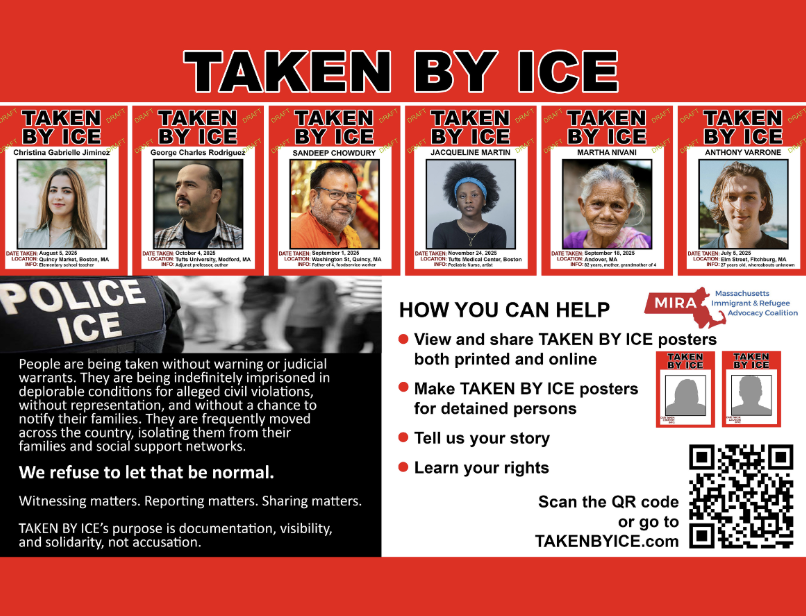
Besides the cruelty of arresting and detaining people, sometimes indefinitely, without due process, human rights advocates in Massachusetts are documenting serious concerns about unsafe conditions at Massachusetts ICE facilities. In December 2025, Senator Ed Markey visited the Burlington, MA, ICE Facility, calling conditions “abysmal” and “inhumane.” In April 2026, Congressman Jim McGovern conducted an unannounced site inspection and expressed concerns about the conditions. Observers at the Burlington ICE facility, such as Bearing Witness New England and Todd Palmer of Justice4All, have been carefully documenting conditions at the facility, including overcrowding, inadequate food and medical care, lack of access to legal counsel, and unsafe conditions for unaccompanied minors and pregnant women.
It is important to note that much of this information sharing is not required under state and federal law. Under a 2017 Massachusetts Supreme Judicial Court rule in Lunn v. Commonwealth of Massachusetts, the state’s highest court held that law enforcement may not hold someone in custody beyond what is mandated under state law solely because ICE requests it. Law enforcement, however, is not mandated to inquire about immigration status or report immigration status to federal authorities, except in limited situations. Due to mounting concerns about ICE enforcement in Massachusetts, Attorney General Andrea Campbell issued detailed guidance in May, 2025, advising residents of their rights and cautioning local law enforcement.
A Proliferation of Safe Community Bylaws
Since 2017, over 50 communities have adopted some version of a local bylaw or ordinance regulating how law enforcement interacts with federal authorities. In 2019, the ACLU developed a municipal bylaw template that has been adopted by several communities. A 2023 study of Safe Community municipal policies, conducted by Northeastern University’s Program on Human Rights and the Global Economy, found that bylaws, ordinances, and policies varied considerably in scope and details, with some newer versions reflecting a more comprehensive response to police-ICE collaborations. The Town of Amherst adopted a Sanctuary Bylaw in 2017 to address these issues, although observers note that this statute does not limit informal information sharing.
The timing of this new bylaw in Shutesbury is opportune, as state legislators are considering comprehensive immigration legislation. The legislature has been considering immigration justice reforms for several years. On March 25 and May 7, respectively, the State House and Senate adopted versions of the PROTECT Act (H.5316, S.3072 ), a bill designed to address some of the many concerns about immigration enforcement. Now, the two chambers must iron out the details for a final version that will hopefully come up for a vote during this legislative session. While the competing versions of the bill cover many urgently needed reforms, neither fully addresses the informal information-sharing challenges.
Shutesbury’s new bylaw is well-positioned to become one of the most comprehensive and up-to-date statutes of its kind statewide, comparing well with statutes in Boston and Cambridge. With the renewed focus on immigration justice statewide, more communities will hopefully follow suit, either creating new policies or updating older ones. The need for local and statewide action has never been greater.
Miriam DeFant is a Shutesbury resident and is the Co-Chair of the Indivisible Mass Coalition’s Immigration Justice Action Team.