
Letter: A Formal $21M Asset-Backed Refinancing Offer and Binding Restructuring Conditions for Hampshire College
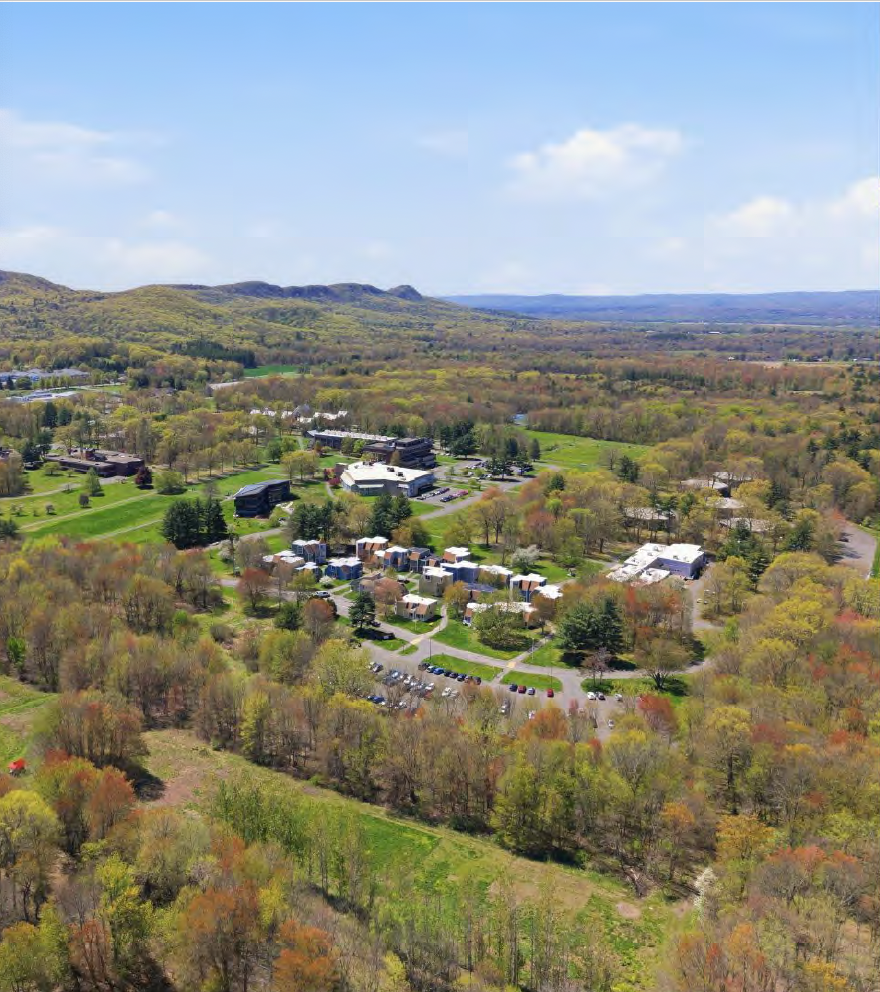
Aerial view of Hampshire College core campus. Photo: hampshire.edu
The following letter was sent to the Executive Committee of the Hampshire College Board of Trusees and to the Hampshire College President on May 27, 2026.
I am writing on behalf of our newly incorporated Hampshire Institute for Peace, Plain Living, and Conflict Resolution Training (HIP) to submit a definitive, structured alternative to reverse the planned closure of Hampshire College. We are prepared to initiate an immediate $21,000,000 refinancing swap to completely buy out, retire, and satisfy all outstanding legacy bondholder liabilities and defaults before the upcoming September deadlines.
We recognize that under current operations, Hampshire College is burdened by a structural $3.7 million operating deficit, rendering the current administration un-loanable under standard credit metrics. Our framework solves this credit barrier by shifting to a Master Teacher Model, which focuses resources strictly on direct classroom instruction rather than high-overhead research production. This model slashes $4.21 million in annual operating costs, instantly transforming the institutional balance sheet from a deficit to a structural surplus capable of comfortable debt service.
In addition, I am attaching draft legislation that would enact “The Saving America’s Small Liberal Arts Colleges Act of 2026” which would transform the admissions calculus, and on its own, eliminate Hampshire structural deficit by generating the needed bump in student enrollment.
With a clean credit footprint and a solid prospects of balanced operational budget, our entity will secure a fresh commercial mortgage facility. Based on a conservative, institutional appraisal of Hampshire’s 800+ acres and physical plant at $34,000,000, this new $21 million loan sits at a safe and routine 61.76% Loan-to-Value (LTV) ratio. This transaction requires zero cash down payment because the existing $13 million in unencumbered land equity fully underwrites the risk for our commercial lending partners.
Because this proposal provides a full exit from your outstanding bondholder liabilities, the Board has a clear fiduciary duty to evaluate it. This financial injection is strictly contingent upon the current Board executing a binding Letter of Intent within seven (7) business days, agreeing to the following non-negotiable legal and structural conditions:
- Condition 1: Letter of Exclusive Designation: The Board must immediately issue a formal letter naming our Institute as the Exclusive Preferred Partner for institutional rescue. We are the only bidder committed to preserving the educational charter intact. We require this exclusivity to freeze competing liquidation proposals while our banking syndicate finalizes the loan underwriting.
- Condition 2: Immediate Board Reconstitution: The current Board must agree to amend the institutional bylaws to create a new class of governance. Upon execution of the $21 million refinancing facility, 51% of the voting seats on the Board of Trustees must be permanently transferred to designees chosen by our Institute to oversee the academic pivot.
- Condition 3: Unencumbered Asset Transfer: All physical campus real estate—specifically the 800+ contiguous acres of fields, orchards, and facilities—must be transferred free and clear of legacy liabilities to the joint Hampshire-Woolman educational charter, permanently blocking any commercial developer land sales.
- Condition 4: Immediate Operational Standstill: The current administration must execute an immediate cease-and-desist on all closure mechanics. This requires a 60-day operational standstill, freezing all active real estate parcel marketing, halting scheduled faculty and staff layoffs, and pausing the regional “teach-out” student transfer protocols.
- Condition 5: Joint Regulatory Appeal: The current Board must co-sign a formal, emergency petition to the New England Commission of Higher Education (NECHE) requesting an expedited administrative hearing. This appeal will present the $21 million asset-backed refinancing facility as verified proof of renewed financial viability to secure a two-year operational probation window, within the context of either or both, the Master Teacher plan and the new tax legislation.
To allow our team to place the formal Proof of Intent to Refinance underwriting documentation into a third-party escrow account, you must acknowledge receipt of this offer and agree to open immediate restructuring negotiations. We look forward to your prompt response to prevent the irreversible fragmentation of this historic educational laboratory.
Sincerely,
Dr. Jerome M. Segal, President
The Hampshire Institute
301-675-3260
Jerome@jeromesegal.org
I have studied the proposal in Jerome Segal’s above letter to the current Hampshire College Trustees, reviewed the enclosures that accompanied the letter, and had an extended video conference with him on Friday, May 29, 2026. I believe this proposal is the best hope to preserve the Hampshire College campus as the site of an innovative educational institution that can support itself economically. While he is proposing something different going forward, my understanding is that Hampshire College was intended to be, and became, something innovative and different in American higher education. The caliber and diversity of Hampshire College graduates make it clear the college succeeded in that mission, despite failing financially. This proposal also would be consistent with current Amherst Town zoning of the campus.
If this were combined with Agricultural Preservation Restrictions on all the Hampshire campus farmland, and Conservation Restrictions on much of the remaining undeveloped campus land, then might it pass muster with the broader community?
What does the Kestrel Land Trust and Trustees of Reservations think about this proposal?
What do the relevant government officials (at both the Town and at the Commonwealth levels) have to say about it?
The Town Manager’s public statement online at https://www.amherstma.gov/m/newsflash/home/detail/3957 makes it clear his position (likely backed by real estate development interests) is that the Hampshire College campus should be carved up for housing development. Despite a mantra that housing development will put the Hampshire College campus “back on the tax rolls,” residential development is generally a drain on municipal finances, not an asset. Notwithstanding the need for housing affordability, the last thing Amherst needs is more residential development that will only worsen the town’s current dire financial straits. Those who want to see Hampshire College continue as an innovative self-sustaining educational institution need to join forces and work together if they are to have any hope of success.
I understand that the haste required by Jerome Segal’s proposal is not of his making but it still makes it very difficult to consider the proposal with the attention it deserves and I find it difficult to join Michal Pill’s measured support, in spite of the potential excitement many of its ideas generate. Specifically, the Master Teacher model, proposed as the basis for rescuing Hampshire from its financial crisis, is presented in terms of metrics having nothing to do with planning, program, or curriculum. I don’t expect these to be spelled out at this point, but the virtually exclusive emphasis of Dr Segal’s proposal on the financial crisis, and its insistence on his new Institute’s total control of decision-making leads to a multitude of questions that need to be addressed.
The Board of Trustees listed lead me to other sorts of questions. If this were an institution planned for the Middle East I would be one of its foremost cheerleaders and would point approvingly at the diversity of its members. But I have no way of knowing how that translates to Hampshire County, which must have other expectations for diversity and inclusion. Nor do I know how active this Board would be in planning, funding, and other hands-on decision-making. We all know of boards whose members are there due to their names, their wealth, their positions in the community. This looks like an attractive Board but I don’t know its role.
So Dr Segal’s proposal lacks clarity about decision-making, program, and curriculum. I would find it difficult to approve such a proposal without some indications of how these matters will be addressed and who will address them.
He spends much more time on financials and fiduciary responsibilities, but I read his ideas much as I do the financial part of The Making of a College, the foundational document of Hampshire College. It turns out that Franklin Patterson’s expectations of enrollment, gifts and grants, and support of local higher education institutions were more dreams than realistic projections about the future. The specificity of Dr Segal’s projections worry me, and while I am by no means an expert in these matters, I recall the old saying about assumptions.
Two last observations. Dr Segal makes no mention of the Five Colleges nor Five Colleges, In c. He seems to want his institute to have major control of the new college he proposes, but does he see any role for collaboration with the other local colleges and university. And if so, how can he make it work better than it has worked for the past sixty years?
Lastly, I applaud his emphasis on teaching, but not on the seemingly rigid separation of teaching and research implicit in his proposal. I could write endlessly on this matter, but in my view one of the important characteristics of Master Teachers is their capacity for and reliance upon questions that are both generated by and answered by their own research. This avoids the issue of research and tenure which does indeed disfigure higher education. But I wish to know whether Dr Segal expects Master Teachers to create their own curricula in response to their own questions. In this day when learning is being captured by AI that seems to be a crucial question.