
Opinion: Democracy is Often Inconvenient. Public Process Can Be Messy
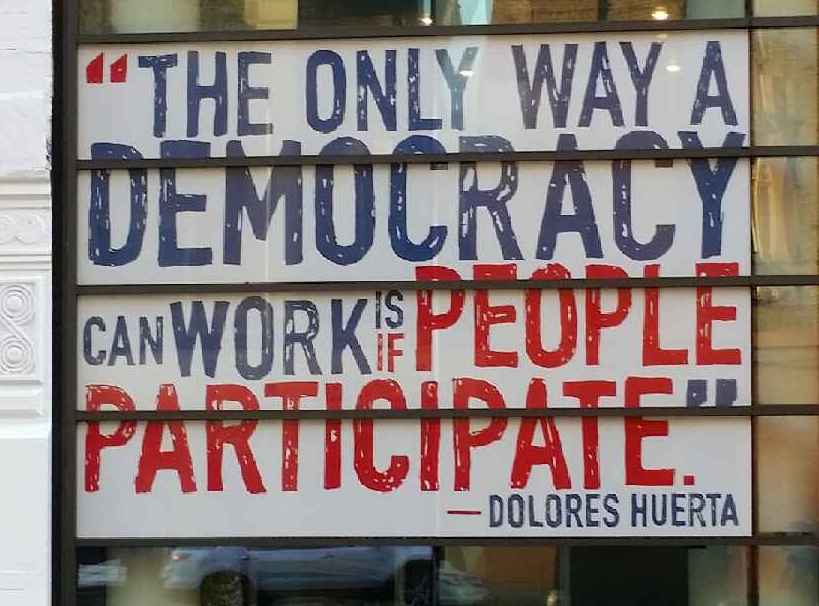
Photo: Sierra Club

There is something increasingly troubling happening in public life, and Amherst is not immune to it.
Across the country, residents who raise questions about major development proposals are increasingly being dismissed as obstructionists. Whether the issue is industrial solar installations, large housing projects, warehouse expansion, or the wave of massive data centers now being proposed in communities nationwide, people who ask difficult questions are often quickly labeled “anti-growth,” “anti-progress,” or accused of selfishly standing in the way of broader societal needs.
That framing is unhealthy for communities and dangerous for local democracy.
A functioning planning process is not supposed to involve residents quietly applauding every proposal placed before them. It is supposed to involve scrutiny, analysis, debate, and sometimes disagreement. That is not a flaw in the process. That is the process.
The pushback communities are expressing around data centers offers an especially revealing example. Across the country, towns and cities are grappling with concerns about enormous energy demands, water consumption, noise, environmental impacts, tax arrangements, emergency infrastructure, and long-term effects on surrounding neighborhoods. In many cases, residents are not opposing technology itself. They are asking whether specific projects, at specific scales, in specific locations, make sense for their communities and whether the costs and tradeoffs have been honestly evaluated and transparently communicated.
The same dynamic plays out repeatedly with large-scale development proposals of all kinds. Communities are asked to balance many competing needs at once: housing, environmental protection, infrastructure capacity, fiscal stability, traffic, emergency services, open space, climate resilience, and neighborhood compatibility. Those tensions are real. They are not solved by dismissing people who raise them.
Nor should disagreement automatically be interpreted as opposition to economic development, affordable housing, or progress itself.
At the same time, many communities, including ours, are also wrestling with a growing sense that ordinary residents are losing meaningful visibility into public decision-making processes. Questions about transparency, access to information, public notice, meeting accessibility, and opportunities for genuine input are arising not just around development proposals, but across a wide range of municipal issues. Increasingly, residents feel they are expected to trust processes they struggle to fully observe or meaningfully influence.
Many residents who are civically engaged are publicly criticized, or in some cases their concerns ignored entirely as they were in Utah this week.
Questions and challenges directed at decisions being made by town representatives on a community’s behalf, at any stage of the process, should be seen as a hallmark of a healthy democracy and civic system. We should always be asking whether a particular proposal deserves closer scrutiny, whether its long-term impacts have been fully understood, and whether the community is truly informed about, and prepared to accept, the trade-offs and costs that major developments often bring over time.
Public officials have a particular responsibility in moments like these. Their role is not to shame residents for participating vigorously in civic life, nor to imply that skepticism itself is illegitimate. Their role is to create space for thoughtful disagreement while balancing competing public interests fairly, honestly and transparently.
The reality is that public trust is not strengthened when residents feel they are being scolded for engaging too early, too forcefully, or too effectively. Trust is strengthened when people believe their concerns will be evaluated seriously, even when others ultimately disagree with them.
Reasonable people can come to different conclusions about development, density, growth, and land use. But communities lose something important when civic participation itself begins to be treated as the problem.
Democracy is often inconvenient. Public process can be messy. Consensus is rarely easy. But residents asking questions, organizing, speaking publicly, and seeking clarity through lawful channels are not signs that the system is broken.
They are signs that people still care enough to participate in it.
Robin Jaffin is a long-time resident of North Amherst and co-founder and managing partner of the digital media partnership Shift Works Partners, LLC.