
Opinion: Potholes in Amherst and England
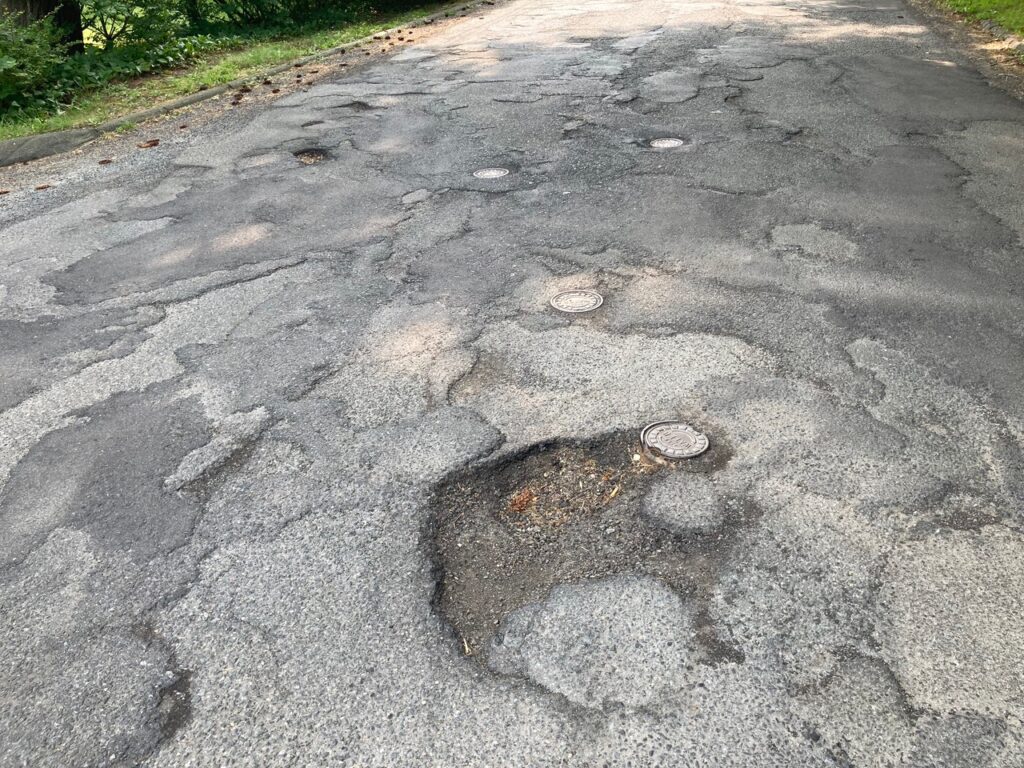
Section of Lincoln Ave. between Amity St. and Route 9 illustrating active potholes and profusion of irregular and uneven patches of more than a decade's worth of previous potholes. Photo: Stephen Braun

Perhaps the good people of Amherst should declare war. No, not on authoritarian aggressors, foreign or domestic; not on undocumented workers or the proto-fascists trying to round them up, hold them in makeshift camps, and ship them off to countries they didn’t come from; not on homelessness or avaricious landlords or blood-sucking pathogenic ticks. This is a call for a war on potholes. These menacing craters threaten the equanimity of our drivers, the suspensions of our cars, and the safety of our pedestrians and cyclists. Pavement patriots here need to take inspiration from our fellow travelers in England.
A recent article in The Guardian documents their rage against insouciant public works bureaucrats and insufficient funds for amelioration, shoddy cold patch repairs, and the holes that have come to pock English roads, streets, and highways. They have an array of tactics. Some Britons are undertaking repairs on their own. Those with more litigious attitudes have begun suing for damages. Others have taken to illustrating the problem with lewd graffiti, using toys to create dioramas in them, filling potholes with yellow rubber ducks, or turning potholes into planters.
How should Amherst rouse its pothole protestors to action? Being an avid gardener, I am drawn to the planter idea. But Amherst is nothing if not a town predisposed to the public voicing its collective opinion. We also have an affinity for community celebrations of all sorts. Acknowledging these strengths, I would like to propose a Pothole Pageant, date TBD. The hoopla could include selecting a pothole regal (king, queen or nonbinary), a parade (EMTs standing by to minister to participants incurring sprains and falls as they encounter potholes unexpectedly), awarding neighborhood prizes for the largest holes and the most ingenious methods of alerting drivers and others to their presence, and perhaps converting a few of the larger craters into BBQ pits where the town’s restaurants could compete in a cook-off.
If the town can’t take road repair seriously, maybe we should just have some fun and celebrate our shared misery. Forward! Into the potholes!
Here’s a draft resolution for the Amherst Council to consider:
Whereas, limited-access highways are absent from Amherst (with the possible exception of Route 116 near Meadow Street in North Amherst); and
Whereas, all remaining roadways (e.g. almost all parts of all roads in Amherst) must reasonably accommodate all users under MGL Chapter 90; and
Whereas, some of Amherst’s potholes are potentially life–threatening to vulnerable road users;
And whereas, capital punishment has repeatedly been found (by 6-1 and 5-2 decisions of the Supreme Judicial Court in the 1980s and in 2014) to violate the Massachusetts Constitution .
Now, therefore, be it resolved that any roadway pothole in Amherst, Massachusetts, and anywhere else in the Commonwealth, be deemed unconstitutional and abolished (with the exception of those on limited-access highways where lethal potholes may continue to exist)….
” Whereas, limited-access highways are absent from Amherst (with the possible exception of Route 116 near Meadow Street in North Amherst)”
This is where people need to remember that the decisions that were made 60-70 years ago affect the Amherst of today. The 116 “Bypass” was built in 1958 — North Pleasant Street used to be Route 116, and a second 116 interchange was planned for the northwest corner of campus.
Wetlands preservation laws passed in the 1970s prevented both this and the extension of the 116 bypass south to connect with the Massachusetts Turnpike — Staples and the other buildings weren’t built until the mid 1990s.
Then there was also a proposal to build a route 9 bypass through Mark Meadow, have an interchange with the extended route 116 bypass, cross the Connecticut river on a new 4-lane bridge, and then connect with I-91.
UMass was rapidly growing and the state’s plan was to build direct connections to both the MassPike and I-91 so as to prevent traffic congestion on the Amherst streets, and in downtown Amherst. Governor Volpe liked to build highways, and he left to become Nixon’s secretary of transportation.
Decisions were made to not build these roads, but to still expand UMass to the size it is today. The consequence of this is the Amherst streets being exposed to more traffic than they really were built for, and the related wear and tear on the pavement.
The converse is Winchendon or Ware — which have no traffic problems because they have no jobs. Or to have built the roads 60 years ago that were needed to support the traffic of a UMass that would grow to the size (and provide the number of jobs) that it does today.