
ZBA Grants Special Permit for Five-Unit Affordable Homeownership Project on Amity Street
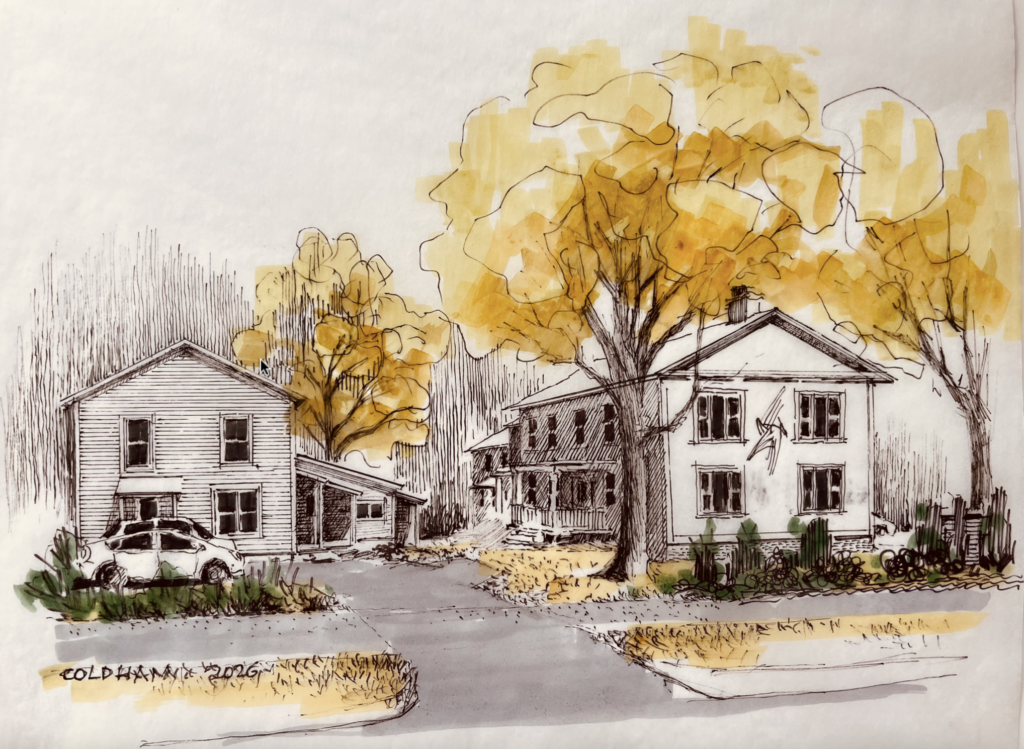
Architect's rendering of renovation project at 174 Amity Street with duplex to be constructed by Habitat for Humanity to the left. Photo: amherstma.gov
Report on the Meeting of the Zoning Board of Appeals, June 11, 2026
By Maura Keene
The meeting was held via Zoom and was recorded.
Present: Everald Henry (chair), Craig Meadows, David Ahlfeld, David Sloviter, and Philip White. Staff: Jacinta Williams, planner.
The Zoning Board of Appeals voted unanimously to grant a special permit to the Amherst Community Land Trust (ACLT) to convert a 19th-century, two-family building at 174 Amity St. into three townhouses to be sold to low-income families earning 80% or less of the area median income (AMI). A second phase of the project will involve Habitat for Humanity constructing a duplex on the eastern part of the site, bringing the total to five affordable homeownership units. The Habitat duplex will require a site plan review by the Planning Board.
The project has received grants from the Community Preservation Act and the Amherst Municipal Affordable Housing Trust. It has also received approval from the Conservation Commission and the Historical Commission. The hearing before the Conservation Commission was required due to a small area of wetlands at the rear of the property created by stormwater runoff from the adjacent building to the east. The Historical Commission approved the demolition of the rear part of the existing building, which is in poor condition, and the construction of the third townhouse and a storage shed.
The completed conversion of the existing house will feature a two-bedroom, a three-bedroom, and a four-bedroom unit. The house is owned by the Grose family and has been rented for many years. None of the three siblings lives in town, and they have opted to sell the property but want it used for affordable housing. They have worked with the ACLT and the town over the past 18 months to develop a plan. The sale is scheduled for July, with completion of the townhouse portion planned for September 2027 and the duplexes the following year.
Three ZBA members—David Sloviter, Craig Meadows, and Everald Henry—along with planner Jacinta Williams, conducted a site visit prior to the meeting. They found the property to be consistent with the special permit application and concluded that the proposed changes would fit well in the neighborhood. The property is across the street from the Marsh Commons condominiums, and there are several multifamily buildings in the vicinity. It is a short walk to the center of town and to establishments on University Drive.
Sloviter said he was pleased that the ACLT decided to address the area damaged by runoff from the neighboring property by constructing underground drainage and detention ponds, rather than seeking legal redress from the neighbor for conditions that should have been addressed when that property was modified.
Felicity Hardee, attorney for the ACLT, explained the land trust model, in which the ACLT will own the full property and issue ground leases to each of the homeowners. When construction is completed, condominium statutes will apply. The homeowners will form a homeowners’ association to manage property upkeep, but Hardee noted that all homeowners would be ACLT members and that the ACLT would offer support as needed.
Because public funds are being used for the project, it must comply with the Fair Housing Law, which requires outreach to potential residents and a lottery to choose the homebuyers. The ACLT mandates that homeowners must occupy the units; they cannot rent them out. The resale price is restricted so the home remains affordable to low-income buyers. The five units will be included on the town’s subsidized housing inventory.
Meadows asked about the possibility of community solar and ground-source heat pumps at the property. Architect Bruce Coldham noted that ground-source heat pumps are too expensive for the project, but the new construction at the rear will have air-source heat pumps, as will the Habitat units. He said the older part of the building will be made more energy-efficient, but he believes that keeping the existing gas heat is necessary to adequately heat the building. The installation of solar panels will depend on both the project’s budget and the capacity of the Eversource transformer. He said the decision to add solar might be left to the homeowners.
The ACLT requested waivers to be exempt from a traffic impact statement, a lighting plan, an erosion control plan, and a sign plan. Henry noted that Amity Street is already a thoroughfare and that the addition of the five units was unlikely to have much impact. Little change is proposed to the site’s lighting, and the Conservation Commission approved the erosion control plan. Finally, he stated that the plans for a sign indicating the address did not require a special submission.
Henry noted that the plan allowed “development of an underused parcel, while maintaining neighborhood character.” Sloviter added that the project fulfills many of the needs that Amherst often cites. He commended the comprehensive application, which addressed many contingencies.
Meadows, David Ahlfeld, and Philip White also complimented the proposal. The special permit was granted unanimously after the findings and conditions were specified.
The ACLT is fundraising to raise an additional $100,000 needed to complete the project. Under the Community Investment Tax Credit program, half of the amount of all donations over $1,000 will be refunded on the donor’s Massachusetts state income tax for the year of the donation.
This is such an exciting project! I’m so glad the ZBA approved the permit and that ACLT will be able to help additional families on the path to affordable homeownership!