
Mark Summer Solstice with UMass Astronomy at the Sunwheel on June 21
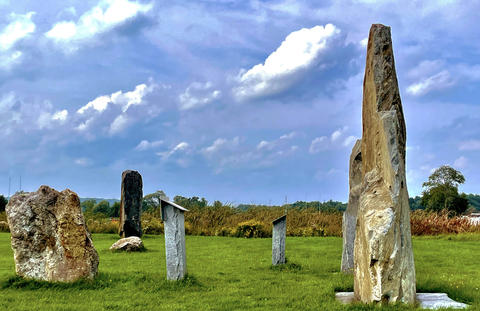
Standing stones at the UMass sunwheel. Photo: umass.edu
Public is Invited to Skywatching Events at Sunrise and Sunset to Celebrate the Longest Day of the Year.
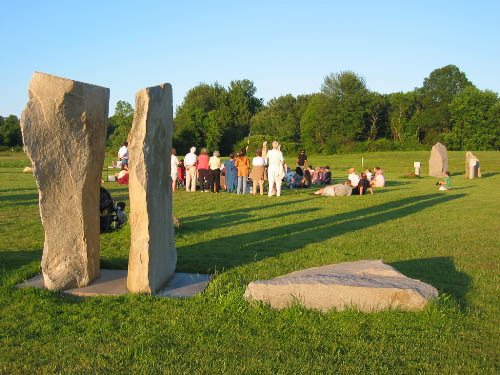
The public is invited to witness sunrise and sunset associated with the summer solstice among the standing stones of the University of Massachusetts Amherst’s Sunwheel on Sunday, June 21. The morning gathering begins at 5 a.m., shortly before sunrise at 5:13 a.m., and the evening gathering begins at 7:30 p.m., about an hour before sunset at 8:30 p.m. These hour-long Sunwheel events mark the astronomical change of seasons and the longest day and shortest night of the year in the Northern Hemisphere.
At the gatherings, UMass Amherst astronomer Grant Wilson will discuss the astronomical cause of the sun’s changing position in the sky during the year. He will also explain the seasonal positions of Earth, the sun and moon, phases of the moon, the building of the Sunwheel and answer questions about astronomy.
The exact time of the summer solstice this year is 4:24 a.m. Eastern Daylight Time on June 21, when the sun reaches its northernmost position in Earth’s sky. This marks the astronomical start of summer in the Northern Hemisphere and winter in the Southern Hemisphere. On the day of the solstice, daylight is longest and nighttime is shortest in the Northern Hemisphere; in Amherst, the sun will be above the horizon for just over 15 hours and 17 minutes.
On the day of the summer solstice, an observer located on the Tropic of Cancer will see the sun pass directly overhead at local noon. For locations north of the Tropic of Cancer, the sun reaches its highest noontime position in the sky for the year. At Earth’s North Pole, the sun remains above the horizon throughout the day, while at the South Pole it remains below the horizon.
From the center of the Sunwheel, the sun rises and sets farthest north along the horizon at positions marked by tall standing stones. Around the solstice, the sun’s position changes only gradually, so visitors who stop by on their own in the days before or after June 21 can see the sun rising and setting close to the summer solstice stones.
At the evening session, if the sky is clear, a solar telescope will be set up to safely observe the surface of the sun.
The UMass Amherst Sunwheel is located south of McGuirk Alumni Stadium, just off Rocky Hill Road. It can be reached from the center of Amherst by following Amity Street west; the Sunwheel is on the right about one-quarter mile after crossing University Drive. Visitors should be prepared for wet footing and mosquitoes. Heavy rain cancels the events and updates will be posted on the UMass Astronomy Events page. For more info, please visit the Sunwheel website.