
Inside a Wisconsin Democratic Gathering: Politics Beneath the Speeches
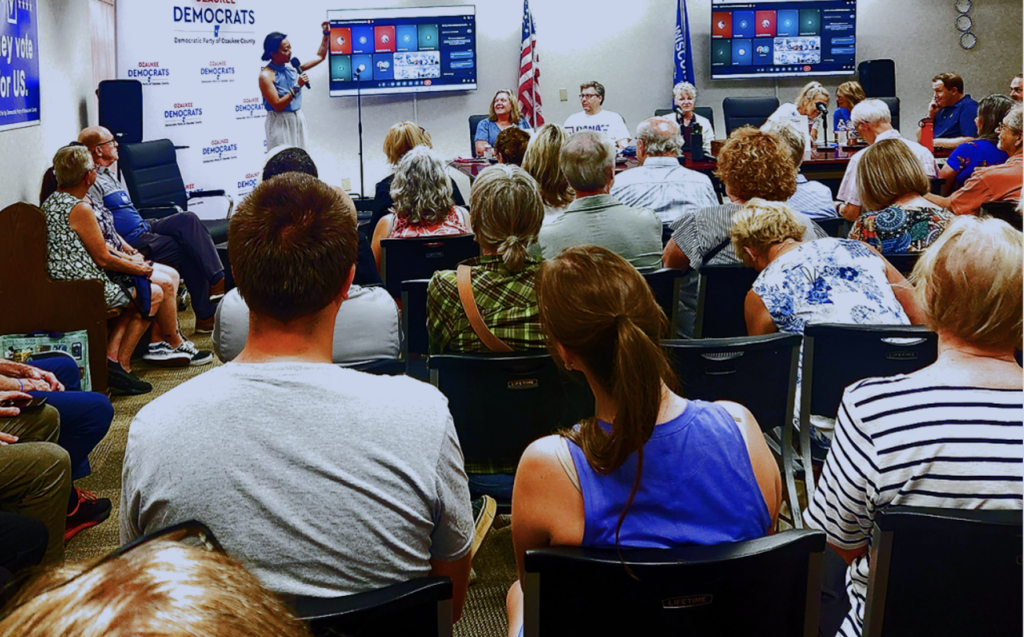
July 2026 meeting of the Ozaukee, WI, democratic committee. Photo: Rizwana Khan
By Rizwana Khan
Earlier this month, I visited Milwaukee and stayed with my cousin, Dr. Ariba Khan, who was elected Ozaukee County supervisor in 2025. During my visit, I attended the Democratic Party of Ozaukee County’s monthly membership meeting July 17 in Grafton. I attended as an observer to learn more about local Democratic organizing in Wisconsin.
When I walked into the gathering, I expected campaign speeches. Instead, I found a political ecosystem negotiating its own future: six Democratic candidates presenting different visions for Wisconsin and different theories of how Democrats could defeat Republicans in 2026. The discussions centered less on campaign promises than on electability: Which candidate could actually win? Which candidate would survive the primary? Which candidate would Republicans rather face in November?
One candidate who drew considerable attention was state Rep. Francesca Hong, the daughter of South Korean immigrants and the first Asian American elected to the Wisconsin Legislature.
Her candidacy illustrates the Democratic Party’s broader ideological struggle. Hong identifies with the party’s progressive wing, emphasizing labor rights, affordable housing, and working-class economic policies. Supporters argue that Democrats need bold ideas to energize voters, while critics worry that Wisconsin’s swing-state electorate might see a democratic socialist as too liberal for a statewide election.
Why Would Republicans Spend Millions on Democratic Candidates?
When Hong finished speaking, the energy in the room shifted. Earlier that morning, news reports had focused on Republican-aligned spending that appeared to benefit her campaign. Hong called it “free publicity.”
The response left unanswered a bigger question circulating among Democratic activists: Why would Republican groups spend millions elevating a Democratic candidate?
Overall, the candidates reflected differing political philosophies more than differing demographic backgrounds.
Outside groups such as PACs spend money to elevate an opposing party’s candidate. Political strategists often call this “boosting the weakest opponent.” Rather than attack the strongest rival in the primary, these organizations use advertising and media attention to raise the visibility of a candidate they consider less competitive in November, hoping primary voters will nominate that candidate instead. Whether that calculation proves correct will ultimately be decided by Wisconsin voters.
The tactic remains controversial because it can backfire if the boosted candidate gains genuine momentum.
Was the positive media attention actually a warning sign? Here, the source of the attention mattered as much as the attention itself. If Republican strategists were willing to spend heavily to raise a Democratic candidate’s visibility, many attendees asked the same question: What did Republicans see that Democratic voters might be overlooking?
Local Democratic activists were fully aware of these strategic games. One party organizer advised attendees not to rush to return absentee ballots, because the field might change before Election Day. Waiting, in other words, was framed as a strategic choice.That advice also answered a question many observers ask: Why would Democrats allow six candidates to remain in the race?
A Crowded Primary
Unlike political parties in many parliamentary democracies, the Democratic Party cannot simply eliminate candidates once they qualify for the ballot. Party leaders may privately encourage weaker candidates to withdraw, but voters ultimately decide. A crowded primary serves several strategic purposes: It lets candidates test fundraising ability, organizational strength, debate performance, and voter appeal. It generates media attention, encourages grassroots participation, and allows the field to narrow naturally as campaigns rise or fade. At the same time, party leaders avoid accusations that they “chose” the nominee before voters had a say.
Politics no longer lives only in campaign rallies, debates, or newspaper headlines. It lives in our feeds, group chats, podcasts, YouTube clips, and the endless scroll of social media. Watching the Wisconsin Democratic gathering felt like watching two campaigns unfold at once. There was the one happening on stage, where candidates delivered polished speeches and policy proposals. Then there was the campaign happening off stage, where journalists, activists, donors, influencers, and everyday voters were collectively deciding who had momentum and who was fading.
Wisconsin political columnist William Walters has spent decades interpreting the state’s political landscape. His reporting doesn’t tell people whom to vote for but helps explain which campaigns are gaining traction, where money is flowing, and why certain candidates suddenly dominate political conversation. At the same time, organizations such as Our Wisconsin Revolution, led by Executive Director Chris Walloch, are building a different kind of political power. Through grassroots organizing, volunteers, digital outreach, and social media campaigns, they help shape what voters see, share, and discuss long before Election Day arrives.
The result is a feedback loop. In modern politics, perception can become its own campaign strategy.
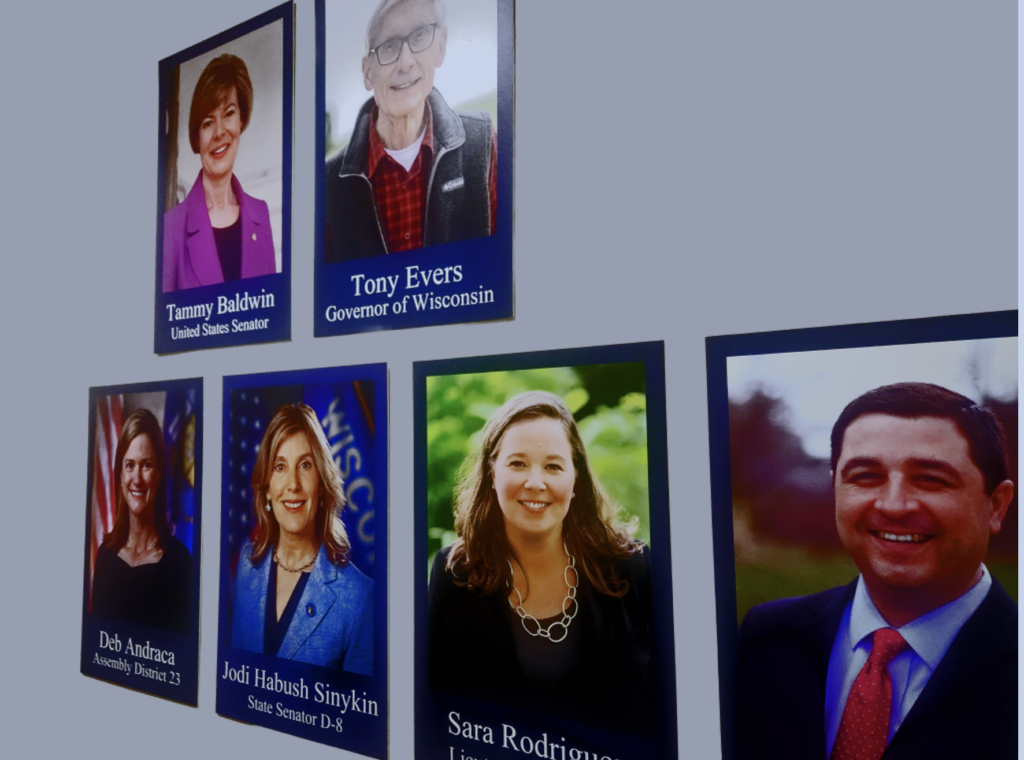
State Rep. Deb Andraca, who was born in Springfield, Massachusetts, pulled back the curtain on another reality that rarely makes it into campaign speeches: money.
Candidates aren’t simply asking people to vote for them. They’re asking supporters to donate $25, knock on doors, repost videos, volunteer on weekends, host house parties, and convince friends to show up at the polls. Every Instagram Reel, every TikTok clip, every viral quote becomes another opportunity to build visibility in a crowded race.
It became clear that elections are increasingly won where journalists analyze, activists organize, donors invest, volunteers mobilize, and algorithms quietly decide which messages rise to the top of everyone’s screen. The speeches may begin the conversation, but in today’s political culture, the real campaign continues long after everyone leaves the room.
Moderates vs. Progressives
Increasingly, the debate is between moderates and progressives. Moderates argue that candidates should appeal to independents and suburban swing voters to win closely contested states like Wisconsin. Progressives counter that bold economic reforms — labor rights, affordable housing, and stronger social programs — inspire new voters and working-class communities that traditional Democratic campaigns have struggled to mobilize.
Among the congressional candidates, Rebecca Cooke framed her campaign around the concerns of rural Wisconsin. Having grown up on a dairy farm, she argued that many rural communities feel abandoned by Republican leaders. She said Republican policies have weakened health care access, increased economic pressure on farmers, and reduced investment in social safety-net programs. Voters who had previously supported President Donald Trump, she said, now feel betrayed because promises made during his campaigns have not translated into improvements in their daily lives.
Campaigns seemed to be conducting two evaluations simultaneously: which candidate best represents Democratic values, and which stands the strongest chance of defeating Republicans in November.
Another issue that surfaced repeatedly in candidates’ remarks was taxation and economic inequality. Several Democratic candidates addressed Wisconsin’s tax system. One proposal discussed was a new state income tax bracket of about 17% for millionaires — taxpayers earning more than $1 million annually. Supporters described the measure as a way to generate additional revenue while reducing pressure on middle- and lower-income taxpayers.
The proposal reflects a broader philosophical divide within the Democratic Party. Progressive candidates argue that decades of tax cuts for high-income earners have widened wealth inequality and that those who have benefited most from economic growth should contribute a larger share to public services. Moderate Democrats generally support asking wealthy residents to pay more but say any tax increase should be carefully designed to avoid discouraging business investment or prompting wealthy residents to relocate.
Republicans strongly oppose the proposal. They argue that a 17% top state income tax rate would make Wisconsin one of the highest-tax states for top earners, potentially reducing investment, entrepreneurship, and job creation. Instead, they advocate lower taxes and market-based economic growth.
Listening to the discussion at the Democratic gathering, I realized the debate reflected two competing visions of government: one that views progressive taxation as a tool for addressing inequality and expanding public investment, and another that emphasizes economic competitiveness, private-sector growth, and limiting the size of government. The proposed millionaire tax symbolizes the broader ideological choice facing Wisconsin voters in the 2026 election.
As of mid-2026, the proposed 17% millionaire tax is a policy proposal discussed by some Wisconsin Democrats. It is not current Wisconsin law.
One absence was impossible to ignore. David Crowley, the Milwaukee County executive and the only major Black candidate in the gubernatorial race, was no longer on the stage. Crowley withdrew from the race July 8 and endorsed Lt. Gov. Sara Rodriguez, a move that subtly shifted the visual and political geography of the Democratic field. Milwaukee County — the state’s largest county, with nearly 1 million residents, and Wisconsin’s economic and cultural center — was no longer directly represented by one of its own candidates. Most of the remaining candidates built their political identities in smaller cities, suburban communities, or statewide offices.
The absence mattered symbolically. Milwaukee is home to Wisconsin’s largest Black population and has long been the electoral engine of Democratic victories statewide. Without Crowley on the stage, conversations about race, urban investment, public transportation, housing, and neighborhood inequality became less visible.
Another conversation circulating involved Lt. Gov. Sara Rodriguez, whose professional background as a registered nurse had been one of her strongest credentials. Days before the event, her campaign announced that serious accounting errors had been discovered in its finances. The campaign had publicly promoted a $1 million television advertising buy, but Rodriguez later revealed that donations had been double-counted, expenses had been underreported, and the campaign had far less cash on hand than previously believed.
She responded by firing her campaign manager and notifying the Wisconsin Ethics Commission. Her Democratic opponents immediately seized on the controversy, arguing that effective leadership requires competent financial oversight. Rodriguez countered that transparency required acknowledging the mistakes publicly and correcting them immediately. The episode raised a larger question that voters repeatedly asked throughout the event: If a campaign struggles to manage its own finances, can it persuade voters it’s prepared to manage a state government?
Editor’s note: Since this post originally appeared as a blog post on July 16, Rodriguez has dropped out of the race and Crowley is considering re-entering it.
See Related:
Wisconsin Lt. Gov. Sara Rodriguez Drops Out of Governor’s Race (NBC News)
David Crowley Considering Re-entering Governor’s Race [WISN]