
Progress on New Waste Hauler Proposal

Photo: flckr.com. Creative commons
Report on the Meeting of the Town Services and Outreach Committee, September 3, 2026
This meeting was held over Zoom and was recorded.
Present
George Ryan (District 3, chair), Andy Churchill (at-large), Pam Rooney and Jennifer Taub (District 4). Absent: Hala Lord (District 3)
Staff: Guilford Mooring (Superintendent of Public Works) and Susan Waite (Municipal Assistance Coordinator, Mass Department of Environmental Protection). Consultant: Mimi Kaplan (Pioneer Valley Planning Commission)
The Town Services and Outreach Committee (TSO) began discussing the 10 decision points needed to finalize the long-awaited Request for Proposals (RFP) for a town-wide waste hauler service with curbside compost pickup. The committee agreed on four of the points and will continue the discussion at its September 17 meeting. At its previous meeting, TSO had agreed on the “Pay as You Throw” (PAYT) model with curbside organic collection.
Five-Year Initial Contract Recommended
Consultant Mimi Kaplan recommended that the town offer the chosen company a five-year contract, acknowledging the program’s significant start-up costs. Although residents might prefer a three-year contract if they are unhappy with the company, Kaplan thought the five-year option would likely attract more bidders.
DPW Superintendent Guilford Mooring said the standard town contract is three years, and he would need the Finance Director’s approval for a longer deal. However, he noted that all contracts contain the clause “subject to appropriation,” which means that they are actually renewed every year.
Councilor Jennifer Taub said she preferred the longer-term contract because Zero Waste Amherst (ZWA) has seen that it usually takes 6 to 18 months for the community to understand and feel comfortable with the new system, and she thought the first contract should take into account this ramp-up period.
Susan Waite, Municipal Assistance Coordinator with the Mass Department of Environmental Protection, said the contract could include options if the town was unhappy with the vendor, but she said both sides are expected to enter the contract in good faith and work together to work through any issues.
A five-year contract would apply even if separate companies handled trash collection and curbside composting.
Environmental Sustainability Should Be Considered in Selection
Although TSO members wanted environmental sustainability to be considered in the selection process, they felt it should not be a major decision point. Kaplan said she hasn’t seen much information about sustainable practices in selection criteria, and Waite agreed that most communities are most interested in keeping costs down. They were unsure if electric vehicles for trash collection were even an option now, but companies could be evaluated on the fuel efficiency of their routes.
TSO Chair George Ryan recommended that the RFP recognize that sustainability matters to Amherst, but that the wording defining it should be sufficiently broad. Andy Churchill suggested that, all other things being equal, sustainability should factor into the choice of a hauler.
Mooring Strongly Recommends a Pre-Proposal Informational Meeting
Mooring felt it was necessary to meet with all interested companies before accepting proposals for the contract. He said that vendors needed to understand the selection criteria and have the opportunity to ask clarifying questions, and he thought that all applicants should be present to hear the same information.
Councilor Andy Churchill worried this requirement might reduce the number of applicants, but Mooring was confident there would be sufficient interest in the Amherst contract. He said it is usually just staff present at these pre-proposal meetings. If TSO members were present, it would have to be a public meeting because of open meeting law.
TSO Settles on 45-Gallon Trash Carts and Overflow Bags with Weekly Pick-up
Trash cart options range from 35 gallons to 96 gallons. Towns using 35-gallon carts are eligible for grants from the state’s recycling dividends program, which would amount to about $5,500 in annual savings. Thirty-five gallons is about the size of the old galvanized steel trash cans. However, the committee agreed that a 45-gallon size, with the option to purchase additional bags for overflow, was better for most households.
According to Kaplan, Pittsfield reduced its waste collection by 20% by switching from 64-gallon to 45-gallon carts. They don’t use overflow bags; instead, they allow residents to purchase a second cart at half the rate of the first.
The Department of Environmental Protection has data showing that weekly collection of 64-gallon trash carts generates more trash, which leads to higher labor and fuel costs as well as higher tipping fees. Waite likened the increased tonnage of waste with larger containers to the “empty suitcase concept”: if you are taking a trip and are limited to a carry-on, you make it work, but if you have a larger bag, you tend to fill it. Kaplan also theorized that going to larger carts would disincentivize the hauler’s commitment to trash reduction.
TSO members noted little difference in trash generation between communities using 35- and 45-gallon carts, so they endorsed the larger size.
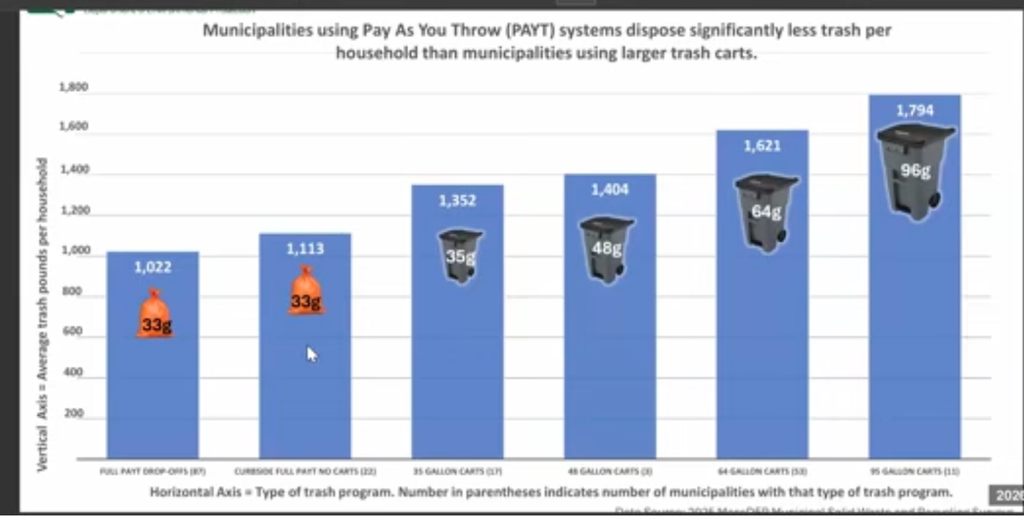
Churchill was concerned the town would face resistance from households with “substantial garbage needs,” since 45-gallon carts are smaller than what the current hauler uses. Waite countered that when you use more water or electricity, you pay for it, and that disposing of trash has real costs. She said that the “Pay as You Throw” system charges people for the trash they produce and incentivizes them to produce less.
In many communities, extra trash bags are available at supermarkets and other stores, as well as in some town buildings. Typical costs are $3 for a large bag or $1 for a standard-size bag. They are usually sold in lots of 10 bags. Waite said that the solid waste coordinator in Agawam told her that stores were happy to sell the bags because it brings customers into the store.
Taub mentioned concerns from some town councilors about bears and other animals breaking into trash bags, but Councilor Pam Rooney pointed out that a bear can get into a trash cart just as easily as into a bag. Waite agreed and said bear-proof containers are available for food scraps. She said towns in Vermont and Colorado, as well as the city of Seattle, have successful curbside composting models, even in the presence of bears.
Churchill said the key is not putting food scraps into the bags. Preventing bears, raccoons, and other animals from getting into the trash should be an enhanced incentive to compost. Kaplan said it should also be a fairly easy behavior to change: have people put out their trash only on the morning of collection.
Kaplan recommended that the town own the carts, at least by the end of the contract, to avoid the difficulty in collecting the carts if the town changes vendors. She said Amherst could obtain a grant to help purchase the carts. Waite mentioned a town in Ohio where the vendor is charging each resident for their carts because the contract period ended. She stated that the contract language should at least specify that there is no fee for collecting the carts at the end of the contract. The carts have an average life expectancy of 10 years.
Although ZWA recommended bi-weekly trash pick-up, TSO members felt that the program should begin with weekly pick-up, at least for the first contract. They felt that if the program substantially reduced waste, they could consider a bi-weekly schedule after the first period. Waite noted that if there is no organic matter in the trash, it won’t stink as much, so bi-weekly collection may be an option and would offer significant cost savings.
TSO still needs to discuss recycling, organics, yard waste, bulky waste, the transfer station’s future, and public outreach. The next meeting is scheduled for September 17. Public comments can be sent to the TSO committee through Town Manager Paul Bockelman or given orally at the meeting. Rooney pointed out that it was important to include on the RFP that Amherst is actually a community of 25,000 residents, because the other 15,000 live on campuses that do their own trash disposal, and companies should know the size of the contract they are bidding on.
At the Board of Health’s September 2 meeting, members asked to be involved in formulating the RFP and selecting the hauler, but this was not mentioned at this meeting.
Virtual Program on Residential Food Waste Reduction and Diversion September 16
The Massachusetts Department of Environmental Protection’s Organics Subcommittee is holding a virtual public meeting on residential food waste reduction and diversion on Wednesday, September 16 from 1 to 3 p.m. More information will be shared prior to the meeting.