
District Secondary School Principals Share Objectives for School Year
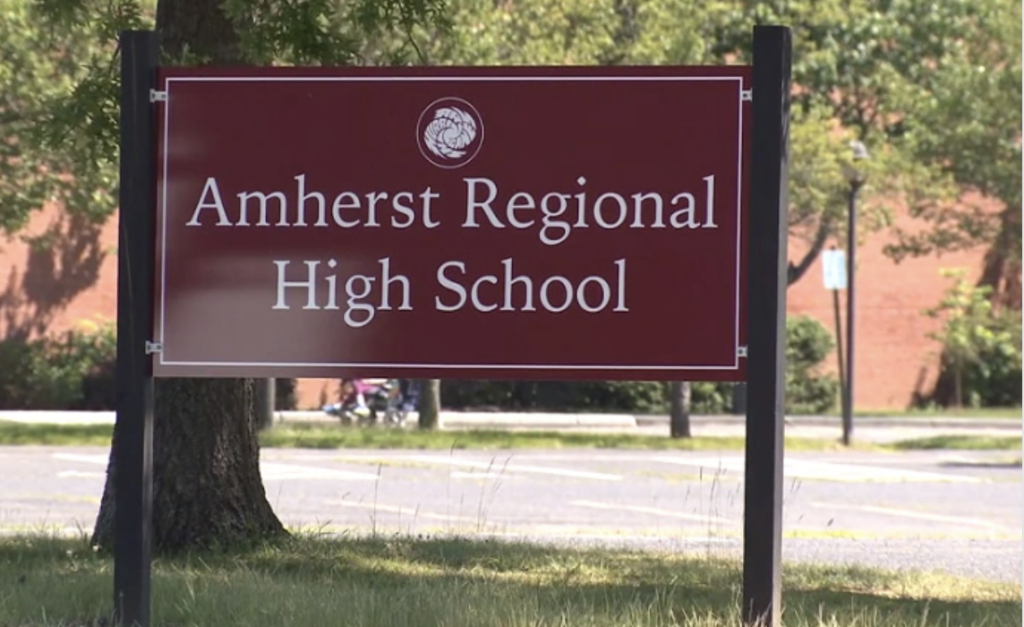
Photo: Art Keene
Report on the Meeting of the Amherst Regional School Committee, September 8, 2026, Part 2.
This hybrid meeting was held in the high school library and was recorded.
Present
RSC members: William Sherr (Chair, Pelham), Sarahbess Kenney (Vice Chair, Pelham), Andrew Hart (Amherst), Anna Heard (Shutsbury), Bridget Hynes (Amherst), Laura Jane Hunter (Amherst), Deborah Leonard (Amherst), Sarah Marshall (Amherst), Tim Shores (Leverett).
Staff: Superintendent E. Xiomara Herman (Dr. Xi)
At the first meeting of the school year, the Regional School Committee (RSC) received reports from the leadership team. Superintendent E. Xiomara Herman (Dr. Xi) and principals Mark Gomes and Juan Rodrigues reported on objectives for the new school year and answered committee members’ questions. Director of Student Services Tom Simon informed the committee about the ongoing search for a principal for Summit Academy. Summit Academy is the town’s secondary school (grades 7-12) for students with IEP’s who require a therapeutic setting.
September 26 Four Towns Meeting to Discuss Regional Agreement
Usually, the fall Four Towns Meeting kicks off the budget process for the regional schools. This year, however, the September 26 meeting will begin discussions on revising the regional agreement between the four towns. The meeting will take place at the new Shutesbury Public Library at 9 a.m.
For the past two years, the Massachusetts Department of Elementary and Secondary Education (DESE) formula for funding the regional schools has disallowed the guardrails the region previously used to limit cost increases for the smaller towns. This has resulted in double-digit increases in the assessments of Leverett and Pelham.
Enrollment Remains Steady. Attendance High
According to Dr. Xi’s report, enrollment for all grades in the middle and high school has remained slightly under 200 students per grade. Attendance at both schools has been over 96% over the last three years.

Dr. Xi reports that over the summer, staff reviewed many policies and procedures and identified those needing strengthening. Staff has organized this work as a series of commitments—specific actions the District must complete to strengthen our systems, improve accountability, and ensure consistent practices across our schools.
They have identified at least 71 commitments. While this is significant work, our immediate focus is on the procedures that have most directly affected District operations, particularly those connected to student safety and well-being.
Updating the policies and procedures will involve research and development, legal review, union review by the educators’ bargaining unit, school committee review where required, and final revisions and approval. The district will post the finalized policies and procedures on the district website and on BoardDocs.
In response to questions from the RSC, Dr. Xi said she will present a report on last year’s School Improvement Plan (SIP) in October, when she presents her “State of the School System” report. The report will document which SIP goals have been met and which still need work. She noted that there has been a transition in leadership at Summit Academy and the high school since the Summit program was created.
Finally, this September Dr. Xi has launched Tea with Dr. Xi, which she describes as “a monthly virtual series designed to strengthen communication and connections across our school communities.” The first series focuses on school leadership. Families can meet their principals and leadership teams, hear about their vision and priorities for the school year, and ask questions. These conversations also serve as a lead-up to our upcoming Open Houses, where families can connect with teachers and learn more about their children’s classrooms. We encourage families to join her live to learn more about the people leading their schools and participate in the conversation.”
Summit Academy Still Searching for Interim Principal
Summit Academy enters the 2026-27 school year still searching for an interim principal until it can organize and execute a formal search process. Newly hired Student Services Director Tom Simon is heading the interim search. Simon said Summit staff have shown great teamwork and collaboration by stepping up to help with day-to-day operations, but the program needs someone to drive its strategic vision.
The leadership transition has given the administration the opportunity to evaluate the Summit program. Simon said that he sat in on a community meeting and met some of the students: “It was a wonderful experience. It was clear that a lot of work had been done over the years, and the kids in the program knew what was expected of them. There is an enormous amount of strength to build from, and our goal in the program evaluation is to identify those strengths and then determine how we build from them. Even though it’s a small group of students, it’s a group with a fair amount of need.”
He said that ideally, the interim principal would have a background as a special education director, understand the therapeutic aspect of the school, and be a strong leader. Unfortunately, he has not been able to engage any of the retired leaders he knows. He said he is ready to coach a new principal.
Dr. Xi said her team has been reviewing old documents to clarify “what Summit truly is.” The Department of Elementary and Secondary Education (DESE) has three different names for the program. Technically, she said, the principal of record for Summit Academy is the high school principal.
Dr. Xi said that she will update the RSC on the program review as it is completed. A revolving fund from student tuition, not the operating budget, funds the study.
New High School Principal Sets Goals for the Year
Dr. Xi introduced the new high school principal, Mark Gomes, saying, “He embodies a student-centered (leader), but also has a grasp of listening to staff and sharing their concerns.”
Gomes presented his first-year goals in a one-page document. He emphasized closing achievement gaps for English language learners and students with disabilities through targeted interventions and regular progress monitoring. He wants to create a school students want to come to by fostering school pride. To meet challenges, he cited the vape intervention program, academic supports, a credit recovery program, and Saturday attendance buyback.
The Saturday program, Gomes said, is for students who are not doing well in subjects or have unexcused absences, and is part of the plan to hold students accountable. The program will give students an opportunity to recoup missed time and receive extra support.
RSC members had concerns regarding the program. Amherst member Laura Jane Hunter questioned Gomes’ use of the phrase “holding students accountable.” She said students miss school or fall behind for many legitimate reasons, including mental health issues and family obligations.
Dr. Xi explained that students with repeated absences receive support from guidance counselors and other staff, and sometimes they just need a different time and setting. Leverett RSC member Tim Shores felt that it was important for students to learn accountability, and he didn’t feel that holding them accountable was punishment.
Educators staffing the Saturday program will be paid from unspent funds allocated to the summer school program, which was run on a reduced scale this past summer.
Hunter also asked if Gomes had regular communications with educators. He replied that he walks the school every day and visits almost every classroom. He said he met with many staff members over the weekend.
As one of the few recent principals to come from outside the district, Gomes said he felt very supported in his onboarding process. He said, “I’ve been saying from day one, Amherst Regional High School should be a blue-ribbon school and that’s what the plan is. But we have to fix things around the edges first.”
Vacant Positions at the Middle School Close to Being Filled
Middle School Principal Juan Rodriguez said that, despite the delay in the Middle School opening due to the roof leak, he felt the beginning of the school year had gone really well. Attendance has been over 96%, and the building has palpable energy. He added that it was exciting to see the new students and staff from Chestnut Street Academy, the Amherst sixth graders who moved to the Middle School this year.
Rodriguez said that the school continues to partner with the Joy and Justice Program through the Collaborative for Educational Services in Northampton. The work has focused on “ensuring that our school has an environment that is safe and supportive to all students, staff, and families.” The work includes surveys of staff, students, and caregivers.
In addition, Rodriguez plans to improve communication with families, especially around student harassment. He is working with the Information Systems Department on a system to email administrators and make sure everyone is on the same page. He is also working with the office staff to arrange for Parent Square messages between the weekly dispatches when necessary.
Rodriguez stated that the school has finalists for the two unfilled math educator positions. Until the new staff members are oriented, long-term substitutes will continue to teach those classes. Once these two positions are filled, the school will have a full complement of teachers; however, two paraprofessional positions remain vacant.
An important focus for the school is improving achievement scores. Recent MCAS and iReady scores were at the 51st percentile, which, although above average, “are not good enough,” according to Rodriguez. The school plans strategic interventions to ensure steady improvement.
A finalist for the Nurse Manager position at the regional schools has been selected. The position became vacant at the end of last school year and has been challenging to fill.
Funding for Middle School Afterschool Program Cut
Rodriguez reported that funding for the Middle School’s VELA afterschool program was not renewed, so the school currently has no afterschool program. He asked the RSC for support in accessing community resources to reestablish the program.
Algebra and Advanced Spanish at the Middle School
Amherst RSC member Deb Leonard asked about the algebra and advanced Spanish programs at the Middle School. Rodriguez replied that last year the school piloted a two-tier program in which students who didn’t quite meet the criteria for taking algebra in eighth grade could be in an “algebra flex” program. If they advanced enough to meet the qualifications for algebra, they could be moved up. Otherwise, they would stay in pre-algebra. He said that the system was messy, so the school discontinued it. Students who do not qualify for algebra will be placed in Math 8, which is essentially pre-algebra.
Shores asked how the school was accommodating students from the Caminantes dual-language program in Amherst in the new advanced Spanish class in the Middle School. Rodriguez said that, of the 25 seats in the class, 15 were reserved for Caminantes students and 10 were for other students in the region who qualified for advanced Spanish. The school used a lottery to choose the students. The class will start next week.
Student Representatives to School Committee to Be Chosen Soon
Mika McGee, the high school Dean of Students, reported that elections for the high school student council will be held at the end of the month. After that, students will be chosen as representatives to the RSC.
The region is still recruiting caregivers to serve on site councils for each school. Site councils are advisory, building-based committees mandated by Massachusetts state law (MGL Chapter 71, Section 59C) to help individual school principals manage and improve local schools. Site councils must include an equal number of caregivers and staff. The deadline to form site councils is in October. DESE states that each council must have an equal number of caregivers and staff.
Volunteer Program in Schools Begins Again
The school volunteer program was re-evaluated over the summer. All volunteers must now have CORI (Criminal Offender Record Information) from the state filed before volunteering. Many in the LGBTQIA+ caucus worried they wouldn’t be able to support students through the volunteer program. Several spoke during public comment, noting the program’s importance and expressing gratitude that it will continue.