
No To Nuclear: Author Linda Pentz Gunter in Conversation with Sharon Tracy

Linda Pentz Gunter (L) , speaking about her new book, "No to Nuclear" at the Clapp Memorial Library in Belchertown on Sept 8, 2026. To her right is moderator and anti-nuclear activist, Sharon Tracy. Photo: Josna Rege
On Tuesday, September 8, Linda Pentz Gunter of Beyond Nuclear discussed her new book, No to Nuclear: Why Nuclear Power Destroys Lives, Derails Climate Progress and Provokes War (Pluto Press, 2026), in conversation with longtime anti-nuclear power activist Sharon Tracy. More than 35 people packed the Clapp Memorial Library in Belchertown for a short reading and a wide-ranging discussion followed by a lively Q&A session.
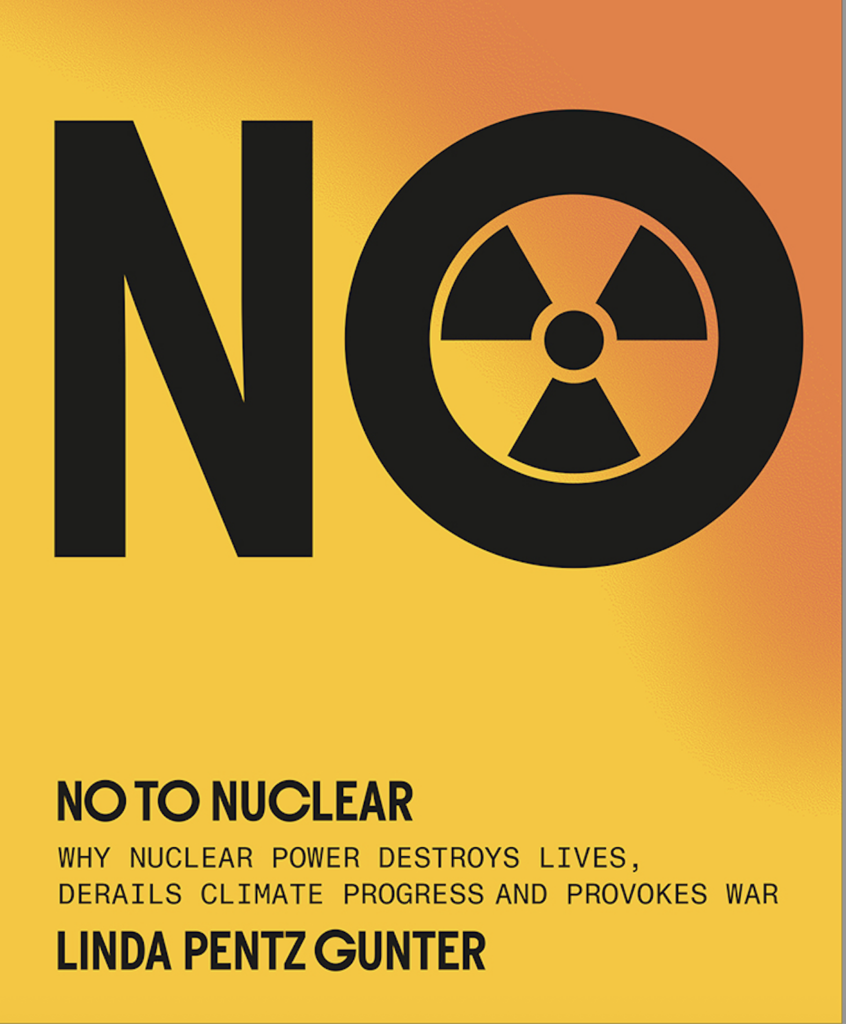
Sharon Tracy, of the Seacoast (NH) chapter of the anti-nuclear Clamshell Alliance in the 1970s and a lifelong anti-nuclear activist, introduced the book by praising its readability and its author’s use of humor instead of technical arguments that make readers’ eyes glaze over. Linda Pentz Gunter elaborated, saying that the word “nuclear” was “clinical and clean-sounding,” and that her goal had been to write “from a human perspective, focusing on people all along the nuclear fuel chain.” She outlined the book’s main points, including “the integral ties between nuclear power and nuclear weapons,” the colonialism and racism of uranium mining and nuclear weapons testing, and the current “obsession” with “new” Small Modular Reactors (SMRs) that she called a “fantasy.” The aim of the book, she said, was to “build an indictment” of nuclear power and, for those pressed for time, recommended its short, hard-hitting appendix, “Ten Reasons to Reject Nuclear Power,” also downloadable from Beyond Nuclear’s website.
Pentz Gunter said that No to Nuclear does not focus only on the harm that the operation of nuclear power does to human beings, but also on its “complete disdain and disregard for all the other creatures we share this planet with,” notably marine wildlife, as nuclear facilities routinely contaminate the rivers and oceans with radioactive waste, “as the Japanese are doing right now” with the contaminated water from the Fukushima nuclear meltdowns. “Justice”, she said, “is the through theme” connecting all these points.
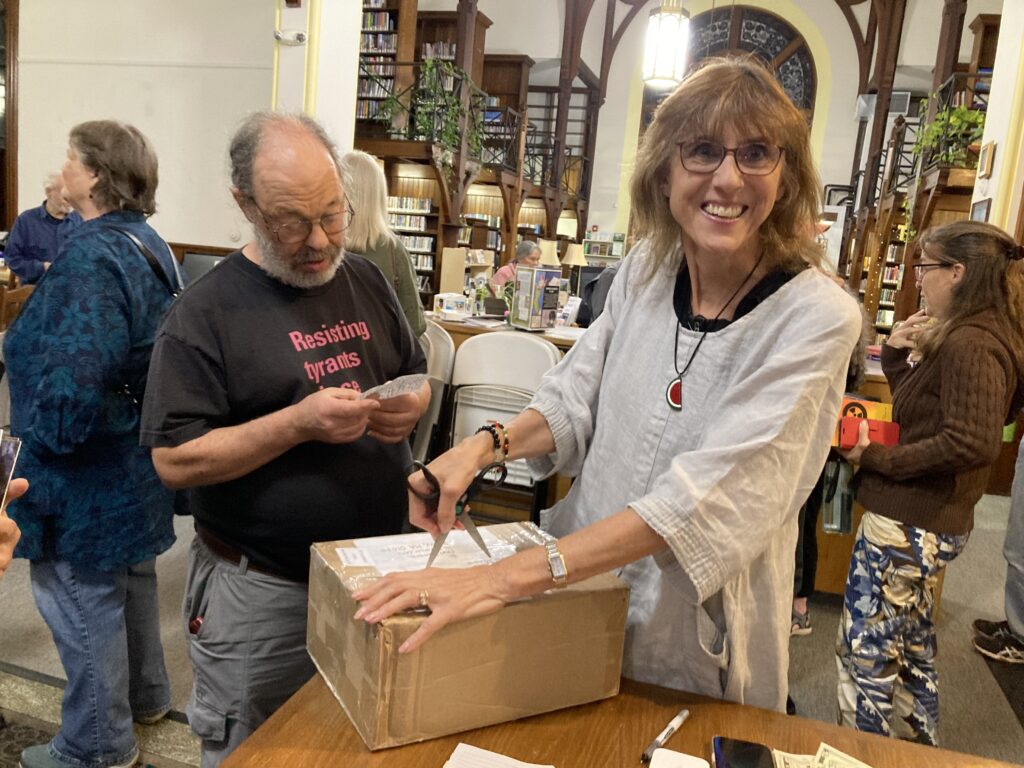
In her questions, Tracy steered the conversation to the looming prospect of new nuclear facilities in Massachusetts under Governor Maura Healey, a strong advocate of SMRs. She asked, “how can we work on politicians who have fallen prey to the nuclear industry myths?” Pentz Gunter responded that the best way to sway politicians was to educate and organize people to exert pressure on them from below.
Governor Healey’s energy legislation, the Energy Affordability, Independence & Innovation Act, sought to repeal Chapter 503, a 1982 law brought about by a statewide ballot referendum that required strict safety measures and a voter referendum before any new nuclear facility could be brought to Massachusetts. In the preamble to the legislation unveiled last May, Healey said that repealing that law would eliminate “a major barrier to the consideration of new small modular reactors that could improve reliability, stabilize prices, and decarbonize the region’s power grid.” That provision cleared the state legislature but, thanks to energetic lobbying by residents and safe energy organizations, it has been removed from the version approved by the state senate on July 1, 2026.
Despite citizen opposition, on September 30, 2026, Healey, along with other regional governors, will hold a nuclear energy summit at UMass Lowell, “exploring the role advanced nuclear and fusion energy can play in New England’s energy future.” Anti-nuclear and safe energy groups around the state are organizing to make their voices heard at the summit.
No to Nuclear refutes the nuclear industry’s inflated claims for untested SMRs that both political parties seem to have embraced, as both the Biden and Trump administrations have handed out enormous subsidies to projects that Pentz Gunter asserted will take at least a decade to come online, and at a tremendous cost that will be borne by the taxpayers. She argues in the book that these much-vaunted “new” nukes are not in fact new at all, but the same old ones in shiny new packaging.
Drawing from the book, Penz Gunter gave several examples of nuclear projects around the country and the world, including in Indigenous and economically disadvantaged communities. She pointed to the U.S. Southwest, where Navajos mined uranium ore without protective equipment and died of lung cancer. She recounted the grisly story of the 1961 assassination of the democratically elected leader of the Republic of the Congo. “The story of Patrice Lumumba is a uranium story,” she said,, one that implicated the U.S., the U.K, Israel, and France, and added, “eighty percent of the uranium in the Hiroshima bomb came from the Congo.” In the Cold War climate of the time, the fear that Lumumba would turn over the newly independent country’s uranium to the Soviet Union justified the atrocity, as did a racist and colonialist mentality still prevalent today, as the greed for precious metals such as cobalt trumps the unfolding genocide in the Democratic Republic of the Congo.
Many of the people in attendance at the library were old-time activists from the U.S. anti-nuclear movement of the 1970s, which was born right here in the Pioneer Valley and first gained critical mass in the decentralized grassroots organizing and nonviolent civil disobedience of the Clamshell Alliance. It must be said that most of them (this writer included) were just plain old. However, the atmosphere at the book event, even as old friends greeted each other, was neither nostalgic nor elegiac. It was charged with a strong sense of urgency, driven by the projected soaring demand for electricity to fuel AI data centers and the resurgence of a nuclear industry greedy for the massive government subsidies being handed out to renewable energy projects, aggressively marketing itself to a new generation. Much of the Q&A focused on the best ways to expose and reject nuclear industry propaganda to a new generation sold on myths that nuclear power is safe, green, and clean.
As Linda Pentz Gunter wrapped up her remarks, she reminded the audience that the elected officials seeking to build new nuclear facilities and reopen decommissioned nukes across the country, and echoing the industry talking points, were engaged in a “massive betrayal of their constituents.” Nuclear power preys on indigenous communities and is the “slowest and most expensive way to generate electricity”. It cannot serve as a stopgap until more renewables like solar and wind come online. In fact, it will block their development by siphoning off the government subsidies intended for renewables. There are the radiation exposures to human beings and the environment all up and down the nuclear fuel chain, routine radiation leaks from nuclear power facilities and—lest we forget—the perennial danger of catastrophic accidents like Three Mile Island, Chernobyl, Fukushima. No one yet knows how or where to store the high-level radioactive waste safely. And, as No to Nuclear reminds us, history has demonstrated that “Atoms for Peace”—the use of nuclear power for civilian energy production—“is also a pathway to war.”
For more information on how to get active, contact:
Beyond Nuclear: https://beyondnuclear.org/
The Clamshell Alliance: https://clamshellalliance.com/
Massachusetts Peace Action: https://masspeaceaction.org/
Citizens Awareness Network (CAN): https://www.nukebusters.org/

Gen Z support for advanced nuclear is well above the public average. Trying to recycle these anti-nuclear talking points to attack new ways of doing nuclear is not going to be persuasive to young people who have very easy access to more complete and sometimes outright contrary information. There are good and bad ways of doing nuclear. By opposing all forms of nuclear, the activists of old have removed themselves from the conversation about how to discriminate the good from the bad, and have no credibility as impartial educators.
When someone says theyre anti nuclear energy I immediately dismiss anything else they say on the topic of climate change. It’s more respectable to just say climate change isn’t real or not a threat so why would we want these ugly nuclear power plants. There is no solution to climate change without mass build out of nuclear power. If we ever master fusion and ever get a form off government that is built around human flourishing instead of profit, nuclear would also be one of the single most impactful boons for social justice we could possibly do. Energy would be virtually free and have virtually no environmental impact.
Couldn’t disagree more. I want a nuclear power plant right smack dab in Amherst.
Sorry, @Nicholas Geary, but Gen Z support of nuclear is predicated on industry lies. Whether it’s the old-style 1000-megawatt reactors or the unproven Small Modular Reactors (SMRs) touted by Healey and others, none of the huge problems with nuclear have been solved.
• Not the need to isolate waste from the environment for 200,000 years
• Not the subsidized limited liability insurance, which means we taxpayers and ratepayers will shoulder the huge costs of any disaster
• Not capital costs that spiral out of control and construction timelines that triple
• Not the fact that counting the whole fuel cycle, nuclear is no friend of carbon reduction—and will divert funds away from the true clean energy solutions we already have
• Not the unfortunate history of MORE THAN 100 potentially serious nuclear accidents in the mere seven decades of the industry’s existence: https://en.wikipedia.org/wiki/List_of_nuclear_power_accidents_by_country (and by the way, think about the climate and agricultural impacts of the land around Chernobyl being quarantined for the next 20,000 years)
• Not the ongoing health costs, the costs of guarding that waste 20 times longer than the founding of the first cities, the cost to our freedom AND our finances of the security apparatus it would need, the numerous environmental costs, etc.
As younger activists discover that nuclear will not only raise electricity prices and endanger not just our safety but the safety of any species that depends on water quality or is susceptible to radiation-related diseases, but it does so while impinging on the rights of Indigenous people, promoting antidemocratic forces and mass surveillance, socializing costs while privatizing profits, and enabling unwanted data centers—and using subsidies from our tax dollars to create these effects—they tend to switch to the no-nukes side.
Even when everything works the way it’s supposed to be, nuclear is the most expensive way to generate electricity and the longest to deploy—but as noted, the systems often fail. And yes, I’m counting the pipe-dream, untested, and potentially even more dangerous SMR “solutions” in this analysis. For some reason, SMR companies want to build them without containment vessels to limit radiation and toxics release in an accident. In Parsons, Kansas, for instance, they even want to stack no-containment-vessel SMRs a mile or more deep and not bother to remove them once they’ve had their useful life (as little as two years, according to the company’s own statements), and so what if the water table is contaminated in the process? (See the company’s quotes at https://www.kosu.org/energy-environment/2025-12-22/kansas-will-get-the-worlds-first-mile-deep-nuclear-reactor-30-miles-from-oklahoma-border And read Linda’s husband Paul Gunter’s critique of this unbelievably bad project, with several clickable references, at https://beyondnuclear.org/deep-fission-approval-is-for-a-drawing-not-a-milestone/
Here in Massachusetts, we’re protected by the guardrails of a citizen initiative passed in 1982 that requires such essential features as an evacuation plan, a permanent waste storage facility, and votes by both the legislature and the citizenry to approve a new nuclear power plant. Healey and her industry buddies pushed a one-sentence repeal through the Massachusetts House, but with massive lobbying, we were able to keep it out of the Senate version. It’s in the conference committee now, and we need to make sure the repeal is not put into the final bill. 1) Please contact all six members of the conference committee (listed, with email and phone contacts, below) to say that you strongly oppose repealing section 503 of the 1982 Massachusetts laws. 2) Please ask your own State Senator and State Representative to tell their colleagues on the Conference Committee NOT to repeal 503.
Sen. Michael Barrett: 617-722-1572 / Mike.Barrett@masenate.gov (Room 312-B)
Sen. Cynthia Creem: 617-722-1639 / Cynthia.Creem@masenate.gov (Room 312-A)
Sen. Bruce Tarr: 617-722-1600 / Bruce.Tarr@masenate.gov (Room 308)
Rep. Mark Cusack: 617-722-2030 / Mark.Cusack@mahouse.gov (Room 43)
Rep. Bradley Jones: 617-722-2100 / Bradley.Jones@mahouse.gov (Room 124)
Rep. Aaron Michlewitz: 617-722-2990 / Aaron.M.Michlewitz@mahouse.gov
(Room 243)
Nuclear power is not a solution to the climate crisis; pursuing nuclear diverts funding, research and development away from achieving a real solution. Nuclear power is too expensive compared to solutions available now. Nuclear reactors’ kilowatt-hour costs to build and operate are far higher than renewables; small modular reactors’ (SMRs) will be even more expensive.
A new nuclear power plant takes 10 to 15 years to generate power. We can rapidly scale up affordable renewable energy and energy conservation. SMRs, still designs on paper, will never arrive in time or in enough quantity to address the current climate crisis.
No energy source is “zero carbon” including nuclear power. Carbon reductions can be made faster for the same investment by choosing renewables (solar, wind, efficiency).
Nuclear power needs cooling water and must be shut down when the intake water is too hot, the water level is too low, and during extreme weather events. For maintenance they power down about 10% of the time. Renewables are far more reliable.
The nuclear fuel chain is far reaching and devastating to people. It violates human rights. Nuclear facilities (mines, mills, enrichment and processing factories, reactors, waste dumps) violate the rights of people least able to resist: poor communities and people of color. The nuclear corporations ignore communities’ democratic votes, violate treaties with Indigenous peoples, plunder sacred sites, and contaminate land, air and water.
Nuclear power is too dangerous and is the pathway to nuclear weapons.
No other energy technology has the same capacity for catastrophic and long lasting harm as nuclear power. We are now seeing nuclear power plants recklessly embroiled in war zones in Ukraine and Iran. The costs of a major accident are astronomical. Countries with a “civil” nuclear power program have the technology, skills and materials to develop nuclear weapons.
No other energy technology is as dangerous. The high-level radioactive waste all nuclear power reactors have produced since 1942 remains deadly to all life for tens of thousands of years. But no storage solution exists. Ionizing radiation released at every phase of nuclear power operations is harmful to life.
I have to admit to a gap in my understanding. I can understand why people who are against nuclear power are so passionate, for all the reasons Shel, Linda, and Sharon put out there. I am having trouble imagining the source of passion of people who want it to expand. They seem to believe that nuclear is needed to cut down on carbon emissions. Maybe they haven’t actually talked with people who live near waste dumps and reactors and mines and milling facilities, or read the history. Becuase, to me, it seems that people who think nuclear power is a good idea are saying, whether they say it out loud or not, that it’s a good idea that uranium miners get lung cancer, that Indigenous and African communities’ water supplies are contaminated, that people living near nuclear reactors get cancer and have miscarriages, that a poorly regulated industry driven by profit shortchanges safety and survives only with subsidies from our tax dollars, that no one has done the work to find a safe place to put the radioactive waste, and on and on. What am I missing here? I just don’t get it.
Ann, from a Gen Z pro-nuclear advocate, I will throw in my 2 cents. Anybody born post 1990 does not have the same framework on nuclear energy as previous generations. We did not grow up with the disasters/near disasters of the Baby Boomers or Gen X such as Chernobyl or Three Mile Island. From my perspective, there are gives and takes for all forms of energy production. Nuclear energy is one of the most highly regulated forms of energy production. It is also the easiest way to produce massive amounts of energy without massive greenhouse gas emission. In confronting the climate crisis, we need an above all approach that will embrace any form of energy production that will slow the warming of our planet, while at the same time keeping energy costs reasonable for everyday workers. Completely renewable resources have made great strides, but they also have drawbacks (I.e. blowback against battery storage, siting of facilities etc). It is very unlikely that renewables will be able to provide enough electrical generation within the next few decades to completely replace fossil fuels. So why not follow the lead of countries such as France that get 70%+ of their energy from nuclear? They don’t seem to be having the massive issues that nuclear deniers/skeptics claim will occur. And on top of that, they are much further ahead on climate goals than the US, or even Germany (which is another major anti-nuclear nation). It just seems, to me, that we need a shake up, and that the anti-nuclear talking points from 40+ years ago do not seem relevant in the modern context.