
Should Large Housing Projects Be Allowed in Neighborhoods Near UMass?
Photo: amherstma.gov
Report on the Meeting of the Planning Board, November 4, 2026
This meeting was held over Zoom and was recorded.
Present
Doug Marshall (Chair), Bruce Coldham, Roy Johnson, Jesse Mager, Angus McLeod, and Jerah Smith. Absent: Fred Hartwell.
Staff: Walker Powell (Planner) and Pam Field Sadler (Assistant)
Overlay Zone Near UMass Will Not Be an Easy Sell
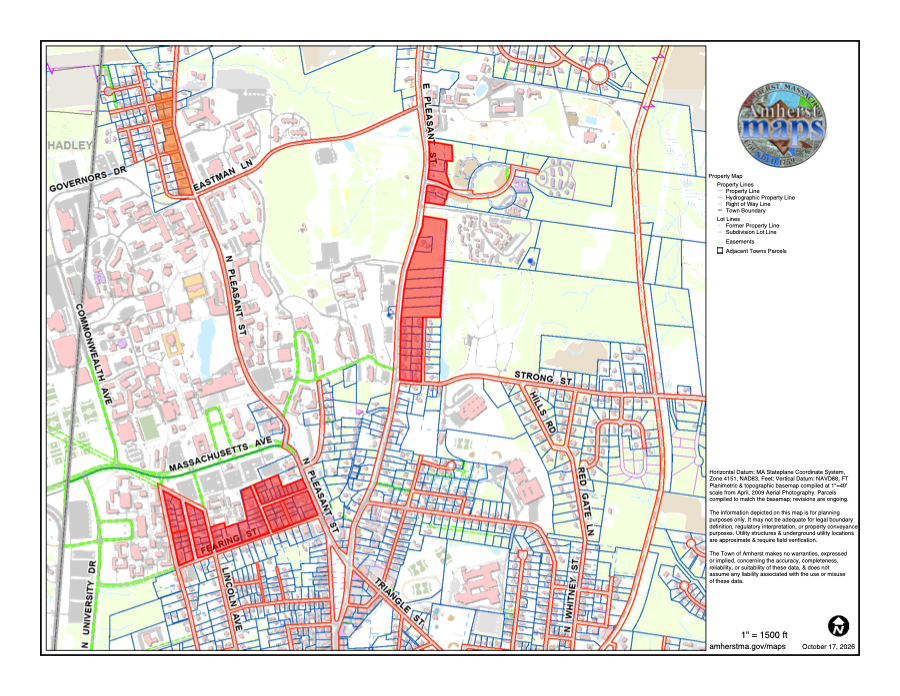
To increase housing for UMass students and protect neighborhoods increasingly being turned into student housing, the Planning Board has been exploring an overlay zone north of Fearing Street and along East Pleasant Street that would allow taller, denser buildings.
The two areas under consideration are the north side of Fearing Street to North Pleasant Street and north to UMass and a strip along East Pleasant Street north of Strong Street to Olympia Drive. A resident submitted a written suggestion to the board to include the strip of lots along North Pleasant Street north of Eastman Lane, and the board concurred.
Planning Board Chair Doug Marshall and Bruce Coldham drove around the areas last week and added the single-family homes on the west side of Wildwood Lane to the East Pleasant Street strip. Coldham pointed out that the slope of the land east of East Pleasant Street could allow six-story buildings that would appear to be only four stories high from the street. He also remarked that the Kestrel Land Trust owns a parcel in the area, and he was unsure whether it was possible to rescind the conservation restriction to permit development.
Marshall said that after hearing from some members of the public, “there was some concern that we might be stirring a hornet’s nest by asking to rezone all of those parcels along Fearing Street, and maybe we’d be smarter to concentrate on [on East Pleasant Street] along with the parcels along North Pleasant Street.” He added that property cards showed that about 50% of the properties in the Fearing Street area were owner-occupied. He suggested the board might want to focus on other initiatives now.
Board member Jesse Mager, who lives in the Fearing Street area, disagreed. He stated that the two areas are quite different, and the larger buildings envisioned for East Pleasant Street wouldn’t fit on Fearing Street, but that doesn’t mean that duplexes, triplexes, and quads would not be appropriate, doubling or tripling the density, not increasing it tenfold. He lamented that now there is no intentional plan for the area—no plan to contain rental units and encourage owner-occupancy. The same conversations have been going on for the past 20 years, yet established neighborhoods “are being quickly eroded, because nothing intentional is being done.” He pointed to McClellan Street, which 10 years ago had about 12 owner-occupied parcels out of 23, but now has only three.
Mager concluded, “Because there’s nothing intentional being done to regulate rental housing, student or non, to me it becomes an almost lesser of two evils that we either designate some places where we want to encourage the density, ideally in places where students would like to live, or we do nothing, and it sort of creeps through the entire downtown, because I don’t think the problem’s going away.”
Coldham countered, “There is a fairly vital group of residents [in the Fearing Street area] who have generated quite an amount of constructive initiative, not the least of which is the formation of the Amherst Community Land Trust. This is a neighborhood that’s learned how to be an intermediary between the intensely student-dominated campus and the RG (general residence) neighborhood.”
Roy Johnson offered a realtor’s perspective. He thought the pushback from the homeowners in the Fearing Street area would be too great, and that the rezoning would be a dead end. He also pointed out that many properties along East Pleasant Street and Wildwood Lane are very expensive, and it is unlikely developers would buy several to create a lot large enough for a multi-family project. He felt the board should spend its time on better projects.
Jerah Smith also raised Amherst’s revenue challenges, in addition to the shortage of multi-family rental units. He noted that the UMass plan to overhaul its dorms using public-private partnerships “is going to upend our town’s housing market over the next couple of years.” He added, “I don’t want the fear of 12 or fewer homeowners stopping us from even having the conversation, because it impacts the whole town, and it needs to be had.”
Angus McLeod suggested that the Planning Board approach the Town Council about its willingness to pursue a campus-adjacent overlay. He said that conversations about the conversion of single-family homes to student rentals have been in the Daily Hampshire Gazette going back 30 years and “clearly this problem has not been solved by UMass. It doesn’t seem like they have any plan to solve it. So, what does the Town Council want to do?” He asked where the council wanted to put additional housing if indeed they want to increase the housing supply.”
Marshall noted that many of the houses near campus, such as those on Phillips Street, were in poor repair, and that many abutters would prefer newer, larger residential development to the existing buildings. “That would actually be a better neighbor for me than to have these little residential buildings that are slowly rotting away and have multiple sorts of local landlords,” he said.
Mager added that creating an overlay or changing the zoning does not make development happen. Maybe it is not financially viable to build larger complexes, but at least it can be an option.
Several Arguments Countered in Public Comment
Amherst Community Land Trust (ACLT) President Linda Slakey said, “It’s not quite true that nothing has been done in the last decades. A group of citizens asked whether there was anything positive we could do to both make housing affordable and to strengthen the viability of neighborhoods, and it turns out that the land trust model is suited to that.” She pointed out that a substantial number of ACLT projects are in or near to the Fearing Street area being targeted for rezoning. These are homeownership opportunities for low-and middle-income families.
Slakey said, “I understand the financial pressures that the town is under, and in fact some neighborhoods that are vibrant now actually need to be sacrificed. I would like to see honesty about saying upfront that the money matters more than a certain viable neighborhood.” She pointed out that people are willing to walk away from hundreds of thousands of dollars of appreciated value in their home to sell to ACLT and maintain owner-occupancy. She stressed the neighborhood’s role as a buffer between UMass and the rest of central Amherst, and that many property owners rent space in their homes to students and enjoy living among them. She emphasized that another development the size of Fieldstone would profoundly impact the area, making it much less desirable to live there for both students and non-students.
Rezoning of the Professional Research Park Zones Advances
The Planning Board received favorable responses from most owners of property zoned as Professional Research Park (PRP) to allow housing to be built in the PRP. Most of that land has not been developed. Board members have been working on a draft bylaw and will submit it to the Planning Department staff to finalize. It will then be put on the Town Council schedule to begin the approval process.
The board received a written comment from Greenleaves residents expressing concern about nearby development.
Planning Board Accepts Signage and Outdoor Furnishing Proposed for Jones Library
As a condition of its 2024 expansion permit, the Jones Library was required to return to the Planning Board with designs for new signage and outdoor furnishing. Josephine Penta of Finegold Alexander Architects and Rachel Loeffler of Berkshire Design Group presented the plans for the completed project.
The library will have two new signs. The one on the Amity Street side will be similar to the previous sign on the lawn in front of the building, mounted on aluminum posts. The north side of the building will have letters mounted on the canopy of the roof above the entrance of the new addition. Both signs will be illuminated at night.
The outdoor seating will consist of four red tables along the north side of the building. The tables will be of different heights to accommodate wheelchairs and children. The tables will have both benches and stools. Boulders suitable for seating will also be placed in the garden area north of the building.
Jones Library Facilities Director George Hicks Richards said plans are to cable and lock the furniture at night to prevent theft, but it may be necessary to bring it inside every evening.
Loeffler said that there will be Goshen stone walkways with five or six fixtures providing lighting leading from the CVS Parking lot to the garden entrance of the library. Vestre Vroom bicycle racks will be placed at both entrances.
The board unanimously accepted the site plans.
See Related
Opinion: Who Benefits from Amherst’s Campus-adjacent Zoning? (Amherst Indy)
If UMass would build more dorms on campus and they paid the town property taxes, we would not have to destroy neighborhoods.
All the new dorm construction will be rehabbing dorms from the 1970s – that’s great – and inadequate.
UMass does not have the right to refuse to accomodate their students. Clearly students want more on campus housing too – that’s why there have been protests of students sleeping outside.
Perhaps if there was less of an overlap of leadership at UMass and the Town of Amherst, we would be more successful in getting UMass to do their part.