
Consultant to Help Town with Long-delayed Trash Hauler Reform
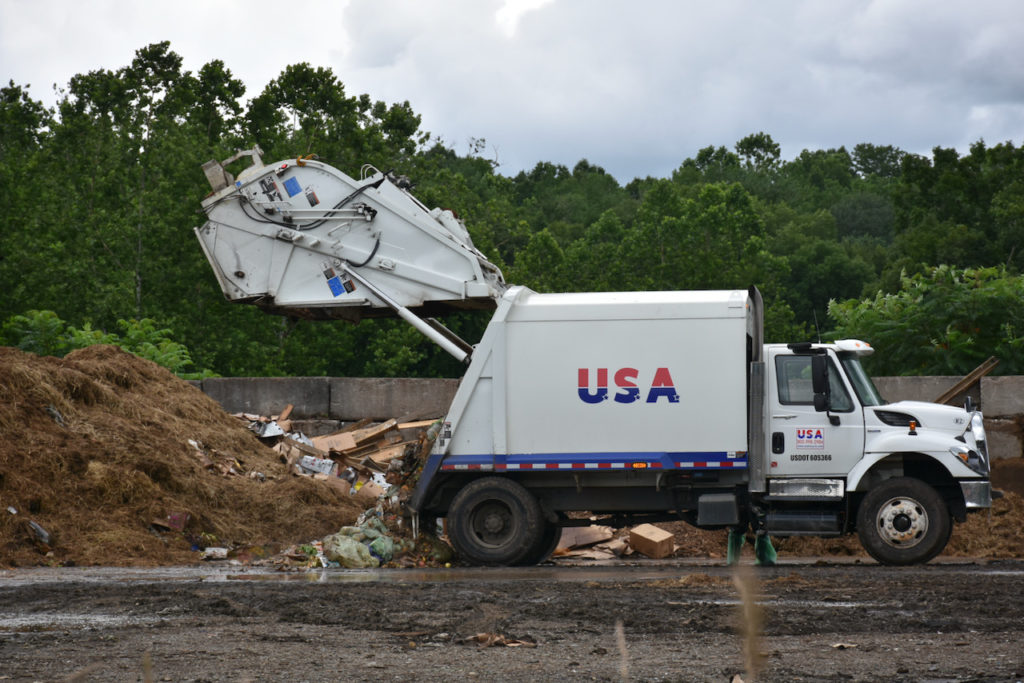
USA Trucking, Amherst's current solid waste hauler, delivering compostable trash to Martin's farm in Greenfield. Photo: Art Keene
The town has hired consultant Eric Weiss from the Pioneer Valley Planning Commission to help move forward the trash hauler reform bylaw that has been in the works since 2021, when it was proposed to the Amherst Board of Health which sets solid waste regulations for the town. (See here, here, here ,here and here for some history on the proposal.) Weiss shared his planned scope of work at the December 4 meeting of the Town Services and Outreach Committee (TSO) .
The proposed bylaw calls for the town to contract, through a competitive bidding process, with a solid waste hauler for services that include universal curbside pickup of compostable materials. Residents would pay a basic fee to the town for trash, recycling and compost pick up, and would either buy official waste (trash) disposal bags or pay a fee based on the size of their trash toter (‘Pay As You Throw’) to incentivize waste reduction. Residents currently contract individually with waste haulers for services and are billed directly by them. USA Waste and Recycling currently holds almost all of the contracts for homes in Amherst.
Weiss will help draft a bylaw that addresses the town’s priorities to substantially reduce the waste stream by implementing Pay As You Throw and universal curbside composting, and to reduce the costs of waste management for town residents. He noted the strong interest of Amherst residents in maintaining services at the town’s transfer station and said he would work to help the town sustain them. Weiss will help the town draft an RFP (request for proposal) to be part of a competitive bidding process, to be sent out to area trash haulers, three of which expressed interest in possibly bidding for the town’s contract, following a request for information (RFI) that was issued in 2023.
The most recent draft of the bylaw was almost two years in the making, and had some councilors questioning why a consultant is necessary, considering that so much work has already been done. Weiss did not share his thoughts on the existing draft.
Weiss, who has been working on municipal waste and other issues in the valley for 40 years, said he is excited about the project. He looks forward to helping move it forward, including helping determine what is feasible. He noted that he has previously worked on solid waste issues in Amherst and is a collaborator with Susan Waite, the town’s previous consultant to the project. He has also taught a UMass course on solid waste and recycling in the region.
Weiss will begin work immediately and hopes to conclude his consultation by April 1, 2026. His report, along with a new draft bylaw, and draft RFP will then go back to the Town Council, which referred a previous draft to the TSO more than a year ago, (in June 2024.) If the Council decides to move forward with the project, it would issue the RFP to determine which contractors are interested and what the costs of the contract will entail.
Weiss proposed the following scope of work:
- Background research of current status of town’s waste reduction and recycling efforts
- Review of Information gathered from previous RFPs /RFIs
- Preliminary discussion with Town Managerlaw
- Meet with Town Services and Outreach Committee
- Review of best practices
- Development of options
- Preparation of draft roadmap
- Presentation and discussion
- Finalize recommendations
- Create draft bylaw
- Complete project by April 1, 2026
He added that he will look for funding options for implementing the plan.
Councilors Andy Steinberg (at large) and Bob Hegner (District 5) expressed concern that any proposal incorporate input from town residents. Weiss agreed that outreach is important. Town Manager Paul Bockelman indicated that while outreach is not explicitly part of Weiss’ contract, there is room to build it into the plan as needed.
TSO previously spent the better part of a year developing an outreach plan that was never implemented, and in 2023, Zero Waste Amherst (ZWA) conducted a community survey that showed there has been little incentive for residents to reduce waste, and broad support for trash hauler reform.
Councilor Jennifer Taub (District 4) emphasized the importance of keeping the transfer station open as many Amherst residents rely on it as their only means of trash disposal and recycling.
Hegner said that several of his constituents have raised concerns that cubside composting might attract bears, and although other municipalities, including Pittsfield, have dealt with this effectively, it should be addressed explicitly. He also said he wants to be certain that a new policy will result in lower costs for residents than the current one.
Public Comment
Darcy DuMont, speaking on behalf of Zero Waste Amherst (ZWA) , which originated the plan and is now a community sponsor of it, reviewed the main elements of the original plan and asked that the group be included in further deliberations.
She said:
“I’m going to speak briefly about Zero Waste Amherst’s preferred language for a request for proposals from local waste haulers to contract with the town to provide a new system that would include a meaningful pay as you throw fee structure and curbside compost pick up, which is in your packet today. We think a well-crafted program will significantly reduce our waste, our climate impact and costs to residents at very little cost to the town. Currently we throw out at least twice as much as we would under this proposal.
“ZWA got involved with this initiative back in 2021 and with three councilors co-sponsored a bylaw proposal that was then referred to TSO in August of 2022. It has suffered a lot of delay but has also received a lot of support over the years since then and we are glad that it appears to be getting some forward momentum.
“Phase 1 of our recommended proposal, would serve the approximately 5000 single and 2-4 family housing units in town, and would also include those who use the transfer station so that all of those 5000 households would have access to the waste reduction possibilities provided by each. I’d be glad to explain that further.
“Our recommended system would involve each household having three rolling carts provided by the hauler if the trucks are automated.
“Cart 1 would be for trash. By diverting compost from the trash, we believe it will be reduced by up to 40%. By adding a pay as you throw system, we believe it could be diverted much further. Towns in California, that ban compostable materials in the waste stream, are seeking to reduce their trash by 75% by doing both of these things. Paying by the bag,using smaller carts and collecting biweekly are all ways of encouraging less waste through financial incentives.
“Cart 2 would be for recycling. For recycling, we’d like to model Pittsfield by using a manual or automated dual stream pick up and processing. Pick up can now be done with automated trucks on alternate weeks, one week for paper and the next for mixed recyclables, as in Pittsfield. According to the Springfield MRF, single stream recycling results in 20% diversion to trash, and dual stream recycling results in only 5% diversion to trash. The town would provide red and blue boxes for residents to hold paper and mixed recycling until pick up from the second cart.
“Cart 3 would be for compostable materials. Having curbside compost pick up allows for diverting a wide range of compostable materials including not just food scraps but items that are not backyard compostable like compostable take out containers, dirty paper, eggs, and meat. Potentially yard scraps can be added. ZWA would like any diverted compost to be processed at a local industrial composting facility, like Martin’s Farm in Greenfield. Residents would get tips on the town website and from the hauler about how to avoid problems with compost, like advising to put compost in a paper or compostable bag when placing it in the cart, and keeping meat scraps in your freezer until right before pick up. Residents would get the hang of this very quickly and like it.
“The contractor would ideally handle customer service and complaints, supply and maintain the carts, collect data, do some degree of outreach and education and spot check for enforcement. The town would provide the billing, based on a standard fee for service plus any additional or more frequent service needed. The Town could supply official town bags in 13 gal and 30 gal sizes available at local stores and the Transfer Station as is done in South Hadley as a further pay as you throw strategy.
“Phase 2 would ideally include our businesses, condo and apartment complexes and municipal schools, buildings and parks.
“ZWA has spent a lot of years discussing the details of this potential program, looking at other states and new developments. I hope you will give plenty of consideration to our recommendations, ask questions and include us in deliberations. There is a lot of information on our website about the history of this proposal and resources related to it which we invite you all to look at.
The committee also received one written public comment, from Marylou Thielman, opposing the bylaw. Thielman objected to eliminating consumer choice for solid waste services and forcing consumers to use a contractor chosen by the town. She argued that the proposed new system would be less efficient and more costly and that she saw no reason to change a system that is working well, with curbside composting already available for a fee from USA Waste and Recycling.
CET is there for free (Why else would city employees put time into becoming ‘green certified’?) for un-biased study and program roll out. They do so Commonwealth ®ion-wide.
I fear another “study”.
The city (when it was still a town) became known by surrounding towns as “Amherst-another–Study town”. The thinking by the hiring entity “If we pay them, we can absorb, then release the findings. I have watched this process go on for a long time (especially the last decade, on many issues, but especially THIS one). PLEASE – come into the 21st century, get with the 5-part best practices w/solid waste policy and program. We have the tech, let’s use it… Now