
Review: “Finding Our Place in the Connecticut River (Kwinitekw) Valley: Beginning to Heal 400 Years of Settler Colonialism”
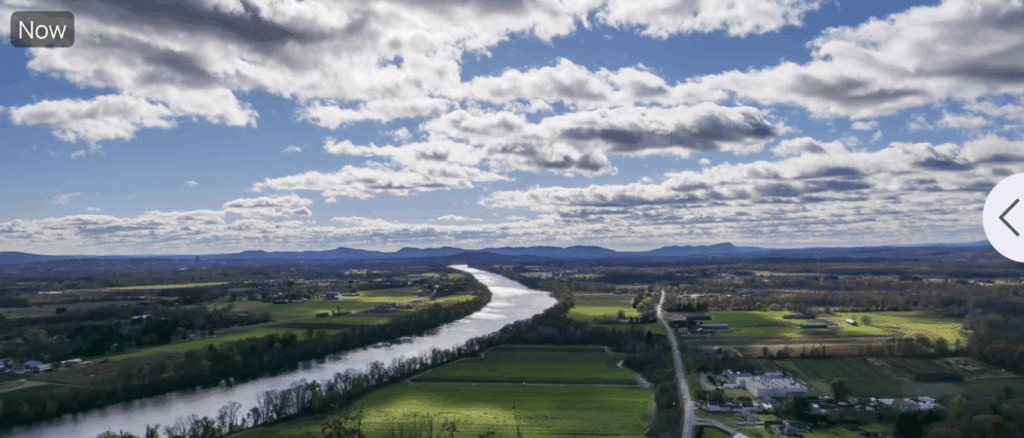
Connecticut River Valley today as viewed from Mt. Sugarloaf. Photo: Pioneer Valley Landform Observatory
On March 22, I attended the kickoff event for the Unitarian Universalist (UU) Society of Amherst’s Workshop Series, “Finding Our Place in the Connecticut River (Kwinitekw) Valley: Beginning to Heal 400 Years of Settler Colonialism.” featuring Indigenous scholar Dr. Margaret Bruchac (Emerita, University of Pennsylvania), speaking on Native/colonial relations.
I found this program fascinating for two reasons. Both of these reasons underpin the avowed purpose of the program itself which is the phrase “beginning to heal” in the title of the series. It is always good to be in a learning setting with Dr. Bruchac. I was not alone in this opinion. On a rainy Sunday afternoon, we were a crowd of about 30 people at UU’s Meetinghouse with 33 more on Zoom, all interested to hear what she had to say. After opening with a land acknowledgment in the Abenaki language, her illustrated talk began by setting up the context for the program as a whole.
Before I say more about her talk, I want to say that I am thankful I had the opportunity to participate in one of the UU’s community events. It is always possible there to sample the ways in which this dedicated group of people learn, worship, and work together for a better world. In fact, before Bruchac spoke, one member of the UU’s Indigenous Awareness Circle (IAC), Rodger Mattlage, called for a moment to acknowledge with gratitude that Bruchac had crossed the river to come talk with us, the very river mentioned in the title of the series. While John Gerber, another member of the Circle, took care of the Zoom link, Mattlage mentioned that the IAC’s work is guided by a five-step framework for developing right relations with Indigenous Peoples (adapted from the Unitarian Universalist College of Social Justice’s more general, original version) for this specific place on Turtle Island (the name for North America used by many First Nations). The steps below–not necessarily taken in any particular order–shaped the way the afternoon event unfolded and our participation in questions after the talk and in group discussions.
1. Learn whose land you are on
2. Learn about the history and current issues
3. Learn about yourself
4. Reach out to Indigenous communities near you
5. Take action for Indigenous rights in partnership—and commit to the long-term
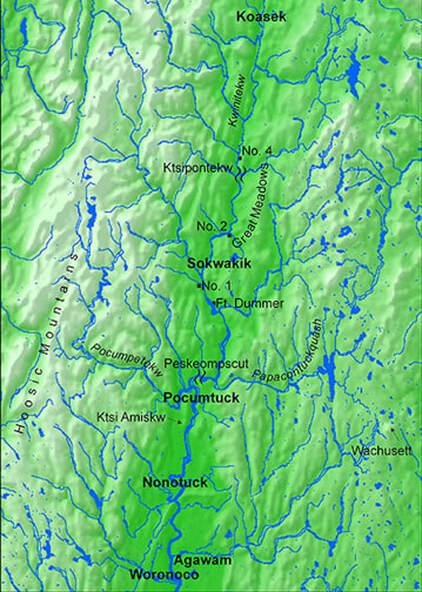
Bruchac began with a map (shown below) drawn from Dr. Lisa Brooks’s book The Common Pot: the Recovery of Native Space in the Northeast (University of Minnesota Press, 2008), an extensive and pivotal study of the 407 mile long river valley. The central part of the Connecticut or the Kwinitekw(kwin-eh-TEKWH) flows from Koasek (in present-day northern Vermont) and travels to Ktsipontekw, the “great falls”of present day Bellows Falls. Then it continues thundering downstream in Sokoki (soh-koh-KEE) territory to the place called Peskeompscut, the “great falls” in Pocumtuck territory (in Turners Falls, or Great Falls as some people call it). Peskeompskut is known as the place of the 1676 massacre at Great Falls. Historically, and down to the present, the Valley is territorially linked but socially distinct in terms of its nations and tribes.
Bruchac’s talk was structured in four parts in order to explain the history of Indigenous Peoples in our midst here in the Valley for each discreet time period.
Part 1 concerned the Deep Past (or deep time). Bruchac told the origin story of the Pocumtuck (poe-come-tuck) Range north of Amherst, that according to Native legend is a fossilized giant beaver. In profile these hills look like a huge beaver swimming with its legs submerged with Mt. Sugarloaf as the beaver’s head.
As a non-native listening to the talk by someone who is Native, I was particularly interested in which images Bruchac used to illustrate her commentary. She included specific events but also demonstrated through imagery the broader themes of settlement patterns, hunting traditions, and rituals, particularly those associated with trade and/or diplomacy— both among Native Peoples (intertribal agreements) and eventually, with colonial settlers. One of her visual resources was the 2004 body of work by Canadian illustrator Francis Back created for the website and programming called the “Raid on Deerfield: The Many Stories of 1704” at the Pocumtuck Valley Memorial Association (PVMA). Bruchac explained that images like these were intended for educational programming and research purposes at the Memorial Hall Museum (the home of the PVMA).
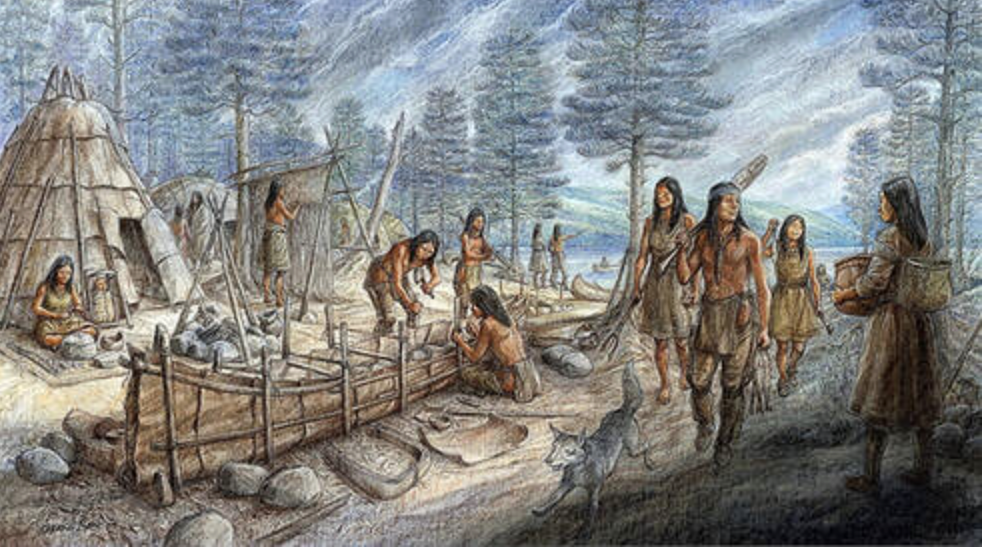
Part 2 of Bruchac’s talk focused on the Valley’s Native peoples in the Contact period [around 1400-1700] that was by turns, a time of trade with periods of peaceful co-existence, and King Philip’s War of 1675-1678, also known as Metacom’s Resistance.
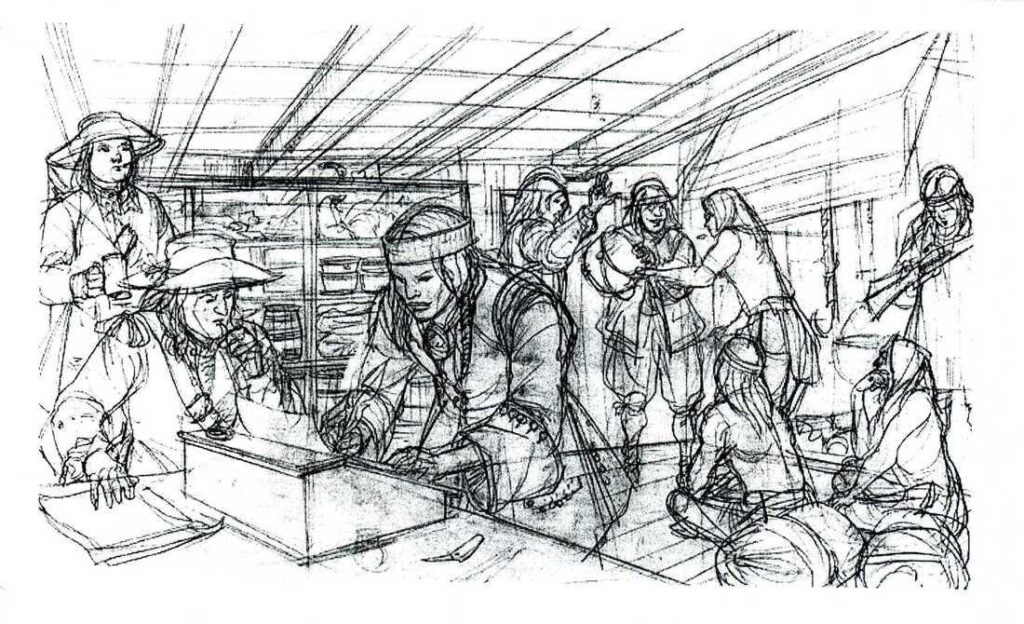
Pocumtuck Sunksqua (female sachem) Mashalisk is shown making a transaction with John Pynchon in the 1660s. Illustration by Francis Back for the website Raid on Deerfield: The Many Stories of 1704. Courtesy of the Pocumtuck Valley Memorial Association, Deerfield, MA.
It just so happened that two days after Bruchac’s talk, the Cambridge Public Library and the organization called Historic Bostons hosted a program called “The Past is Now: An Intertribal Panel on King Philip’s War, Past and Present” (video recording). Four panelists from indigenous groups (Mashpee Wampanoag, Aquinnah Wampanoag, Massachusett at Ponkapoag and Hassanamisco Nipmuc) discussed this topic in the context of the 250th anniversary of the United States this year; the inference from listening to the talk might well be that maybe King Philip’s War is not really part of the distant past at all. This discussion is clearly part of a wider issue of beginning to heal. All the speakers at that event argued that Metacom’s War is still deeply present and that we live in its aftermath. This is especially true in relation to the historical markers dotting the New England countryside, reinforcing this long struggle as very brutal on all sides. It still shapes daily life, experience, and memory today.
Part 3: A particular strength of Part 3 of the talk was that it covered a period closer to our own time; the late 1700s and 1800s. And here, Bruchac could draw on a substantial body of research she had developed as a costumed interpreter of the life and times of a native medicine woman/doctor in New England. It was as an interpreter at historic sites such as Old Sturbridge Village where, incidentally, I first encountered Bruchac’s work. This part of her talk also referenced the book by University of Minnesota history professor Jean M. O’Brien (White Earth Ojibwe), Firsting and Lasting. In a video recording, O’Brien, argues that local histories of Connecticut, Massachusetts, and Rhode Island written in the 19th century became a primary way in which Euro-Americans could assert their superiority while simultaneously denying agency to Indian peoples, making it easier for colonial settlers to erase natives’ access to their homelands. She said, “Erasing, then memorializing Indian peoples also served a more pragmatic colonial goal: refuting Indian claims to land and rights.” One such place, locally, where native patterns of settlement is evident is at Indian Hollow on the Westfield River that was home to a botanical healer named Rhoda Rhodes who survived through this period of what is called “disappearance.” She is someone who remained highly visible after periods of colonial settlement and great violence.
Part 4 of the talk took us up to the present time and, in some ways, brought home the theme of reckoning with this past history. And at this point in the talk, Bruchac acknowledged the work of the scholar-writer Dr. Robin Wall Kimmerer, a member of the Citizen Potawatomi Nation, who has made non-human beings the focus of her scholarship and teaching. So much of Kimmerer’s work relates to issues of a right relationship with all living things and work that is restorative – and righteous – for native peoples. (See also her excellent websitehere). But for the purposes of this talk, Bruchac made the point that we are all [still] the beneficiaries of this river valley and its gifts and that we are in a moment of “recovering indigenous histories”, of plant beings (the term is Kimmerer’s), human beings, and all other non-human beings. Perhaps most important of all, in her concluding comments she said that this area is “still an indigenous landscape.” She pointed to areas like the Barrett Street Marsh in Northampton, just off King Street, and behind one of the strip malls, as places where wildlife are coming back on their own. It is possible here – as in other valley places – to remember that we are both guests on the land and also being giving the opportunity daily to get back to being in balance with nature.
In the Q and A period and discussions that followed, workshop participants met with a facilitator and used a ‘talking stick,’ to participate in rounds, being encouraged to respond to three questions; what stood out to each of us in the talk, and what might have been surprising or uncomfortable. Thirdly, we were invited to share what could arise for each person as a possible action item from the event overall. One participant recalled growing up in Natick, one of the original “praying towns” from where local tribes (Nipmuc) were later forcibly sent to Deer Island in Boston Harbor. The same person remembered a wall mural in town that depicted native peoples in racially insensitive ways. The story was covered in the local press
With this in mind, Bruchac shared with us that it is important to seek out Native perspectives both about the present and the past. In this context, she mentioned the Six Nations Iroquois Cultural Center, a museum in Onchiota, NY that presents Indigenous Haudenosaunee history and culture and stewards hundreds of acres of Adirondack forest land.
The discussion period was helpful and people were thoughtful. As a participant, rather than someone reviewing this series, I look forward to the rest of the programs in the series. In the meantime, I try to remain hopeful for a larger and more inclusive history of this valley and a better sense of right relationship with all beings in our beloved community. To quote Wendell Berry from Sabbath poem, “II, 1988, ‘It is the destruction of the world’,
“To destroy that which we were given
in trust: how will we bear it?”
More information about the UU’s Indigenous Awareness Circle (IAC) and its work can be found at: Indigenous Awareness Circle.
Read More
Bruchac, Margaret M. 2023. “From Nonotuck to Northampton: Recovering Indigenous Histories.” In Indigenous Native History. Northampton, MA: Historic Northampton.
Bruchac, Margaret M. And Laurel Davis-Delano. 2020. Springfield-Agawam Indigenous Land Acknowledgement. Springfield, MA.
Thank you for this enlightening piece! I am delighted to learn about the people and organizations working to preserve knowledge about our common human history. I often think how wonderful it would be to restore geographic features to their original indigenous names. I visited New Zealand many years ago and witnessed this effort to replace English names with the original Maori names. They have done this in a serious way over the years. Could we possibly do the same here? Kwinitekw, Ktsipontekw, Peskeompscut, Sokoki, such beautiful names from a past that we pay little or no attention to. “Healing” seems like a dream too far, but certainly a worthy aspiration. Seeing and recognizing on a daily basis through place names might be a useful step. Thanks again for this.
I agree, Stevie, it seems to be the least that a “bloody colonial” like me can do!
And a small step beyond [just] saying the words of a land acknowledgement in these parts, committing as well to an action that supports a modicum of healing. I especially hope that over time an indigenous word emerges for the Mill River in North Amherst.
My review references a talk I listened to on Zoom by the Partnership of Historic Bostons, that is actually an 8-part series marking the 350th anniversary of King Philip’s War! 🪶 More information about that series was recently shared by the Nolumbeka Project, based in Greenfield, and I am adding some info and the link to the series below….”often considered the least known yet bloodiest conflict in U.S. history, its story has long been told from the perspective of colonial victors. In Metacom’s Resistance, historians, tribal citizens, and Indigenous scholars challenge that narrative—offering new perspectives on how this devastating war shaped the New England we know today.
Visit our website [https://historicbostons.org/learn?fbclid=IwY2xjawRDHx1leHRuA2FlbQIxMABicmlkETF1SVBnYURtUHd0UUM2cE1Uc3J0YwZhcHBfaWQQMjIyMDM5MTc4ODIwMDg5MgABHhqO1k_4z8y_WeqkuxxF_8uyhXbSfoh9ePeJHM6O0yVLPBRX2rEHNidjzS1x_aem_HTt9c-UbToupu1Zk69saiA] to learn more about the series including how to register for upcoming programs and to watch recordings of past programs. 🎥
🔗 https://historicbostons.org/learn
#historymatters #indigenoushistory #newenglandhistory #publichistory #kpw350 #17thcentury