
Little Agreement Emerges from Eversource Public Meeting with Residents, But Discussions Will Continue
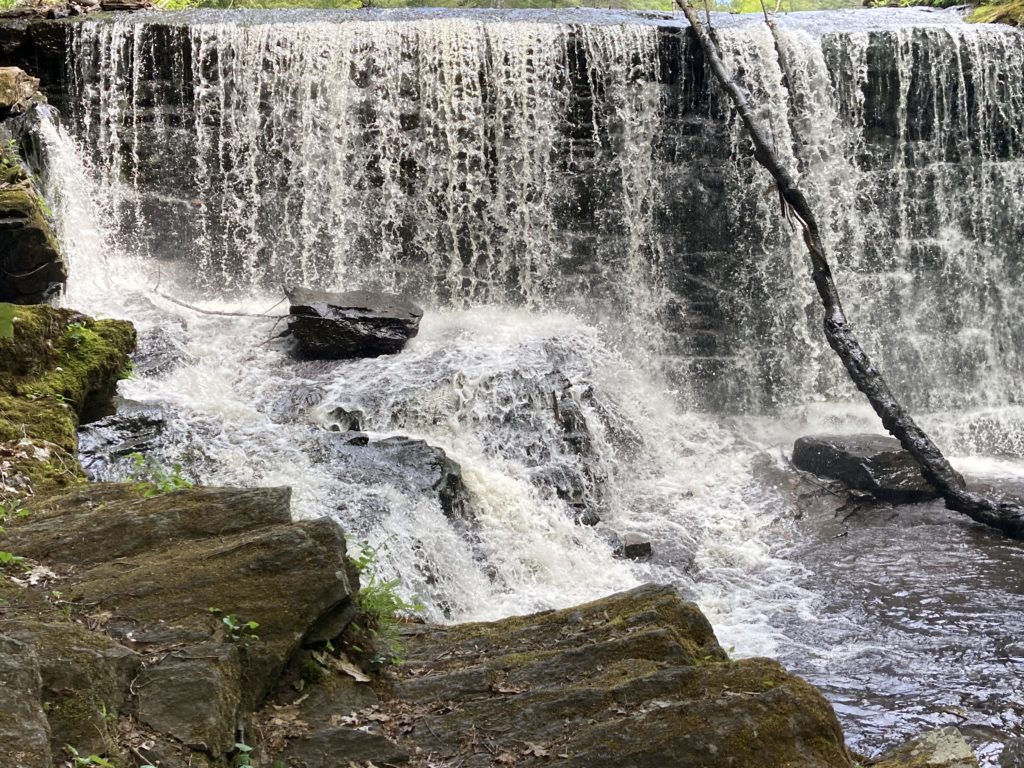
Buffam Falls, May 2022. Photo: Annique Boomsma
Area residents packed the Town Room of Amherst Town Hall the evening of April 14 to hear a panel of representatives from Eversource describe their WT-11 Transmission Right of Way Reliability Program (TRRP) and to engage them with questions and concerns about the project. The meeting was accessible on Zoom and was recorded.
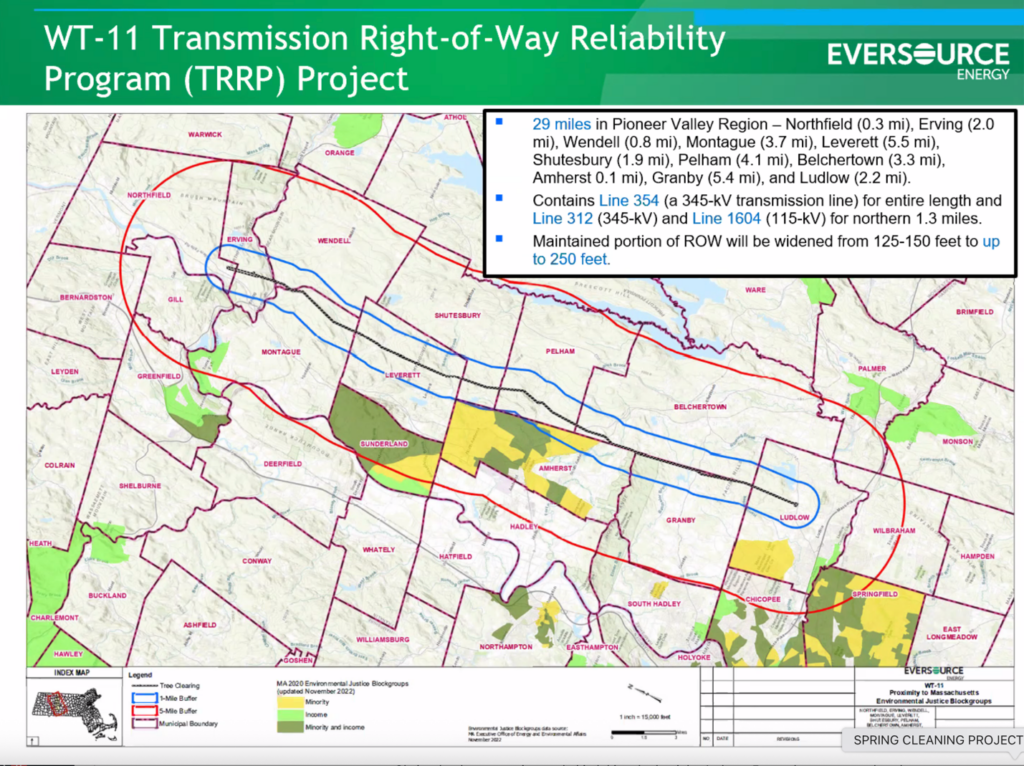
The event was organized by State Senator Jo Comerford and State Representative Mindy Domb. The project proposes substantial tree cutting within the company’s right-of-way, along a 29-mile corridor from Northfield to Ludlow, with 0.1 miles of the corridor passing through Amherst. More information on the project can be found at the project website here.
The project has met with considerable opposition from residents of the towns along the right-of-way, resulting in the formation of the advocacy group, Responsible Grid, which has mobilized to oppose clear-cutting within the right-of-way.
The evening involved a presentation from a panel of four representatives from Eversource who explained the TRRP program, followed by a question and answer period. The meeting ended after two hours with several people still waiting to ask questions. They were encouraged to submit those questions via email to: MAVegMaintenance@eversource.com
The number of people who attended and the number of those listening in on Zoom was not announced.
Domb opened the session saying, “We are living in very challenging times and this is the kind of activity that will strengthen us and sustain us.” Domb reminded those in attendance that the session was not a public hearing and that Eversource had agreed to participate even though the public comment period on the proposal had closed. Throughout the evening she and Comerford emphasized the collaborative nature of the engagement, referring to ongoing conversations with “our friends at Eversource”.
She reviewed the history of the project and her and Comerford’s involvement going back to 2022. She noted that Eversource had originally requested an expedited process that would have eliminated the requirement for extensive environmental reviews and public hearings, and that request was denied.
Commerford and Domb have had meetings with Eversource following consultations with other legislators and with the Massachusetts Environmental Policy Act Office (MEPA) that twice resulted in the extension of public comment periods. Eversource submitted its final Environmental Impact Statement in August 2025.
The Panel
The panelists from Eversource were:
- Bill Hayes – Manager, Electric Transmission Vegetation Management, Eversource
- Jonathan Roberge – Senior Environmental Specialist, Eversource
- Mike Babineau – Supervisor, Transmission Vegetation Management, Eversource
- Beky Socha – Environmental Consultant, SWCA
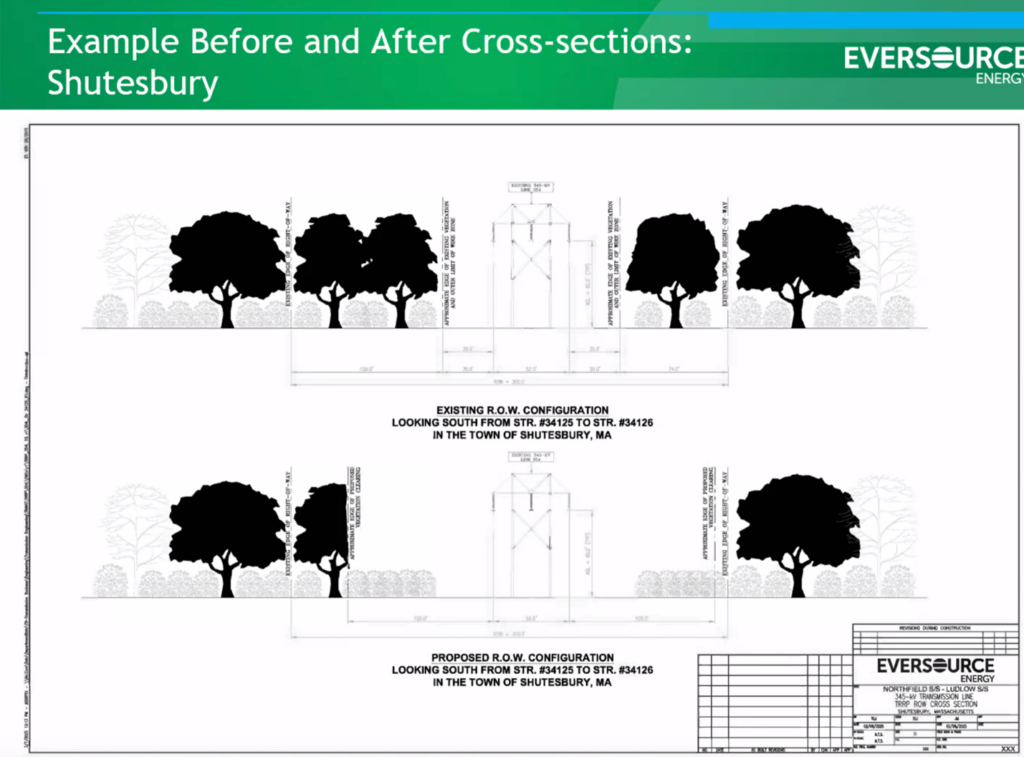
The stated purpose of the project is to reduce outage risks and service interruptions by removing vegetation that might fall and take down power lines or obstruct access for servicing those lines, in order to increase transmission system reliability and resilience to severe weather events and insect damage. This will entail expanding the right-of-way to the easement edge (300 feet), or 100 feet from the outer conductors, whichever is less, by selective cutting–removing trees that will reach a maximum height of 15 feet or greater at maturity. Not all trees in the right-of-way will be cut; however, the process does not leave much behind, as there isn’t much understory under the tallest trees, and so in many places in the corridor, the area will look clear-cut after the cutting. Eversource aims to preserve the forest floor by maintaining shrubs, small trees, and understory growth, sometimes through replanting.
The panelists cited several recent storms that have taken out transmission lines and noted that such events did not occur in areas where TRRP had already started.
Panelists noted that Eversource had looked at a variety of alternatives to the proposed plan, but none were deemed to be as effective as the one proposed. They reported that this plan is in the process of being developed in coordination with a number of agencies and that mitigation efforts are still in the planning stage. The Eversource representatives concluded by reporting that the project requires a variety of local, state, and federal permitting, including by Conservation Commissions in each of the towns and that they will continue to accept public comments and feedback on the project and support local decision-making.
Questions and Answers
The two questions that received the most attention were:
1. Why is Eversource’s right-of-way more than twice the size of National Grid’s, even where both companies have lines passing through the same town, as is the case in Shutesbury?
2. How will substantial cutting and vegetation removal impact the highly-used, beloved nature/conservation area of Buffam Falls in Pelham?
Nearly every speaker suggested that they had not heard sufficient proof that this project was necessary. All perceived the proposed cutting as excessive.
Size of the Right-of-Way
Michael DiChiara of Shutesbury was the first to question the need for the expanded clearing of the right-of-way, which was then echoed by subsequent speakers.
Bill Hayes attempted to field that question but was unable to come up with a substantial explanation. “We are trying to maintain a certain successional habitat, and this allows us to know the risk,” he said. He noted that the engineering and vegetation management of Eversource is not dissimilar to National Grid, so the question remained, why the disparity in right-of-way width?
Comerford noted he hadn’t fully answered the question and asked him to try again. He did, but it still didn’t provide more clarity. The Indy reached out to Eversource with the same question and Olessa Stepanova, Manager of External Communication, provided the following answer:
“We can’t speak to the specifics of National Grid’s project, but it’s important to note that the comparison raised at the meeting was between two different types of work.
The WT-11 project is a vegetation maintenance initiative, focused on improving reliability by reducing the risk of trees contacting or falling into existing transmission lines. In contrast, projects that involve rebuilding or replacing transmission structures (which may have been the case referenced for National Grid) often require temporary or different clearing to accommodate construction.
Additionally, transmission corridor width is not one-size-fits-all. It varies based on engineering design, including voltage, structure type, line configuration, terrain and safety clearances. These factors are determined during the design of each individual line and can result in different right-of-way footprints, even between projects that may appear similar at a high level.”
Buffam Falls
Multiple speakers raised concerns about unnecessary tree cutting in Buffam Falls and expressed fears that substantial removal of trees will severely damage the ecosystem and irreparably harm the 2.3 mile hiking trail and conservation area.
Tony Rodgers from Pelham questioned the need to cut trees in the ravines at the heart of Buffam Falls where the tree tops are so far below the wires that there would be no chance of growing tall enough to interfere with the wires or disturb them through tree fall.
Hayes responded, “The hemlocks need to come out, but we have substantially reduced our footprint for that particular project. After the cutting, there will be mitigation planting of more favorable plants – such as witch hazel and mountain laurel, but that plan has not yet been written or approved. This is clearly an issue, and so we’ll be revisiting it.”
Comerford said, “We have a commitment from Eversource to look at this [further] so let’s do a field visit together.” She suggested a field visit with residents and Eversource to which Eversource agreed. Hayes added, “We will continue that conversation and address all questions.”
Nina Keller from Wendell said, “I haven’t heard anything about proof of the projected need. I’m looking for more evidence of a commitment to conservation.”
An unidentified speaker said she felt that the explanations from Eversource were largely performative.
Commerford explained that the process is not performative, that it has been ongoing for three years. She said, “At the outset, Eversource asked for an expedited process, and we and the public went to MEPA, and that request was denied. This is us together engaging in a difficult process. And Eversource is hearing what our concerns are. It’s part of a process.”
Brendon Larson, who identified himself as a long-time friend of Amherst, referred to the
timber matting that goes down to allow movement of equipment along the power line. “Wherever the planks go down, it kills everything underneath. It’s been five years now [since the planks were removed from my yard]. That road caused some damage in our backyard,” he said.
Stacy from Pelham said, “In the bike community we refer to a bike-shaped object – an old piece of machinery that looks like a bike, but doesn’t serve the needs of a cyclist.” She asked, “Will you respect the decisions of the conservation Commissions that you will come before? Are there any principles impacting projects such as these that say, be selective when you can–prune when you can, as opposed to the dramatic clear-cutting you are proposing? I ve read the proposal and it’s a proposal-shaped-object.”
“
Hayes responded that they are not going after any trees that can’t hit the lines except in the “wire zone” where we need access”. But he had earlier acknowledged that much of the project area will appear clear cut when the cutting is over.
Comerford asked about the process that Eversource will bring to their meetings with Conservation Commissions.
Hayes responded, “We can’t do anything without a permit, and we have to abide by local, state, and federal regulations, and we have to abide by any conditions set by the individual commissions. And we respect all of those processes.”
Comerford reminded everyone that the requirement to “avoid, minimize, and mitigate” in environmentally impactful projects informs the Eversource proposal and is now codified in law.
But Lenore Bryck cautioned that minimizing and mitigating is not enough to get us where we need to be when we consider long-term resilience and the need to restore an already damaged ecosystem. “Human health is dependent on the protection of the ecosystem,” she said.
With time running out, Hayes announced that Eversource had scheduled a pop-up meeting on Friday, April 17 at the Munson Memorial Library, for the environmental justice community. Comerford noted that there had hardly been any publicity about that meeting, and asked that Eversource make a commitment to give better notice. Hayes said there will be more events and made a commitment to give better notice in the future.
Comerford and Domb closed the meeting with thanks to all who participated and with gratitude to Eversource for coming and staying in conversation when they were not obliged to.