
Opinion: Jackson Katz in the Age of Podcasts and Polarization

Jackson Katz at Amherst Books on May 6, 2026. Photo: Rizwana Khan
Social Injustice Goes Global

At Amherst Books on May 6, Jackson Katz presented his latest book, Every Man: Why Violence Against Women Is a Men’s Issue, and How You Can Make a Difference (Bloomsbury Academic, 2026), as part manifesto, part survival guide for institutional masculinity reform.
The 2026 edition updates previous editions of the book under the same title, the earliest published in 2016, to address the post -2020 rise of digital “manfluencers” the normalization of misogyny, and the need for immediate, accountable bystander intervention in a heightened digital culture.
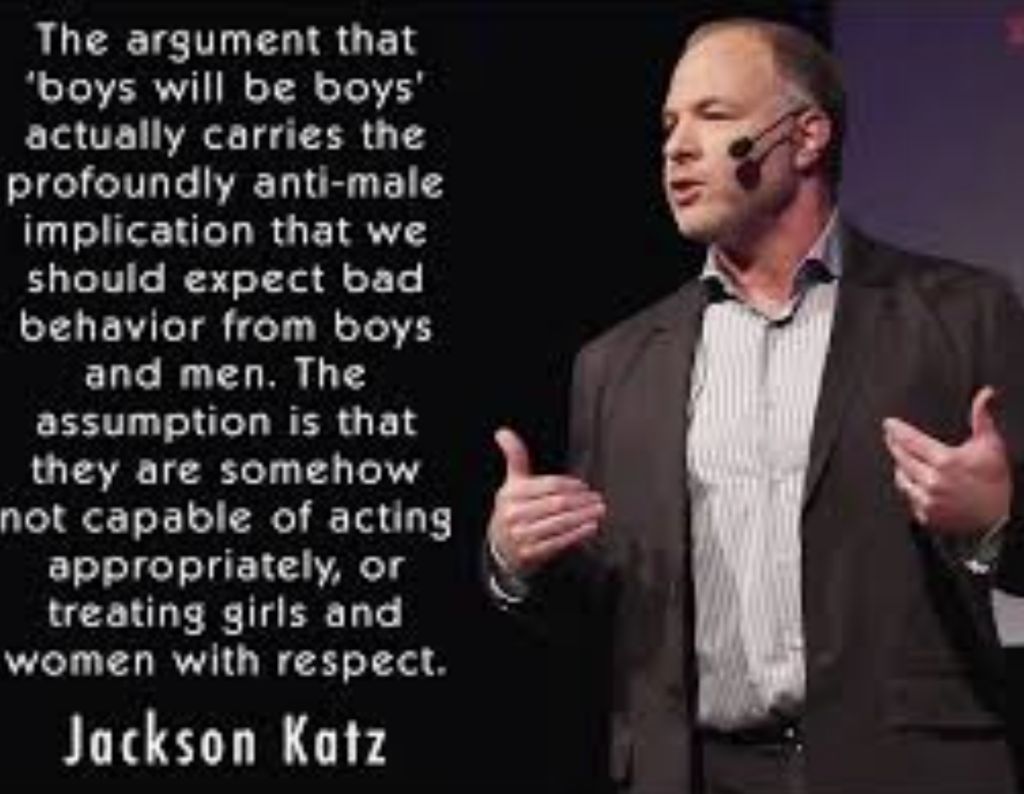
A triathlete from a blue-collar Boston Irish background who came of age inside what he once called a “jockocracy,” Katz has spent nearly four decades moving through locker rooms, military programs, universities, and sports culture trying to convince men that violence against women is not a “women’s issue” but men’s responsibility.
He often framed Donald Trump as both a political figure and a cultural symbol — the normalization of cruelty, grievance, and performative misogyny becoming mainstream masculine branding. But beneath the familiar progressive framework was a more unsettled anxiety hovering over the room: What exactly is happening to young men?

A Familiar Crowd, an Unfamiliar Unease
The audience was older: retired professors, educated white UMass alumni, downtown liberals, and longtime residents carrying tote bags and decades of institutional memory.
The refreshments matched the demographic — vegetable platters, hummus, careful cheeses, and restrained wine-country aesthetics, instead of the overflowing abundance of the previous night’s graduate-student book club.
Everything about the event carried the atmosphere of liberal New England respectability, where people still believe deeply in discussion, civic responsibility, and the moral authority of education.
Yet beneath the calm politeness was an unmistakable anxiety about whether any of it still works. These educated communities are fluent in diagnosis. They still tend to believe in workshops, books, classrooms, and dialogue as engines of democratic change. So at Amherst Books, surrounded by retired professors, graduate students, and liberal institutional veterans, Katz openly acknowledged that real influence now belongs to digital ecosystems dominated by podcasters, live streamers, influencers, and manosphere personalities with audiences in the millions.
The Contradiction at the Heart of the Evening
Katz seemed deeply aware that young men face unstable economic futures, dating cultures shaped by apps and algorithmic hierarchies, social isolation intensified by COVID-19, and identities increasingly formed online rather than through local institutions.
That was the contradiction haunting the evening. Katz has spent decades building intervention programs like MVP (Mentors in Violence Prevention), one of the first large-scale gender-violence prevention initiatives in sports culture and the military. Yet the online worlds shaping younger men often reward outrage, humiliation, certainty, and resentment far more effectively than institutions reward empathy or reflection.
Katz pointed out that many hugely successful male podcasters almost never seriously address misogynistic behavior itself, even while speaking constantly about male suffering, discipline, loneliness, and status anxiety. Their audiences experience these creators as emotionally available older brothers.
What Amherst intellectual culture still struggles to accept is that influence now depends less on institutional authority and more on emotional scale.
Influence in the Age of Algorithms
That contrast became impossible to ignore when thinking about Dua Lipa and her enormously influential Service95 Book Club, a platform that combines interviews, playlists, essays, podcasts, and online discussion in ways universities rarely manage successfully.
Katz, after more than 30 years of training and intervention programs, said that a workshop attended by 30 graduate students cannot compete with a charismatic media figure reaching millions through intimacy, aesthetics, and algorithmic visibility.
The problem is that institutional language itself increasingly feels emotionally powerless against the internet worlds where younger generations now build identity, desire, and meaning.
Why Are Young Conservatives Different?
The larger question hovering over the talk was harder to settle: Why are younger conservatives so often described as more radicalized than their predecessors?
Part of Katz’s implicit argument is that older conservatives came of age in a world that still offered relatively stable narratives: steady employment pathways, clearer institutional authority, and a shared sense that the American system — while imperfect — generally functioned. Their politics often reflect that baseline optimism, even when critical.
Younger conservatives, by contrast, are shaped by fragmentation: algorithmic media environments, economic precarity, declining trust in institutions across the board, and identity formation happening through online subcultures rather than civic organizations. The result is not simply an ideological but an emotional difference.
That shift helps explain why political discourse now feels like a clash between emotional worldviews still oriented toward repair and another increasingly oriented toward exposure, collapse, or withdrawal.
Katz’s framing suggested that radicalization is not just a matter of ideas moving further right or left but is infrastructural: a divide between people formed inside institutions and people formed inside feeds.
The Uneven Weight of Reform
Many older white men who built or controlled these institutions often adapted to new moral languages — diversity, equity, inclusion — while retaining structural positions of authority. In practice, this meant that the visible pressures of reform frequently landed on younger employees: early-career staff, graduate students, junior faculty, and administrators who became the point of enforcement for evolving norms around language, conduct, and representation. Even when intentions were progressive, the lived effect often felt uneven, producing quiet anxiety about evaluation, speech, and professional vulnerability.
One UMass professor, speaking bluntly in a separate moment, described how the threat of losing one’s job can quickly discipline speech and behavior — how institutional precarity becomes a form of behavioral control even in environments committed to justice.
Fluent in Naming, Stuck in Repetition
The town markets itself through consciousness and education, yet every conversation eventually circles back to the same unresolved question: How can communities become so fluent in naming injustice while remaining unable to interrupt its repetition?
In Amherst, this tension is a kind of intellectual loop, translated into frameworks and discussed across generations of scholars and organizers.
The skepticism hung quietly in the room. The audience had spent decades reading the right books, attending the right panels, building workshops, forming committees, mentoring students, and trying to move institutions inch by inch toward equality. And still the internet seemed capable of radicalizing millions faster than universities could educate them.
What makes this especially striking is the sense of inheritance without resolution. Younger participants enter spaces already saturated with equity discourse, trauma-informed vocabulary, and institutional self-awareness — but also with the quiet awareness that these tools have not fully delivered the structural change they promised. The discussion becomes an act of care and an admission of limitation. Amherst, in this sense, has perfected the language of justice while still living inside its contradictions.
Rizwana Khan is a writer, educator, and human rights advocate in Amherst.