
Opinion: Amherst’s Year-Round Residents Deserve a Seat at the Table When UMass Plans Housing
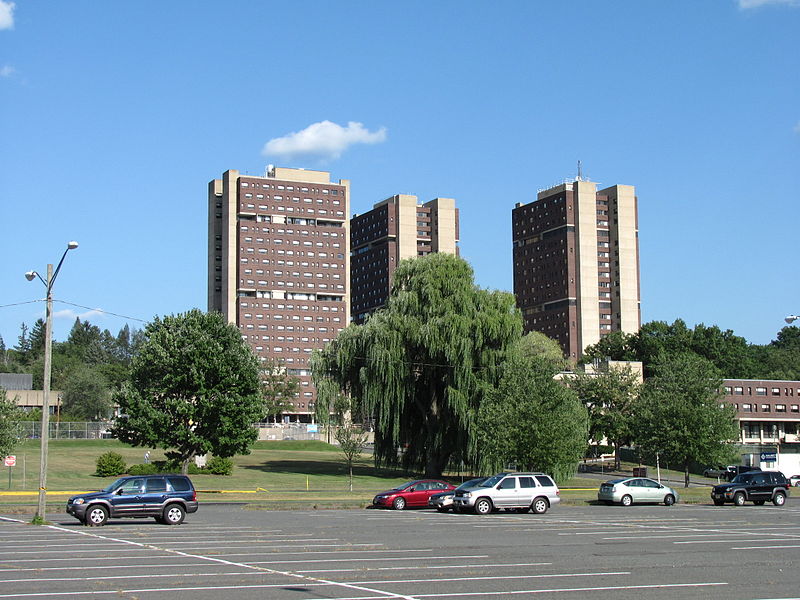
John Adams, John Quincy Adams and Washington residential towers at UMass. \ Photo: wikimedia commons

UMass Amherst often cites a reassuring figure: that about 60% of its students live on campus, placing it among the top public universities in the country for housing students in university facilities. On its face, that sounds like a sign that the campus is doing its part. But for those of us who live here year round, the number is hard to interpret and, on its own, does not reflect the scale of impact the university has on the town of Amherst.
First, the 60% statistic is unclear. It appears to exclude many graduate students and instead focuses on a narrower slice—likely full‑time undergraduates at the Amherst campus. That may be a reasonable internal metric for UMass to track, but when it is presented to the public as “more than 60% of students,” it implies a level of coverage that does not match the lived reality. If thousands of graduate students are living off campus, the community deserves a clearer breakdown of exactly who is being counted, and who is not.
Second, Amherst is not just another college town. It is a relatively small town hosting a very large flagship campus, with a student population that is roughly comparable in size to the town’s total population. Whether Amherst is the very smallest town in the country to host a major flagship university, or whether Orono, Maine is slightly smaller, the basic point stands: there is very little buffer between university decisions and the fabric of the town. When thousands of students are not housed on campus, they are not disappearing; they are becoming a dominant presence in what is supposed to be a mixed, year‑round community.
That leads directly to the crisis many neighbors are seeing: Amherst is steadily losing families and long‑term residents and, in many neighborhoods, is effectively becoming an extension of the campus. Houses that once held families with children are now rented to groups of students. Rents and purchase prices rise in ways that track university demand more than local wages. The rhythms of the town—noise, traffic, seasonal emptiness and intensity—are increasingly synchronized to the academic calendar instead of the needs of a stable population. Any meaningful discussion of housing and community health has to acknowledge that this is not a marginal issue; it is reshaping who can afford to live here and what kind of town Amherst will be.
Meanwhile, the university’s main housing initiative on the near horizon is focused on refurbishing existing 1970s dorms, not adding significant new on‑campus capacity. Renovations may improve quality of life for students who already live on campus, but they do not address the central issue: there are not enough beds on university land to match the size of the student body. Without a commitment to substantially increase the number of on‑campus beds, any enrollment growth—or even maintaining current enrollment—continues to push more students into the surrounding neighborhoods, deepening the pressures that residents are already feeling.
This is why the 60% figure, taken in isolation, can be misleading in public conversation. It suggests that UMass is going above and beyond, when in practice Amherst is absorbing a very large off‑campus student population relative to its modest size. A more honest framing would pair the on‑campus percentage with two other numbers: the total count of students living off campus in Amherst and nearby towns, and the share of Amherst’s non‑student housing stock now occupied by students. Those are the figures that tell families, workers, and seniors what their housing market actually looks like.
Finally, when UMass speaks about “campus stakeholders,” it should be explicit that this category includes a real seat at the table for year‑round Amherst residents. The university’s decisions on housing, enrollment, and land use do not stop at the campus boundary; they shape our schools, our tax base, our neighborhood life, and our ability to remain here. Neighborly relations do not mean avoiding hard truths; they mean honestly acknowledging the scale of the university’s footprint, recognizing how unusual Amherst’s situation is among flagship campuses, and inviting the people who live with those consequences 12 months a year into the core of the planning process.
Put plainly: a truly responsible housing strategy for a flagship in a small town must go beyond polishing its percentages. It must commit to adding substantial on‑campus capacity, be transparent about who the current numbers include and exclude, and treat long‑term residents not as an afterthought, but as essential partners in deciding what kind of community Amherst and UMass will share in the decades ahead.
Ira Bryck has lived in Amherst since 1993, ran the Family Business Center for 25 years, hosted the “Western Mass. Business Show” on WHMP for seven years, now coaches business leaders, and is a big fan of Amherst’s downtown.
I have written and commented frequently on the issue of student housing encroaching on Amherst’s working force neighborhoods (as opposed to more posh neighborhoods). Some landlords and students have rebutted that if I can’t abide students’ partying, I shouldn’t live in Amherst. My riposte: If students wish to live in a residential neighborhood instead of a dorm or student apartment complex, they should behave as fully responsible, law-abiding adults. Students come and go in a matter of a couple years. They are not our entitled masters, they are our town’s guests. True, as most adults have gone through rowdier years as teens or twenty somethings, we have some perspective on what that is like, and we should treat them with some leniency. In return, they should treat us, as hosts, with some respect. I hope the University makes that clear when students go through orientation, and every year thereafter. And I hope students take that to heart.
Students are not “guests”, they are members of the community, same as you and me. They pay rent, this is where they live. Imagine writing this about seasonal migrant workers?
Andrew Leinung> Let’s look at a dictionary.
Definition of guest: One to whom entertainment or hospitality has been extended by another in the role of host or hostess, as at a party. One who pays for meals or accommodations at a restaurant, hotel, or other establishment; a patron.
Definition of migrant worker: An agricultural laborer who travels from place to place harvesting seasonal crops. A person with temporary permission to work in another country.
Students are here for a few months each year, for a few prescribed years. Most go home to parents and homes for vacations holidays and summers, then go off to the rest of their lives. Guests, like our student population, are treated with hospitality and deference. Permanent town residents feed, fete and entertain them. It seems they ARE guests, even if they are temporary community members and do pay rent, whether they live in dorms, complexes or residential neighborhoods. Good guests show hosts some respect and gratitude. Unruly guests are typically asked by hosts to tone it down or leave.
Migrant workers come here to escape poverty, wars, gangs, etc., follow work from community to community, and are now the focus of deportation efforts and harassment by ICE. They largely do not eat, drink and party all over town. If they live here at all, it is on the margins, as anonymously as possible.
There is clearly no equivalence, so, no, I cannot imagine saying migrants are guests, or students are not our guests. We should give our good guests leniency. Our bad guests, not so much.