
UMass Team Will Develop Plan to Modernize Campus Housing
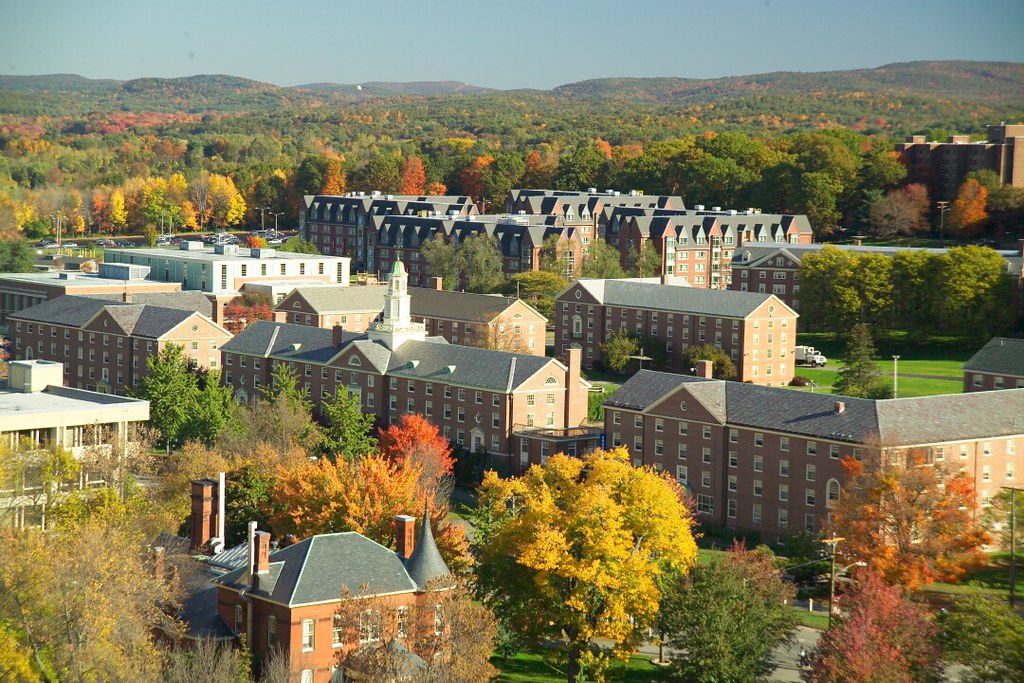
UMass Central Residential Area Photo: Flickr.com
The project team will work toward developing options for contemporary undergraduate, graduate and non-student housing that preserves affordability while adding community amenities
Source: UMass News and Media
The University of Massachusetts Amherst, in partnership with the University of Massachusetts Building Authority (UMBA), announced on May 7, that it has selected a development team led by American Campus Communities (ACC) to collaborate on a comprehensive, long-range, and phased plan to modernize campus housing while maintaining affordability and exploring non-residential amenities to enhance the campus experience.
The strategic planning process will focus on both the Amherst campus and the Charles River Campus in Newton. The project team envisions building new student housing to allow for the renovation or replacement of existing residence hall facilities in a multi-phase approach without the loss of current student housing capacity. The development team will also assist the university in evaluating non-student housing and non-residential amenities that have the potential to enhance student life, engage the community, and address campus infrastructure needs.
“We are excited for our community to begin working with our new partners on envisioning the near, mid- and long-term future of the flagship campus,” said UMass Chancellor Javier A. Reyes. “By focusing on how residential communities interact with and enhance academic, cultural, and recreational spaces, and aligning private partnership with investments in academic, research and athletic facilities, we can design a cohesive campus that maintains affordability, achieves sustainability goals, and promotes community wellbeing.”
Beginning summer and fall of 2026 and throughout the multi-phase design and development process, the university and ACC will provide opportunities for recurring input from students, faculty, governance groups, and other campus stakeholders. Over the summer, the project team will work with campus governance groups to coordinate opportunities for broader campus community input at the start of the fall semester. Planning efforts will also leverage recent student feedback and survey data collected as part of the university’s campus planning processes to date. Any projects that emerge will require approval through the university’s multi-step approval process, including the UMBA Board and the UMass Board of Trustees.
ACC is the nation’s largest developer, owner and manager of high-quality student housing opportunities. After initiating a request for proposals through UMBA last year, the campus worked with real estate advisory firm Newmark to manage the RFP process that led to the selection of ACC from a large pool of competitive responses. The development team also includes Elkus Manfredi Architects and Suffolk Construction.
Currently, more than 60% of students live in 51 residence halls and apartment buildings on campus. Of the 209 ranked public universities, UMass Amherst is among the top five in the country for percentage of on-campus students.
“First-class facilities are needed to match the first-class quality and caliber of our students, faculty, staff and operations,” said Andy Mangels, vice chancellor for administration and finance. “This project will position UMass Amherst to continue to attract top talent through a phased campus development that emphasizes creativity and affordability.”
The strategic planning process is informed by recent student housing market analyses, including student surveys and focus groups and aligns with the Healey-Driscoll administration’s statewide housing priorities. This effort is separate from the BRIGHT Act, which is navigating the state legislature and authorizes capital expenditures intended to upgrade campus infrastructure as well as support decarbonization efforts.
The public private partnership (P3) procurement that resulted in the selection of the ACC-led group is based on an approach previously used by UMass and UMBA, and by higher education institutions nationwide, to create the best results possible for the UMass Amherst campus, its students and the Amherst community while remaining prudent stewards of resources.
UMass Amherst often cites a reassuring figure: that about 60% of its students live on campus, placing it among the top public universities in the country for housing students in university facilities. On its face, that sounds like a sign that the campus is doing its part. But for those of us who live here year round, the number is hard to interpret and, on its own, does not reflect the scale of impact the university has on the town of Amherst.
First, the 60% statistic is unclear. It appears to exclude many graduate students and instead focuses on a narrower slice—likely full‑time undergraduates at the Amherst campus. That may be a reasonable internal metric for UMass to track, but when it is presented to the public as “more than 60% of students,” it implies a level of coverage that does not match the lived reality. If thousands of graduate students are living off campus, the community deserves a clearer breakdown of exactly who is being counted, and who is not.
Second, Amherst is not just another college town. It is a relatively small town hosting a very large flagship campus, with a student population that is roughly comparable in size to the town’s total population. Whether Amherst is the very smallest town in the country to host a major flagship university, or whether Orono, Maine is slightly smaller, the basic point stands: there is very little buffer between university decisions and the fabric of the town. When thousands of students are not housed on campus, they are not disappearing; they are becoming a dominant presence in what is supposed to be a mixed, year‑round community.
That leads directly to the crisis many neighbors are seeing: Amherst is steadily losing families and long‑term residents and, in many neighborhoods, is effectively becoming an extension of the campus. Houses that once held families with children are now rented to groups of students. Rents and purchase prices rise in ways that track university demand more than local wages. The rhythms of the town—noise, traffic, seasonal emptiness and intensity—are increasingly synchronized to the academic calendar instead of the needs of a stable population. Any meaningful discussion of housing and community health has to acknowledge that this is not a marginal issue; it is reshaping who can afford to live here and what kind of town Amherst will be.
Meanwhile, the university’s main housing initiative on the near horizon is focused on refurbishing existing 1970s dorms, not adding significant new on‑campus capacity. Renovations may improve quality of life for students who already live on campus, but they do not address the central issue: there are not enough beds on university land to match the size of the student body. Without a commitment to substantially increase the number of on‑campus beds, any enrollment growth—or even maintaining current enrollment—continues to push more students into the surrounding neighborhoods, deepening the pressures that residents are already feeling.
This is why the 60% figure, taken in isolation, can be misleading in public conversation. It suggests that UMass is going above and beyond, when in practice Amherst is absorbing a very large off‑campus student population relative to its modest size. A more honest framing would pair the on‑campus percentage with two other numbers: the total count of students living off campus in Amherst and nearby towns, and the share of Amherst’s non‑student housing stock now occupied by students. Those are the figures that tell families, workers, and seniors what their housing market actually looks like.
Finally, when UMass speaks about “campus stakeholders,” it should be explicit that this category includes a real seat at the table for year‑round Amherst residents. The university’s decisions on housing, enrollment, and land use do not stop at the campus boundary; they shape our schools, our tax base, our neighborhood life, and our ability to remain here. Neighborly relations do not mean avoiding hard truths; they mean honestly acknowledging the scale of the university’s footprint, recognizing how unusual Amherst’s situation is among flagship campuses, and inviting the people who live with those consequences 12 months a year into the core of the planning process.
Put plainly: a truly responsible housing strategy for a flagship in a small town must go beyond polishing its percentages. It must commit to adding substantial on‑campus capacity, be transparent about who the current numbers include and exclude, and treat long‑term residents not as an afterthought, but as essential partners in deciding what kind of community Amherst and UMass will share in the decades ahead.
Thank you, Ira. In March, four hundred Amherst residents presented a petition to Chancellor Reyes urging him to support housing more student on campus. And it urged the town council to prioritize housing for seniors, workforce, families and low income folks over student housing, to stem the flow of our year round residents from town. https://www.amherstindy.org/2026/03/27/letter-four-hundred-residents-urge-umass-chancellor-to-create-more-student-housing-on-campus/
While UMass should house more undergrads on campus, public private partnerships are not the way! They are far more expensive than in reality, send tax payer dollars to private business, and in UMass’s case, will push more students off campus. If we look at the Fieldstone apartments undergraduate rate for a 2 bedroom apartment, each student would be paying upwards of $21,000 in rent for about an 11 month lease. Meanwhile, on campus housing is around $10,000 during the school year for shared dorms. If UMass keeps this up, they’re going to make on campus housing far more expensive than living in town or surrounding communities, thus continuing the growing housing strain on this region.
Hi–
In your recent story on UMass housing plans you state the following:
“Currently, more than 60% of students live in 51 residence halls and apartment buildings on campus. Of the 209 ranked public universities, UMass states that it is among the top five in the country for percentage of on-campus students.”
If you delve into the actual numbers, you will find that this statement, often repeated by Mass officials, is NOT true. In calculating this percentage, UMass put the total number of residential beds in the numerator, but only the number of undergraduate students in the denominator. Graduate students are excluded (although housing for graduate students is included in the numerator). If UMass properly represented its housing, you would find that only 50 percent of undergraduate and graduate students are accommodated on campus. That’s a significant commitment so there is no reason to misrepresent it except to mislead the public and State Legislators.
I have had this conversation with University officials, who claim that it is too difficult to make an accurate estimate. I don’t agree. In any event that does not justify publicizing an inaccurate estimate. Please do not rely on University misrepresentations in the future.