
Amherst School Committee Condemns Use of Restraint and Seclusion in Elementary Schools; Revised Policy Approved
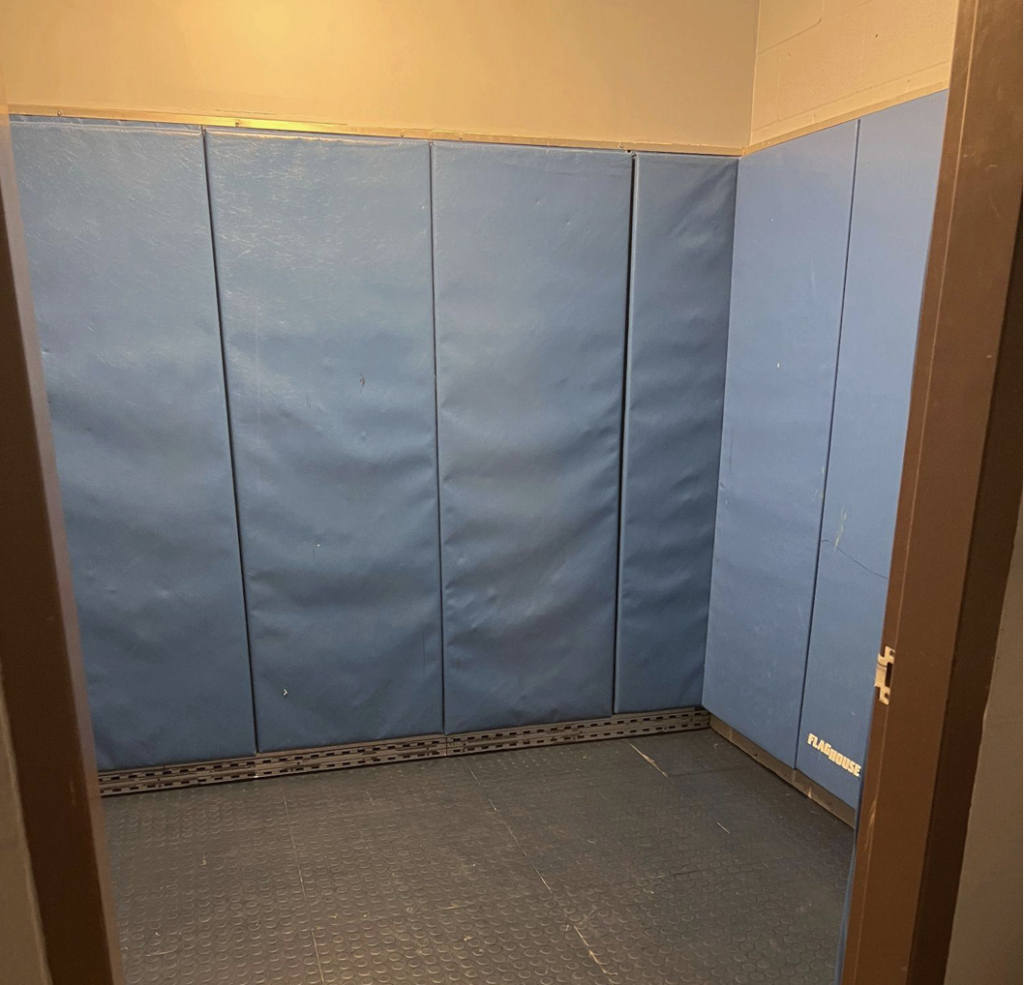
A seclusion room or "blue room" at Fort River Elementary School. Photo: amherstma.gov
Report on the Meeting of the Amherst School Committee, May 7, 2026
This was a hybrid meeting held in Town Hall and was recorded.
Present Deb Leonard (chair), Bridget Hynes, Laura Jane Hunter, and Andrew Hart Staff: Tonya McIntyre (director of curriculum, instruction, and assessment), JoAnn Smith (director of special education), and Alison Estes (principal, Wildwood Elementary School)
Special Education Parents Demand Changes to Restraint and Seclusion Policy
Despite the state Department of Elementary and Secondary Education’s (DESE) initiative to reduce the use of physical restraint and seclusion of students to “near zero” and only in emergency situations, such measures have continued to be used regularly in Amherst elementary schools. At the Feb. 24 Amherst School Committee meeting, Director of Special Education JoAnn Smith reported that seclusion and restraint had been used more than 30 times in the fall semester and that eight students had multiple instances. For the 2024-25 school year, there were 187 instances of restraint or seclusion.
Superintendent E. Xiomara Herman (Dr. Xi) has contracted with independent investigator Jeffrey Sankey to investigate instances of seclusion and restraint in the elementary schools. Sankey is a retired attorney acting as an investigator — not as legal counsel — for the district.
Members of the Special Education Parents Advisory Committee (SEPAC), Angelica Bernal and Ellen Jedry-Guidera, stated that the revised policy issued by the district in January was unclear, with terms open to interpretation and without specific guidance for timely caregiver notification, mandatory review after repeated instances, detailed reporting, training, and transparent systems for monitoring compliance and addressing disproportionality.
Jedry-Guidera said those structures are not punitive but protective, supporting students, caregivers, educators, and administrators in times of crisis. She asserted that the lack of oversight and consistency has damaged trust between families and the district, and strongly encouraged the school committee to include procedures — as suggested by the Massachusetts Association of School Committees — in the adoption of a new policy on restraint and seclusion. The revised policy approved unanimously by the Amherst School Committee (ASC) at this meeting does contain explicit procedures for both physical restraint and seclusion.
In response to caregivers’ descriptions of children being repeatedly confined to “reflection rooms” or “blue rooms” — padded isolation rooms — educators from Fort River Elementary School came to the Regional School Committee meeting on March 10 to report on the threats to their own safety posed by students who are out of control and the need for these isolation rooms to help students self-regulate. Although Wildwood and Fort River elementary schools have these rooms, Crocker Farm does not. The doors were removed from the isolation rooms at Wildwood as ordered by DESE but remain in place at Fort River.
School Committee Adopts New Policy to Take Effect in August 2026
The tension between caregivers and educators over the use of seclusion and restraint was acknowledged by the ASC, which led to the unanimous adoption of a new policy aimed at reducing the incidence of these procedures to “near zero” through staff training in de-escalation and neurodiversity.
The new policy, JKAA, complies with DESE regulation 603 CMR 46.00 and mandates prompt notification of caregivers, complete reporting, and a review of precipitating factors in each case of seclusion or restraint. Repeated use “of restrictive interventions on an individual shall be treated as evidence of unmet student need and shall prompt review of behavioral supports, programming, and placement appropriateness rather than reliance on continued physical discipline.”
The new policy further states:
The following are prohibited under all circumstances:
- Mechanical restraint and medication restraint
- Locked seclusion
- Any restraint that restricts breathing or circulation
- Prone restraint, except in the narrowly defined emergencies permitted by regulation
Physical restraint or seclusion shall never be used:
- As discipline, punishment, retaliation, convenience, or staff preference
- In non-emergency situations or for programmatic control or compliance
- When medically or psychologically contraindicated
- In response to property destruction, disruption, refusal to comply, or verbal threats
- Absent imminent risk of serious physical harm
- As a routine or planned intervention; no IEP or behavior plan may include restraint or seclusion as a planned response
However, “Nothing in this policy limits staff from using reasonable force to protect against assault or imminent, serious physical harm or diminishes protections afforded under state or federal law.”
Design of Reflection Rooms Questioned
The new Amethyst Brook Elementary School contains a “reflection room” on each floor. ASC member Laura Jane Hunter visited the rooms at Fort River recently and reported that they are bare rooms with mats covering the walls and door. She concluded: “Based on this visit, and the layout, style, and location of the rooms, which were difficult to observe from outside and had uncomfortable spaces for the students to de-escalate, I found that the rooms were counter to their intended purpose.”
The Elementary School Building Committee (ESBC) discussed making changes to the reflection rooms, but designers said changes would be difficult at this late stage, as the building design has been set and materials ordered. The designers agreed to lower the ceiling of the room, remove the sound barrier from the door so that an individual inside could communicate with someone outside, and install a visibility panel in the door. However, requests to remove the interior wall between the anteroom and the seclusion room and to install video cameras were not accepted. ASC and ESBC member Deb Leonard said video cameras could not be installed because of a union agreement, despite her view that they would protect both the student and the district by providing documentation.
ASC members stated that the term “reflection room” was a euphemism for seclusion and that there was little in the design of the bare, padded rooms to encourage students to voluntarily use them for self-regulation. Bridget Hynes pointed out that state policy does not permit doors on these rooms, and she objected to the fact that the rooms are located in the special education area of the school.
Alison Estes, Wildwood principal and incoming principal of Amethyst Brook, said the doors on the rooms can be easily removed and that other spaces in the school can be used for students to calm themselves, though some students do best in a small space.
Investigation Into District’s Use of Seclusion and Restraint
Tim Shores. a member of the Leverett and Regional School Committees, said he has been meeting regularly with SEPAC parents. He submitted a statement endorsed by SEPAC that acknowledged the risk some neurodiverse students can present to staff but urged all parties to consider how they refer to students who are among the most vulnerable in the community. “Describing student behavior in graphic terms at a public meeting stigmatizes them and undermines an inclusive culture,” he said.
Shores advocated for the development of a “program committed to neuro-affirming strengths-based special education pedagogy,” which the new ASC policy states should be presented to the committee in June for implementation before the next school year. Strength in this area should be considered in the hiring of a new student services director.
Shores noted that some educators at the March 10 Regional School Committee meeting cited budget cuts and staff shortages as reasons for the need to restrain and seclude students, but said “any school operating with limited resources can and should do without the practices reported by caregivers. Pre-empting an investigation with a budget argument shifts accountability away from the practices themselves.” He said that if funding gaps are identified, they can be used to frame future budget concerns.
Shores also encouraged caregivers with concerns about treatment to contact the investigator at Attorney Sankey Law Offices, 300 North Main St., Suite 104, Mansfield, MA 02048; jsankey@sankeylaw.com; or (508) 339-9421. Sankey is interested in speaking with any caregivers who wish to contact him.
Other Schools Have Eliminated Seclusion and Restraint
Hynes said she has been working to revise the school district’s policy on seclusion and restraint since last summer, after hearing from caregivers and advocates about their children’s experiences. She aimed to align the policy with state guidelines and actively reduce use of those measures to rare emergencies. “These policies were never meant to be routine instructional or behavioral tools, yet in some schools, they are being applied to young children. I feel like a school system committed to inclusion, dignity, and equity should treat this use as extraordinary, not ordinary,” she said.
To determine whether Amherst’s use of these measures was out of line with other districts, Hynes examined state data and found that at least three communities — among towns beginning with the letter “A” alone — had reported no use of seclusion or restraint, including Amesbury, Andover, and Arlington.
“It is possible to run schools without these practices at the elementary level,” she said. “The state and national evidence is conclusive that restraint and seclusion cause long-term harm, particularly to the most vulnerable students. The data shows that they are disproportionately used with students with disabilities, students of color, and transgender and gender-nonconforming students.” She also noted that some of the first state laws limiting the practice were enacted in response to injuries and deaths. A student’s jaw was broken and a sexual assault occurred in a seclusion room at Peck Middle School in Holyoke in 2016. She pointed to other school districts that have greatly reduced the use of these procedures through comprehensive policy and staff training.
Hynes continued: “When something this rare becomes commonplace, especially with young children, I don’t think it’s a failure of any of the individual educators — I think it’s a leadership, culture, and systems failure. Our staff do really hard work day to day, and they brought to our attention the effects of budget reductions. At the same time, we have an obligation to make sure that our schools operate within the law, regardless of resource constraints.”
After unanimously approving the revised policy, the ASC voted to direct the superintendent to present training materials on the use of restraints and seclusion, as well as on neurodiversity, at the June 16 meeting to be evaluated for how well they address the concerns raised.
DESE Policy on Seclusion
The following text is quoted from the DESE policy on seclusion.
Seclusion is prohibited in a public education program except in an emergency situation as a last resort on an individual basis when student behavior poses an imminent threat of assault, or imminent serious physical harm to self or others, but only if safeguards are accounted for. The following safeguards are required prior to the use of seclusion:
1) The student has a documented history of repeatedly causing serious self-injuries and/or injuries to other students or staff.
2) The student is not responsive to directives or other lawful and less intrusive behavior interventions, or such interventions are deemed to be inappropriate under the circumstances. 3) Other forms of interventions have failed to ensure the safety of the student and/or the safety of others.
4) There are no medical contraindications as documented by a licensed physician.
5) There is a psychological or behavioral justification for the use, and there are no psychological or behavioral contraindications, as documented by a licensed mental health professional.
6) The program has obtained consent to use seclusion from the student’s parent or guardian and, if appropriate, the student, and such use has been approved in writing by the principal.
7) Any individual using it has received training about alternative behavior interventions and management techniques.